


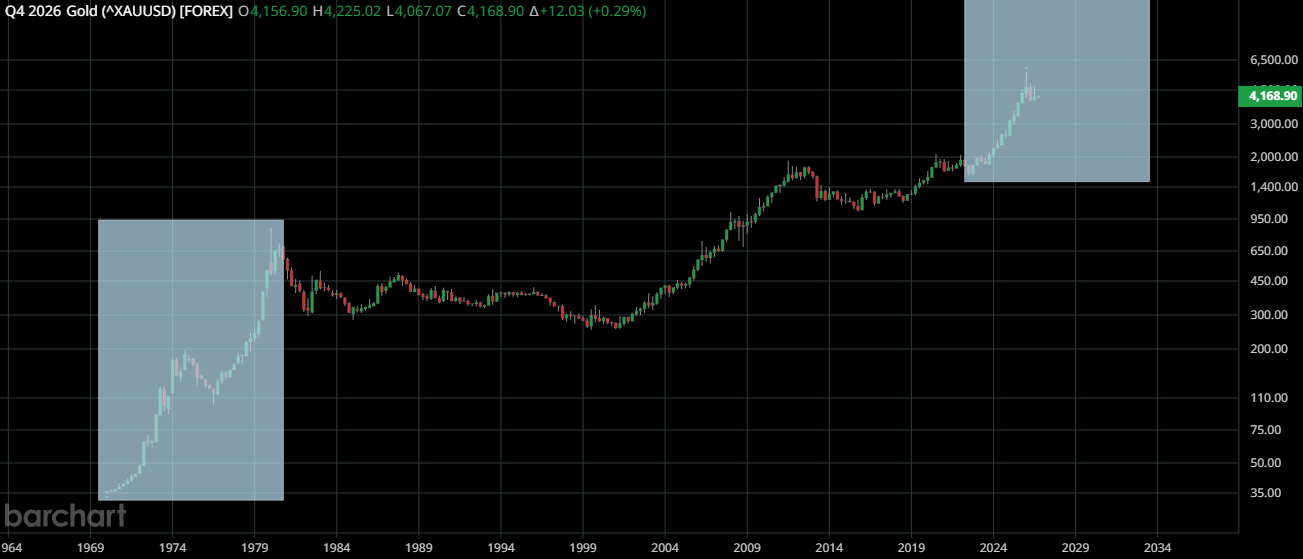
SIMILARITIES BETWEEN THE 1960–1980 PERIOD AND TODAY IN GOLD AND SILVER
The rise in commodities, particularly gold and silver, between 2024 and 2026 has led us to question whether a new commodity era has begun. Looking back at the rally in gold and silver between 2000 and 2011, we can see that it was not merely a commodity boom but a rally across almost all asset classes. We need to look specifically at the 1960–1980 period, when commodities were among the dominant performers. This makes it necessary to examine how closely that period resembles the world we live in today.
There are a surprisingly large number of similarities between the 1960–1980 period and today, although the structural differences are greater.
SIMILARITIES:
Energy Shocks: The 1973 oil embargo and the 1979 Iranian Revolution caused oil prices to rise sharply. Today, conflicts in the Middle East have also disrupted energy supplies. The IMF lowered its global growth forecast for 2026 to 3.0% and raised its inflation forecast to 4.7%. The similarities between the situation involving Iran and the disruptions to oil distribution are evident.
Inflation Fears: The main problem of that period was “stagflation,” the combination of slow economic growth and high inflation. Today, the IMF's adverse scenario also points to a similar risk, with growth falling to 2.5% and inflation rising to 5.4%. In other words, a similar threat is on the table, although the baseline scenario is not yet as severe as the conditions of the 1970s. If adverse developments in Iran and Saudi Arabia extend to the Bab el-Mandeb Strait and the Suez Canal, we could be experiencing a period even worse than 1960–1980.
Geopolitical Blocs: The US–Soviet rivalry of the Cold War has given way to US–China competition, technology restrictions, and tariff wars. Protectionist measures in trade were also widespread during the 1970s. We are witnessing a strongly protectionist approach from the US administration. This is a period with considerable similarities to the past.
The Rise of New Powers: During that period, Japan, Germany, and the East Asian “tigers” were rising. Today, China and India are playing a similar role. The IMF expects India to grow by 6.4% in 2026. The established leaders of the global economy are changing places. This should also be regarded as a significant similarity.
Interest Rates: Interest rates experienced an upward trajectory from the 1960s through 1980. While rates stood at around 2% in the early 1960s, they reached 18.90% by the end of 1980. This was the result of aggressive monetary tightening aimed at combating high inflation. Interest rates, which reached a trough in 2008, have risen since then. I believe this creates the conditions for a similar period driven by inflation concerns. Quite frankly, I do not expect interest rates in the United States to resume a downward trend anytime soon. The era of high interest rates has now begun to take shape.
Technological Transformation: The spread of computers and the Green Revolution, together with today's artificial intelligence investments, is reshaping productivity expectations. The 1960–1980 period laid the foundations for the global economic model of the 1980s and 1990s. Likewise, the years from 2000 to 2020 are laying the foundations for the 2020–2040 period. It is clear that globalist approaches will be taken to a much more advanced level between 2020 and 2040.
DIFFERENCES:
Economic Growth: The 1960s are often referred to as a “golden age,” when global economic growth was high, at approximately 5%. Growth slowed significantly during the 1970s. Today, global growth is around 3%. Clearly, growth is no longer at the levels seen in the past.
Inflation Levels: Inflation reached double digits during the 1970s, climbing to approximately 13–14% in the United States around 1980. Today, global inflation is around 4–5%. I believe a new wave of inflation could make the two periods more similar.
The Monetary System: The collapse of the Bretton Woods fixed exchange rate system between 1971 and 1973 was a defining feature of that era. Today, we have floating exchange rates, free capital movements, and digital finance. The greater complexity of derivatives markets and the emergence of new markets that resemble gambling reduce the similarities between the two periods.
Central Banks: During that period, central banks were susceptible to political influence, and inflation targeting did not exist. Today, they are generally considered independent and operate with specific targets. At least, that is how the situation appears. This is the official picture presented in economic life. However, there are now hardly any central banks that act independently of their governments. Institutionally, they still appear to be independent. In formal financial markets, the two periods seem different, but in reality, political pressure on central banks today is arguably greater than it was during 1960–1980.
Labor Markets: Trade unions were strong between 1960 and 1980, and a wage-price spiral occurred. Today, unionization is weaker, working arrangements are more flexible, and automation is widespread. We are experiencing a period in which working conditions are vastly different.
Globalization: During that period, capital controls were in place, and trade accounted for a smaller share of economic activity. Today, almost the entire world is under the influence of the global economy.
Energy Intensity: Production was heavily dependent on oil. Today, oil consumption per unit of GDP is much lower, while renewable and alternative energy sources also play a role.
Public Debt: Public debt was relatively low in the period following World War II. Today, global public debt as a share of GDP is historically high.
The Structure of the Economy: The economy was dominated by industry and manufacturing during that period. Today, services, data, and the platform economy are at the forefront.
Demographics: The workforce was young, and the baby boom was a defining demographic feature. Today, populations are aging in developed countries and China.
I have attempted to outline the similarities and differences between the 1960–1980 period and the period from 2020 to 2040. In this context, similarities remain in key economic factors, particularly interest rates and inflation, while the other elements show fewer parallels.
Now, let us turn to the central issue: the similarities between these two periods point to a comparable starting point in the pricing of gold and silver. Before gold and silver reached their 1980 peaks, the market was already experiencing a process that bears striking similarities to the one that began in the 1960s. The factors that most strongly support this comparison appear to be excessive borrowing, rising interest rates, and inflation fears.
Let us follow together how this situation, which began under similar conditions, unfolds over the coming years.
Thank you.
Serdar AYDOĞAN