


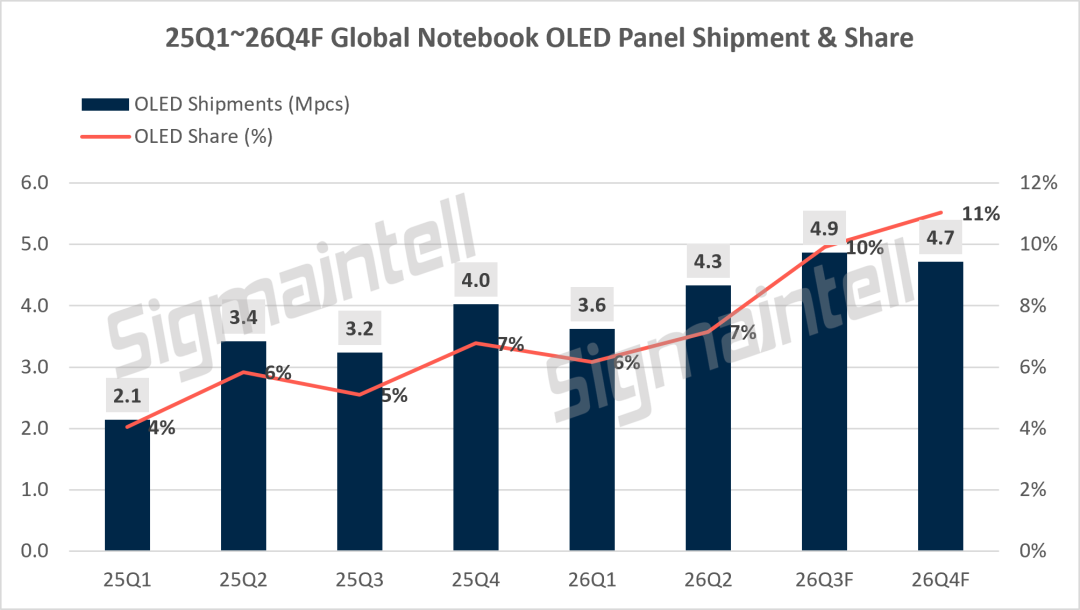
The Zhitong Finance App learned that according to data from Sigmaintell (Sigmaintell), in 2026, the penetration rate of OLED technology in the panel demand of the three major brands Lenovo, HP, and Asus will all exceed 10%, leading the growth direction of the OLED market. At the same time, mass production of MacBook Pro OLED also constituted a landmark event for the growth of the OLED laptop panel market in the second half of the year, injecting new growth momentum into the OLED laptop market growth. However, although brands such as Dell and Acer have controlled the speed of OLED introduction, they have maintained a gradual growth trend. Major brands are showing the characteristics of the “three camps” in terms of OLED introduction strategies, pointing to the certainty of growth in the OLED laptop market. OLED panel shipments achieved a significant jump from 2.1 million to 4.3 million pieces from the first quarter of 2025 to the second quarter of 2026, and are expected to continue to rise to 4.9 million pieces in the third quarter of 2026, leading all technology paths. In the same period, OLED's share in overall laptop panel shipments also increased steadily from 4.1%, especially in the second half of the year.
1. Contrary emission: Deterministic OLED growth under total contraction
Currently, the global laptop market is facing multiple pressures: terminal loading momentum has declined significantly, GPU supply is insufficient, and the increase in machine cost continues to be transmitted to terminal prices. Combined with the channel inventory digestion cycle, total global laptop panel shipments have entered a downward channel. Prudence on the demand side and adjustments on the supply side are superimposed, causing total laptop panel shipments to face obvious contraction pressure in 2026, and the market focus will shift from scale growth to structural upgrading. In this context, LCD's growth as a basic market has hit a bottleneck. The market resilience of different technology paths is clearly divided, and industrial upgrading momentum is being concentrated on OLED at an accelerated pace.
According to #群智咨询 (Sigmaintell)'s tracking data on the global laptop panel market by technology, OLED panel shipments achieved a significant jump from 2.1 million to 4.3 million pieces from the first quarter of 2025 to the second quarter of 2026, and are expected to continue to rise to 4.9 million pieces in the third quarter of 2026, leading all technology paths. Over the same period, OLED's share in overall laptop panel shipments also increased steadily from 4.1%, especially in the second half of the year. In an environment of total volume contraction, OLED's contrarian expansion is not a short-term fluctuation, but the beginning of structural growth.
Source: Sigmaintell_2026~2027 Worldwide Notebook Display Panel Market Research Report_26Q4
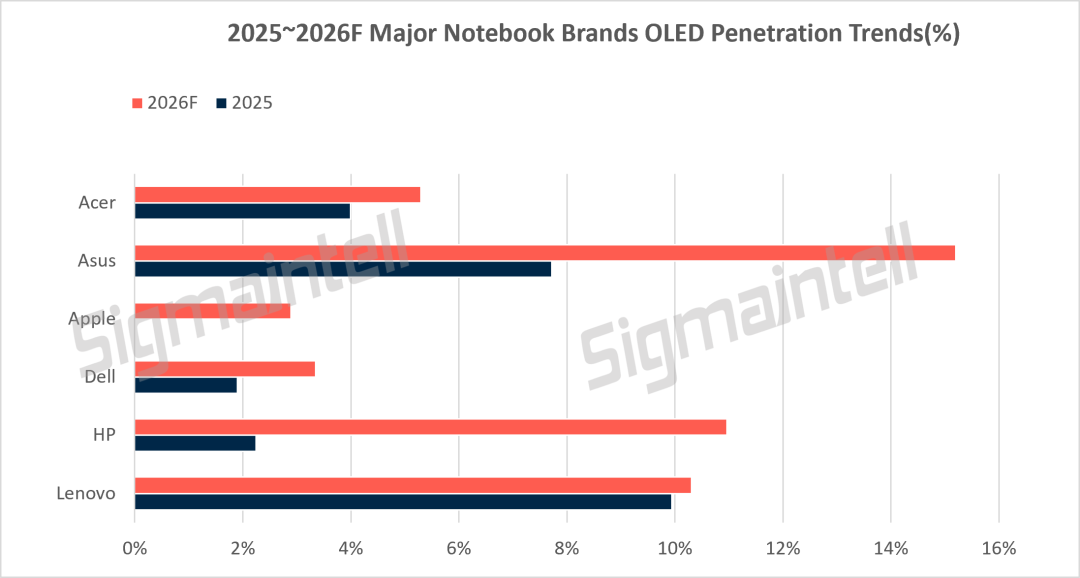
From the brand side, the path to improving OLED penetration rate is also clear. According to data from Sigmaintell (Sigmaintell), in 2026, the penetration rate of OLED technology in the panel demand of the three major brands Lenovo, HP, and Asus will all exceed 10%, leading the growth direction of the OLED market. At the same time, mass production of MacBook Pro OLED also constituted a landmark event for the growth of the OLED laptop panel market in the second half of the year, injecting new growth momentum into the OLED laptop market growth. However, although brands such as Dell and Acer have controlled the speed of OLED introduction, they have maintained a gradual growth trend. Major brands are showing the characteristics of the “three camps” in terms of OLED introduction strategies, pointing to the certainty of growth in the OLED laptop market.
Source: Sigmaintell_2026~2027 Worldwide Notebook Display Panel Market Research Report_26Q4
More importantly, the increasing penetration rate of OLEDs in the laptop market is moving from “flagship verification” to “structural volume”: OLEDs are no longer limited to high-end creator models, but are gradually sinking along the product line and entering the mainstream price segment of the product definition. The brand's supply chain strategy has also moved from a “single point of import” to a “large-scale layout”. Predictably, as more brands use OLED as the core option for product definitions, the increase in penetration rate will no longer be a demonstration effect for a few high-end models, but a structural expansion covering the entire price range. As a result, the structural issue of OLED laptop panel supply resources will be pushed to the center of industry discussions.
2. Decentralization: Brand OLED supply is moving towards a diversified layout
Judging from the OLED panel supplier structure of mainstream brands, concentrated supply is currently the most prominent feature. Lenovo uses SDC as the main supply, with EDO and BOE; HP is led by SDC and is trying to import EDO on specific models; Dell's XPS series is basically dominated by LGD, and the rest of the product line is still dominated by SDC; Asus imports BOE and EDO outside of SDC; about 75% of Acer's OLED supply comes from SDC, and the rest is complemented by BOE+EDO. Even considering the differentiated layout of various companies, SDC still accounts for more than 70% of OLED supply for most brands.
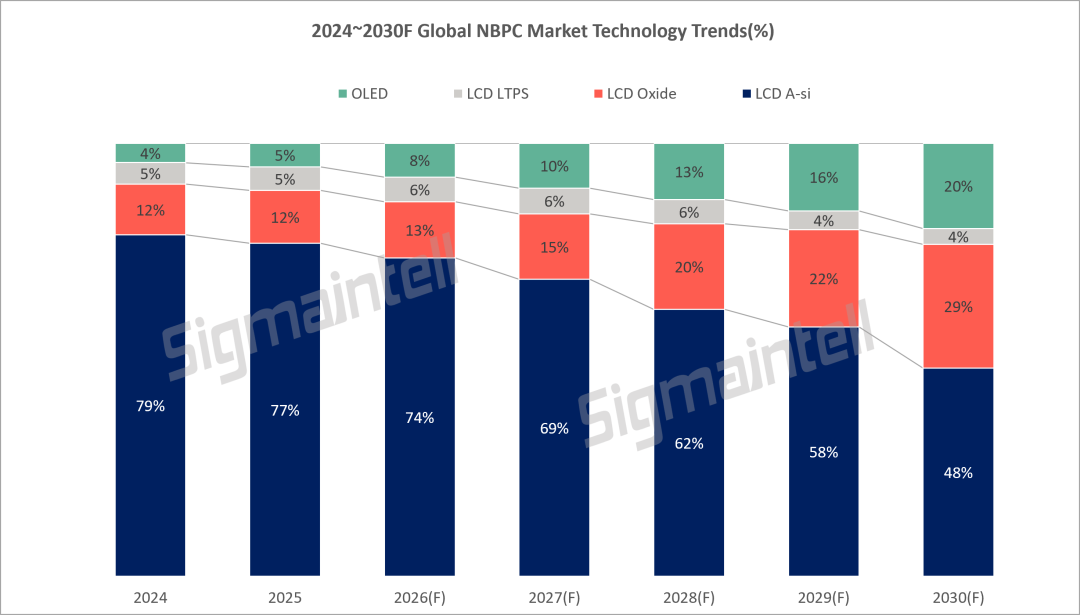
Looking at the shipping structure, SDC itself is also accelerating its trend towards mainstream specifications. It is estimated that this year, shipments of 14-inch WU products will increase by about 50% year on year, 16-inch WU products will increase by about 199%, and shipments to HP and Asus will increase by about 313% and 82% year on year. Over a longer period of time, the competitive landscape of NBPC panel technology continues to evolve. The share of LCD a-Si will drop from about 79% in 2024 to about 48% in 2030F, LCD Oxide will rise to about 29%, and OLED is expected to increase to about 20%. Technology substitution is the fundamental driving force for supply restructuring. For brands, the risk of relying solely on capacity guarantee, bargaining space, and product rhythm coordination continues to increase, and demand for diversified supply resources has deepened markedly as a result.
Source: Sigmaintell_2026~2027 Worldwide Notebook Display Panel Market Research Report_26Q4
1. Mainstream platforms: CSOT IJP technology maturity speed and volume pace are important topics
In the mainstream price segment, currently SDC is basically the only company. Inkjet OLED (IJP) is the key path to breaking this concentrated supply pattern, and CSOT is the most important driver in this path. CSOT's T12 (G5.5) IJP production line achieved mass production and shipment of MNT products in the third quarter of this year, and plans to mass-produce laptop products in the fourth quarter. The T8 production line is scheduled to mass-produce IJP OLEDs in the second half of 2027. The first phase has a monthly production capacity of about 22.5K, of which Oxide has a monthly production capacity of 16K and LTPS of about 6.5K.
Judging from the pace of CSOT IJP laptop products, the new volume of 14-inch WU IJP OLED products in early 2027 is critical, which means that the supply of mainstream OLED laptop product platforms is diversified. Whether this mass production plan can proceed as scheduled will mainly depend on CSOT IJP's ability to iterate on materials and the speed of technology improvement, and will also directly affect the release space and supply structure of mainstream OLED laptops in 2027 and beyond.
2. Middle and high-end platforms: 100 companies compete, flexible manufacturers seize positions
Unlike the “single point betting” of mainstream platforms, high-end product platforms were the first to enter the 100 competition pattern, and mainland flexible panel manufacturers are important shapers of this pattern. Represented by BOE, its B16 production line will be mass-produced in the second quarter of 2026. The monthly production capacity of the first phase will also gradually increase from 8K to 16K, and the second phase of production capacity construction is progressing steadily. B16 covers LTPS/LTPO flexible and hybrid processes. On the product side, shipments of BOE's 14-inch 2.8K flexible OLED products are expected to increase by about 2.6 times in 2026. New 16-inch 3.2K products will be added in 2027, and the shipping target for the full year of 2027 is 1 to 2 million pieces; Lenovo, Asus, and Acer are willing to introduce them, and cooperation between Dell, HP, and MSI has also opened up. Entering the middle and high-end markets with flexible OLED and hybrid forms, BOE is actively exploring growth opportunities and will clearly crowd out the rigid OLED market space.
The diversification of the middle and high-end markets does not stop at BOE. The Vicino V3 production line has already mass-produced a number of flexible WQ+ OLED laptop customer projects in the third quarter, and plans to achieve mass production of VIP WQ+ OLED laptop products in the fourth quarter. More importantly, construction of the first phase of its V5 production line (about 8K) is progressing as scheduled. It is planned to achieve mass production of OLED laptop products in the second half of 2027, and promote the VIP flexible and hybrid multi-product route positioned in the middle and high-end markets. Meanwhile, construction of LGD's FLIPP OLED production line has officially begun, and mass production of IT products is expected to be achieved in 2029.
Overall, diversification of supply resources is unfolding along the path of platform differentiation: the mainstream platform is played by CSOT IJP, the key role in cost efficiency, and the middle and high-end platforms are handled by multiple technology routes and multiple suppliers in parallel. The significance of this differentiation is that it matches the process of diversification of supply resources with the technical requirements of the product platform, avoids the mismatch of “with capacity without demand” or “with demand without production capacity”. The prototype of a diverse supply pattern has already been formed.
3. Share rewriting: diversified supply reshapes the pattern of panel factories
From the perspective of the competitive landscape, diversification of supply resources will directly rewrite the share curve of panel manufacturers. #群智咨询 (Sigmaintell) predicts that by 2030, the penetration rate of OLED in the global laptop panel market is expected to rise to about 20%; in the process of penetration, the share of mainland panel manufacturers in the OLED supply of brands is also rapidly increasing. In 2026, the four major brands of Apple, Asus, Lenovo, and Acer will account for more than 50% of the mainland panel supply, and HP expects to exceed 40% in 2027. SDC continues to lead the way with mainstream WU specifications and A6 high-end production capacity. BOE seizes the middle and high-end OLED laptop market with mid-range and high-end flexible production capacity, CSOT uses IJP production capacity cards to position the mainstream market, and new processes such as Vicente ViP complement it over a longer period of time. The share of the main brand OLED panel vendors is expected to continue to increase.
At the same time, the development space for LCD will continue to converge. In the middle and high-end markets, flexible OLEDs and hybrid OLEDs accelerate penetration with their morphological and performance advantages; in the mainstream cost-effective market, the supply resources for rigid OLEDs are expected to expand production capacity after 2027. The dispute between OLED and LCD technology in the laptop panel market is rapidly shifting from “value competition” to “scale competition.” The diversification of OLED laptop supply resources has also shifted from “whether they can be supplied” to “whether they can be supplied quickly or not”. The differentiation of technology platforms will determine the growth potential of each panel manufacturer in future competition, as well as the brand's product voice in the OLED era.
Overall, the structural growth trend of the OLED laptop panel market has been established, and the strategy of diversifying supply resources will become the core issue that determines the pace of development and competitive pattern of this market. For OLED panel manufacturers, actively improving the mass production capacity and cost capacity of mainstream and high-end OLEDs is the key to grasping the next stage of growth; for brands, accelerating diversified supply layout is a prerequisite for calming concentrated risks and gaining initiative in product definition. As high-generation OLED production capacity is released one after another, the supply pattern in the OLED laptop market will enter a period of accelerated reshaping.