


On October 9, just 10 days after landing on the Hong Kong Stock Exchange, PCB leader Jingwang Electronics (03228) handed over a large pre-increase report card for the third quarter.
In the third quarter of 2026, the company expects to achieve operating income of 6.12 billion yuan to 6.98 billion yuan, an increase of 53.48% to 75.05%; net profit to mother of 912 million yuan to 1,089 million yuan, an increase of 205.46% to 264.74% year on year. The profit for one quarter alone exceeded the sum of 602 million yuan in the first half of this year.
For Jingwang Electronics, the leading PCB company listed in A+H, the significance of this performance forecast is not just a sharp increase in profits in a single quarter. It was an acceptance test that took several years of capital investment: the AI computing power PCB and high-end production capacity of automotive electronics, which had continued to increase in the past, finally ushered in an order fulfillment window.
However, this “explosion” report card did not translate into a continuous rise in stock prices — on October 12, Jingwang Electronics Hong Kong shares opened more than 4% higher, but then fell rapidly. The intraday fluctuation reached 15.35% on the same day, falling from a high of HK$83.4 to HK$71.4, and at the close, the stock price plummeted 10.44% to HK$71.2; A-shares closed down 0.93% on the same day to $96.98.
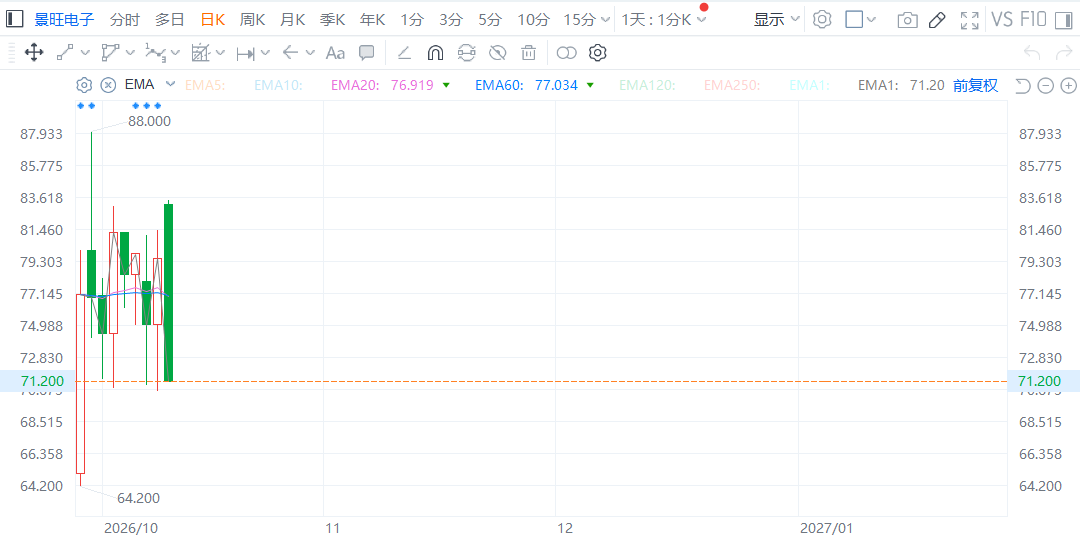
After successful results, the stock price did not rise but fell. Is Jingwang's high growth a short-term boom pulse in the industry or a permanent rise in the profit center?
From “increasing revenue without increasing profit” to “releasing profits at an accelerated pace”
To understand the explosive power of Jingwang Electronics in Q3 2026, I'm afraid we need to understand its financial undertone in 2025.
In the first three quarters of 2025, Jingwang Electronics's revenue was 11.083 billion yuan, up 22.08% year on year, but net profit to mother was only 948 million yuan, a year-on-year growth rate of only 4.83%; after deducting non-net profit of 776 million yuan, a year-on-year decrease of 6.36%. Revenue has increased by more than 20%, and profits have almost stagnated. The reason is not complicated: the AI production capacity construction period is ahead of the cost, compounded by exchange losses and equity incentive costs, which erode the statement. Looking at the 2025 Q3 alone, revenue was 3,987 million yuan (+24.19% YoY), and net profit to mother was 299 million yuan (+20.44% YoY). The profit growth rate clearly lagged behind revenue.
This divergence of “increasing volume or profit not increasing” was completely broken in Q3 2026.
What is most noteworthy is not the 205% year-on-year increase in net profit due to mother, but the performance after deducting non-net profit: it is estimated to be 939 million yuan to 1,116 million yuan, up 294.34% to 368.68% year on year, and 239.90% to 303.97% month-on-month. The growth rate after deducting non-growth significantly outperformed the return growth rate, indicating that the improvement in profit came from a substantial increase in the main business, rather than a whitewash of one-time profit and loss.
The company's explanation points to two directions: one is to accelerate mass production and shipment of high-performance PCBs in the field of high-speed communication and AI data infrastructure, and the other is to promote joint optimization of the order structure and internal cost reduction and efficiency. By the end of the reporting period, the company had plenty of on-hand orders in the field of AI servers, data centers, and high-speed optical modules, and production capacity utilization and yield remained high.
This means that Jingwang Electronics' “construction period costs” that suppressed profits in 2025 are being converted into “harvest period profits” in 2026.
Agency expectations are also rapidly following up. Among them, on September 3, China Post Securities released a research report on Jingwang Electronics (603228), predicting Jingwang Electronics' net profit of 2026 to be 2,511 billion yuan, giving it a “buy” rating. In addition, Changjiang Securities, Caixin Securities, and China Merchants Securities have also recently given buy or recommendation ratings. It is worth mentioning that the net profit target set by the company's 2026 equity incentives is 2 billion yuan to 2.2 billion yuan. Compared with the implied growth rate of about +79% in 2025 — the actual performance in Q3 is being verified or even exceeded.
From “increasing revenue without increasing profit” to “releasing profits at an accelerated pace”, Jingwang Electronics is completing a transition from the AI production capacity construction period to the harvesting period. The hardest signal for Q3 2026 was not a 205% increase in net profit due to net profit, but a nearly three-fold year-on-year increase in non-net profit and more than two-fold month-on-month — this shows that profit improvements come from mass production and shipment, order structure optimization, and cost reduction and efficiency of high-speed communication and AI data infrastructure PCBs, rather than one-time profit and loss.
However, the fuller the expectations, the more we need to face up to the risks: exchange fluctuations, rising raw material prices, rising production capacity and yield fluctuations, changes in the pace of AI capital expenditure, increased industry competition, and equity incentive amortization may all cause twists and turns in profit release.
Upgrading industry logic: from “competing for production capacity” to “competing for yield”
If the inflection point in performance is the result, then changes in the competitive logic of the industry are the reason.
The demand for PCBs in AI computing power is undergoing a structural shift. According to Insight Consulting, in terms of revenue, the global AI server PCB market is expected to grow from US$3.5 billion in 2024 to US$10.8 billion in 2030, with a compound annual growth rate of 20.7% from 2024 to 2030. According to statistics from Dongwu Securities, the global AI server PCB market will rise from 3 billion US dollars in 2024 to more than 20 billion US dollars in 2027, corresponding to year-on-year growth rates of over 100% and 70% in 2026 and 2027, respectively, and the industry is moving faster.
But what really deserves investors' attention is not the increase in total volume, but the shift in the competitive dimension.
In the past two years, almost all PCB manufacturers have invested more in the field of AI computing power. New production capacity for high-grade HDI and ultra-high multilayer boards is expected to continue to be released from the second half of 2026 to 2027. The scale of production capacity itself is changing from a scarce resource to an industry standard.
At the same time, high-speed M8-M9 grade copper-clad plates and PTFE materials are still scarce resources throughout the industry. Downstream customers are shifting their focus from “can they do it” to “can do it with high yield”.
And Jingwang Electronics is in an advantageous position for this transition.
Jingwang Electronics, which has been deeply involved in the PCB field for more than 30 years, is already the world's largest supplier of automotive electronics PCBs. According to Insight Consulting data, the company accounts for 10.6% of the global automotive electronics PCB market in terms of revenue in 2025, ranking first in the world.
However, its process management capabilities and quality control system, which it has cultivated and accumulated in the field of automotive-grade products, unexpectedly became the sharpest weapon in the AI era. According to reports, in addition to being the world's leading automotive electronics PCB supplier, Jingwang Electronics is also one of the few manufacturers that provide PCB products to leading global AI computing infrastructure companies.
At present, Jingwang Electronics has mass-produced high-end PCBs that can be used in AI computing infrastructure, including 40-layer high-layer PCBs, 6-level 22-layer HDIPBs, 14-layer HDIPBs using the MSAP process, and multi-layer PTFEFPC. In addition, the company also has manufacturing capabilities for high-multi-layer PCBs with more than 70 layers, 9-layer 28-layer HDIPBs, 12-layer Any-layer rigid-flex boards, and high-speed FPCs.
The company also revealed that it has supplied 800G products in batches to many leading optical module customers and is actively cooperating with leading international customers in early development. It is expected that CSP customers such as G, A, and M will successively achieve mass production breakthroughs from Q4 2026 to 2027. The HDI and MSAP production lines in Jinwan, Zhuhai are being implemented at an accelerated pace, the Thai base is expanding overseas customers, and the release of high-end production capacity is supporting the continuous introduction of high-margin orders over the next two years.
From the above, it is easy to see that after the arms race for production capacity, yield, material supply, and long-term stable quality control capabilities are the tickets to the knockout tournament. With the technological heritage accumulated in the vehicle regulation business, Jingwang has successfully entered the AI computing power hardware supply chain. The two major bases in Jinwan and Thailand continue to release high-end production capacity, and superimposed optical module customers are in the mass production window for iterating from 800G to next-generation products, and the company has already qualified for structural growth. However, the challenges behind the opportunity also cannot be ignored. Whether the company can change from a “card holder” to a “pricer” depends not on how hot the story is, but on whether high-end orders can become consistently high in gross profit.
epilogue
Based on the above, it can be seen that Jingwang Electronics' Hong Kong stock listing on the 10th is a phased verification of Jingwang's strategic layout over the past few years. The company has completed the fundamental switch from the “construction period” to the “harvest period”, holding the PCB basic board and the AI computing power incremental circuit, and has a first-mover advantage in the knockout race where the industry shifts from competing for production capacity to competing for yield. However, the outbreak in a single quarter is not enough to prove the certainty of long-term growth.
However, its stock price did not rise but fell after a profit. The core point is that Jingwang A shares have accumulated a cumulative increase of more than 80% since April this year, and hit a historic high of 113.56 yuan in mid-September. The market's expectations for high performance growth have already been fully priced. When a financial report that “exceeds expectations” comes to fruition, the first reaction of capital is no longer to chase up the rise, but to cash in on profits.
For investors, it is necessary to continuously track the three major indicators in the future: the continuity of high-end board orders in hand, the changing trend in comprehensive gross margin, and the progress of new production capacity delivery climbing. Yingxi is only a phased test; it is not a final exam answer sheet. Subsequently, whether Jingwang Electronics can transform the short-term performance pulse into a steady upward medium- to long-term profit curve will be tested over time.