


The Zhitong Finance App learned that Chinese memory chip manufacturer Changxin Storage (CXMT) has achieved a breakthrough in memory chip technology comparable to competitors such as Samsung Electronics and SK Hynix (SKHY.US), and the latter has been working hard for many years to achieve this technical goal. According to reports, Changxin Storage is accelerating the deployment of next-generation DRAM technology, and plans to launch DDR5 RDIMM server memory products using a 4F² storage unit architecture by the end of this year.
Changxin Storage “grabs” the next generation of high-density DRAM architectures
As the manufacturing process continues to approach physical limits, how to continue improving storage density has become a core challenge facing DRAM manufacturers. The 4F² storage unit architecture is considered an important technical node in the DRAM miniaturization process. Traditional DRAM storage units usually occupy a larger silicon area, while 4F² designs can accommodate more storage units on the same wafer area by further compressing the unit size, thereby increasing chip capacity and reducing unit storage costs.
In recent years, along with the rapid development of generative artificial intelligence (AI) and large-scale language models, demand for high-capacity, high-bandwidth memory in data centers around the world has continued to rise. In addition to HBM high-bandwidth memory receiving much attention, the traditional DDR5 server memory market has also ushered in a new upgrade cycle. For storage vendors, whoever can take the lead in breaking through higher density DRAM technology will have an advantage in the next stage of market competition.
For a long time, major global storage vendors, including Samsung, SK Hynix, and Micron Technology (MU.US), have been studying next-generation high-density DRAM architectures. However, large-scale commercialization is progressing relatively slowly due to extremely difficult aspects such as design complexity, manufacturing process, and yield control. Therefore, according to industry sources, if the relevant plans are successfully implemented, Changxin Storage's commercialization progress on this key technology route may lead Samsung Electronics by about two years.
Competition concerns trigger a wave of sell-off in memory chip stocks
Affected by growing competition concerns raised by news that Changxin Storage's next-generation high-density DRAM architecture is progressing, shares listed by Samsung Electronics and SK Hynix in South Korea fell by about 8% and 11%, respectively, as of press release on Tuesday, causing the Korea Composite Stock Price Index (Kospi) to fall by more than 5%.
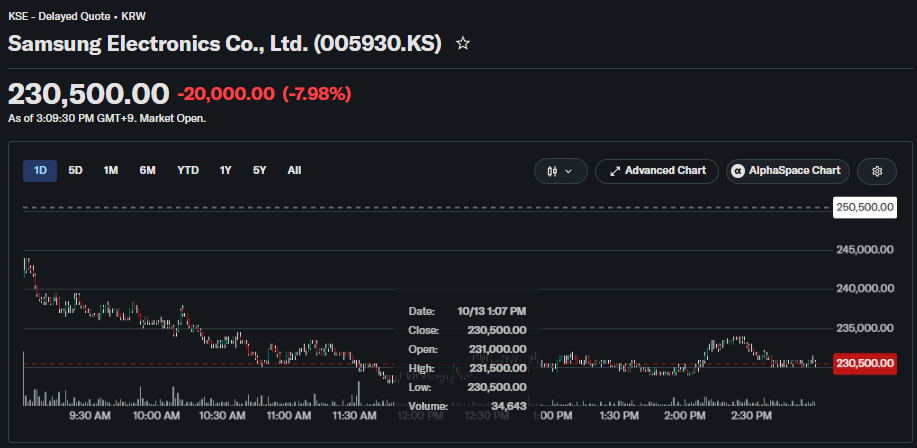
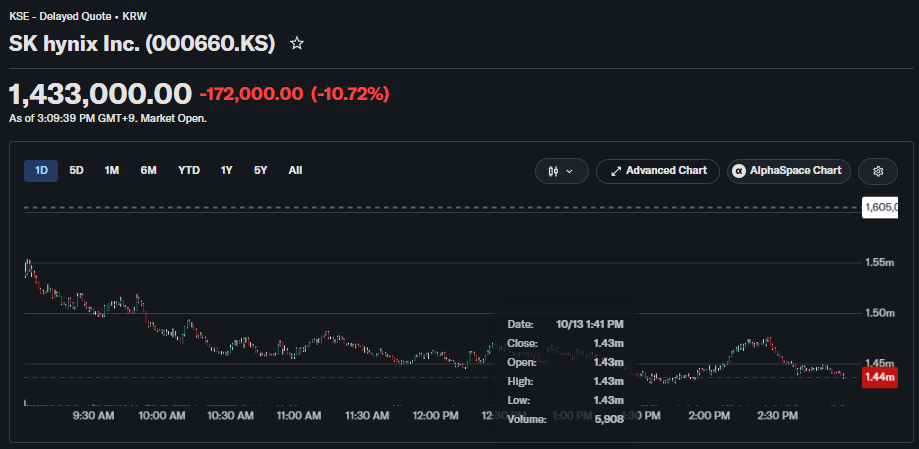
Meanwhile, US memory chip stocks generally declined in night trading. SK Hynix's US stock fell nearly 6%, while Micron Technology, SanDisk (SNDK.US), Western Digital (WDC.US), and Seagate (STX.US) all fell more than 3%.
Regarding the sell-off of memory chip stocks triggered by related news, Union Bancaire Privee Managing Director Vey—Sern Ling said, “Investors are currently nervous and looking for reasons to make a profit settlement, especially AI-related stocks that performed well this year, especially memory chip stocks.”
It is worth mentioning that in addition to the news that Changxin Storage is making progress in the next generation of high-density DRAM architectures, the reason for the sell-off in memory chip stocks also included statements made by executives of the two major chip giants. Broadcom (AVGO.US) CEO Chen Fuyang said at an event in Singapore on Monday that as the entire industry competes to build infrastructure and provide computing power support for increasingly complex AI models, financing may become a greater obstacle to AI expansion, and its impact may even exceed the shortage of semiconductors, memory chips, or electricity.
Intel (INTC.US) CEO Chen Liwu, who appeared on the same stage, also expressed concerns about financing issues. He pointed out that capital costs continue to rise, and the market is also questioning whether companies that invest heavily in AI can ultimately obtain sufficient returns. Chen Liwu said, “If there are any current challenges, they are capital and capital costs. On the other hand, in the long run, people want to see return on investment (ROI).”
The new architecture is expected to improve competitiveness, but the commercialization process has yet to be verified
According to the latest news, Changxin Storage is planning to take the lead in introducing the 4F² architecture into DDR5 RDIMM products. RDIMM is a registered dual in-line memory module. It is mainly aimed at the server and data center markets, and is widely used in AI training, high-performance computing, and cloud computing infrastructure.
The 6F² standard currently used by the industry means that the surface area of a chip is equivalent to 6 times the “feature size” (feature size) square - the characteristic size refers to the basic line width between transistors. The president of Changxin Storage said that the company is changing the way transistors are laid out through stacking technology. This so-called “vertical surround gate” (Vertical Surrounding Gate) scheme is expected to reduce electric leakage and other side effects — a problem that larger competitors have long faced when trying to reduce the size below 6F².
The industry believes that if Changxin Storage can complete product launch and achieve stable mass production as planned, it will mean that it will not only continue to expand its production capacity scale, but also achieve breakthroughs in the field of core DRAM architecture innovation. For the server market, higher storage density means being able to deploy larger amounts of memory under the same space and power consumption conditions, which is particularly appealing to AI data centers.
According to some reports, Samsung Electronics' current mass production schedule on a similar technology route is expected to take several years. If this judgment is accurate, Changxin Storage may gain a time advantage of about two years in commercializing products related to the 4F² architecture. However, since related projects are still in progress, the final mass production progress, product performance, and actual yield level still need to be further verified.
Changxin Storage is speeding up the production of advanced memory chips to meet the soaring demand for AI. Although Changxin Storage is still lagging behind in the high-bandwidth memory (HBM) field, the company is making steady progress in the broader DRAM market. According to data compiled by Counterpoint Research, Changxin Storage's share of the DRAM market expanded to 10% in the second quarter of this year, compared to only 4% a year ago. Being able to manufacture more complex products will also give the company a better competitive position as global supply constraints begin to ease in the next few years.
Jing Jie Yu, an analyst at Morningstar (Morningstar), said, “If Changxin Storage can successfully implement the 4F² architecture in DRAM production earlier, it will greatly enhance its competitive position compared to its peers. However, leading companies in the storage industry and equipment manufacturers have also emphasized the difficulty of this technological transformation, and we still anticipate that there will be a clear time gap between the launch of Changxin Storage 4F² products and achieving commercially viable yield and commercialization.”