


When 10 and 30 year Treasury yields jump to 20 year highs and mortgage backed securities sit at the center of the storm, mortgage REITs and MBS focused yield vehicles can move sharply, for better or worse. That kind of stress can shake out weak spots but also expose income ideas that many investors overlook. This article explains the market backdrop in more detail and then examines three US mortgage REIT stocks that are closely tied to these developments.
The three stocks in this article are just a sample set, and the full screen surfaced 21 more US mortgage REITs and MBS focused yield vehicles with equally compelling income stories that are not covered below. To go straight to the broader opportunity set, use the US Mortgage REITs and MBS-Focused Yield Vehicles screener to identify, compare, and analyze the highest conviction ideas for your watchlist.
Invesco Mortgage Capital (IVR)
Overview: Invesco Mortgage Capital is a US mortgage REIT that invests in and finances residential and commercial mortgage backed securities and related assets.
Operations: The REIT generated about $139 million from mortgage focused activities in the United States, giving investors concentrated exposure to domestic MBS income.
Market Cap: $607 million
For a screener built around mortgage exposure, Invesco Mortgage Capital offers direct access to how MBS pricing and funding conditions react when long term yields surge.
"Invesco Mortgage Capital has notably improved its capital structure and reduced its cost of capital by redeeming its Series B preferred stock in favor of lower cost repurchase agreements."
This raises a key question: what happens to that carefully rebuilt funding stack if a single key pressure on mortgage spreads and hedging costs moves in an unfavorable direction?
If that pressure point is on your radar, read the full narrative for Invesco Mortgage Capital to see whether funding risks are stalling or accelerating the income story.

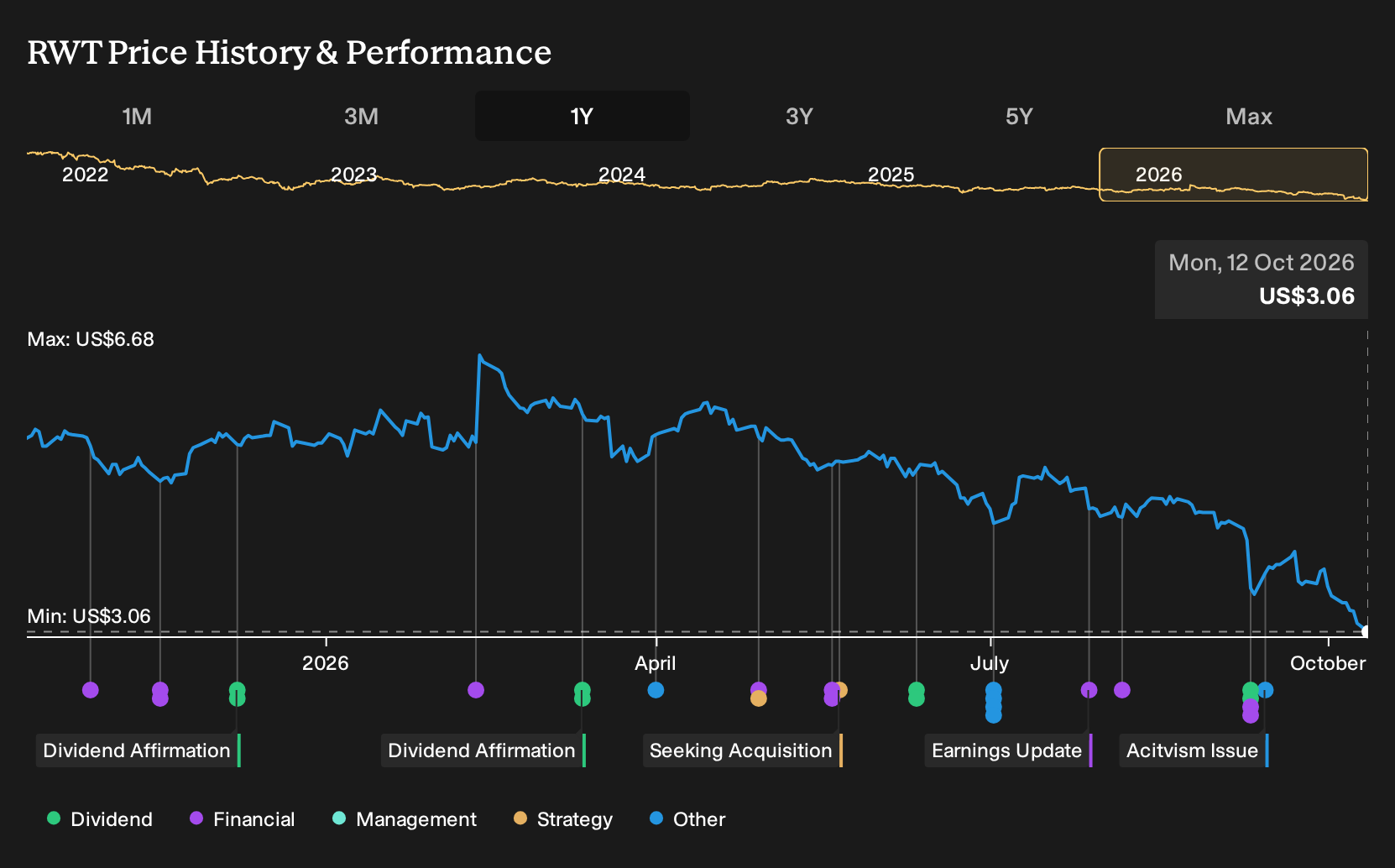
Redwood Trust (RWT)
Overview: Redwood Trust is a US specialty finance company that acquires, originates, and securitizes residential mortgages to generate mortgage credit income.
Operations: Redwood Trust reports about $77 million from Redwood Investments and $64 million from CoreVest Mortgage Banking, within $262 million in US mortgage related revenue.
Market Cap: $384 million
Redwood Trust matters for this mortgage focused screen because its platforms sit directly between housing credit, securitization volumes, and investor demand for mortgage yield. This provides a relatively direct way to watch how wider spreads and higher long term rates filter through to real-world mortgage cash flows.
"Redwood now has an activist pushing for a sale, a large shareholder buying heavily and three mortgage businesses whose economic value deserves more attention than a simple comparison with book value."
The key issue for Redwood Trust is how one unresolved pressure on its mortgage platforms ultimately feeds through to cash earnings and dividend capacity.
That unresolved pressure point is exactly why the full narrative for Redwood Trust goes deeper into how activist demands, capital moves and mortgage cash flows could be quietly decoupling.
Angel Oak Mortgage REIT (AOMR)
Overview: Angel Oak Mortgage REIT focuses on first lien non-QM residential mortgage loans and related mortgage assets in the US, giving investors targeted exposure to mortgage credit and securitization income tied to long term yields.
Operations: Angel Oak Mortgage REIT generates about $36 million by acquiring, investing in, and financing mortgage related assets entirely within the United States.
Market Cap: $167 million
Angel Oak Mortgage REIT matters for this mortgage focused screen because it sits directly in the non-QM corner of US housing finance, where long maturity yields, funding spreads, and securitization terms can quickly reshape income for investors seeking higher yield.
"Origination volumes in the non-QM loan market, supported by demographic factors such as millennial and Gen Z household formation, influence Angel Oak Mortgage REIT’s ability to expand its loan portfolio and support revenue as that demand is funded and securitized over time."
The key consideration now is how shifting pressure on funding costs and pricing power affects the balance between income potential and payout risk.
That trade off is exactly what the full narrative for Angel Oak Mortgage REIT unpacks, separating temporary funding pressure from longer term income potential as Angel Oak Mortgage REIT scales its non-QM platform.

Seeking Alternatives Before Momentum Flies
Fresh ideas move first. Breakout themes gather momentum, then the best entry points get caught by the crowd and pricing power starts dropping. Scan these while it matters and act now.
- Target resilient compounding by reviewing the 31 resilient stocks with low risk scores that aim to hold up when markets wobble and keep portfolios anchored when volatility spikes.
- Consider real-world infrastructure momentum with the 43 power grid technology and infrastructure stocks built around companies tied to grid upgrades, electrification spending, and long-term capital programs that may still be under the radar.
- Position ahead of potential energy buildout using the 16 nuclear energy infrastructure stocks that focuses on critical suppliers before demand for capacity broadens across the sector.
This article by Simply Wall St is general in nature. We provide commentary based on historical data and analyst forecasts only using an unbiased methodology and our articles are not intended to be financial advice. It does not constitute a recommendation to buy or sell any stock, and does not take account of your objectives, or your financial situation. We aim to bring you long-term focused analysis driven by fundamental data. Note that our analysis may not factor in the latest price-sensitive company announcements or qualitative material. Simply Wall St has no position in any stocks mentioned.
Have feedback on this article? Concerned about the content? Get in touch with us directly. Alternatively, email editorial-team@simplywallst.com