


The Zhitong Finance App learned that TrendForce Jibang Consulting published an article stating that according to the latest AI interconnection technology research, as AI data centers push up high-speed transmission requirements, co-packaged optics (CPO) is gradually moving towards mass production, shortening test time and reducing costs has become an important issue. Since CPO needs to collaborate on electrical and optical measurements, the need for integration of test equipment and software is increasing, and it is estimated that 2027 will be a critical year for test architectures to converge. While traditional semiconductor automatic test equipment (ATE) manufacturers are actively deploying, new processes and technical challenges have also created new business opportunities for related equipment, test interfaces, and packaging and testing service providers.
TrendForce Jibang Consulting said that the CPO integrates the optical engine and the switching or computing chip in the same package. The mass production challenge covers precision optical coupling. It relies on alignment module suppliers with multi-axis control technology to provide precise alignment technology, with position feedback and light finding algorithms to help the coupler and test equipment improve alignment speed and stability. Currently, optical alignment has been shortened to the second level or even sub-second level, but the complete test of a single PIC may still take more than 100 seconds, and the bottleneck in mass production is shifting from “accurate alignment” to “fast measurement.”
Currently, CPO testing requires various devices such as laser light sources, optical switches, optical power meters, and spectral analyzers. Functions and supply sources are scattered, making it more difficult to integrate cross-device control, correction, and testing processes. Furthermore, the length of time each measuring instrument is used is different. If each test station is equipped with complete equipment, it is easy to cause some expensive instruments to be idle, driving up testing costs. Therefore, the focus of optoelectronic testing integration is to coordinate electrical and optical measurements through unified software, with optical path switching and multi-station sharing to improve equipment utilization. As CPO moves towards mass production, whether different instruments can effectively collaborate on the same platform will be the key to reducing costs and increasing production capacity.
Test competition shifts to platform integration, and manufacturers actively deploy
TrendForce Jibang Consulting pointed out that the current CPO testing industry chain can be summarized as automatic test equipment, probes and test interfaces, optical and high-speed measurement instruments, test integration and automation, core coupling and positioning modules, third-party testing and analysis, as well as sealing and mass production testing. The division of labor in all aspects still overlaps.
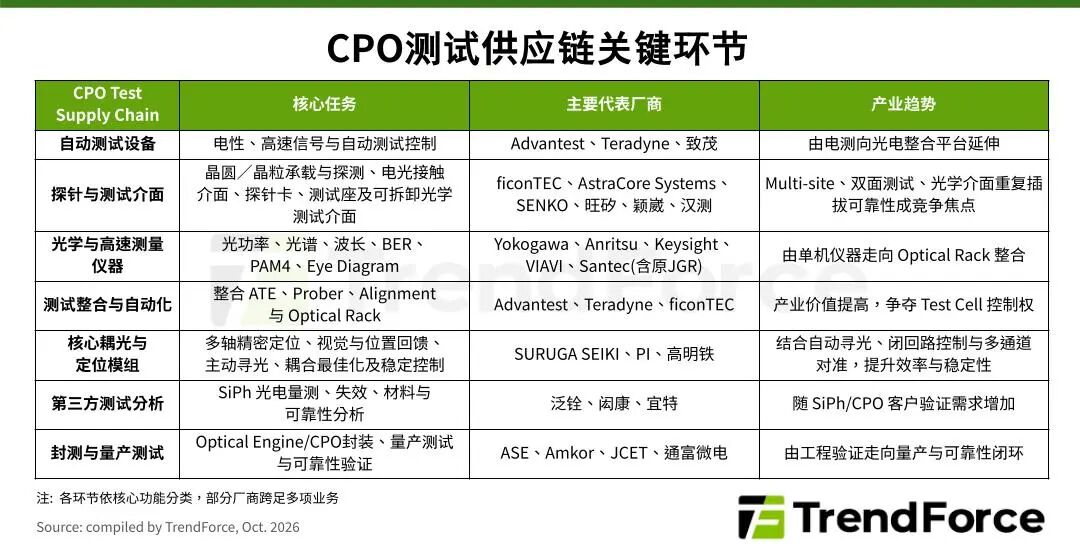
Traditional ATE testing leaders have invested more resources in response to customer needs. Teradyne (Teradyne) acquired Quantifi Photonics in 2025 to enhance optical measurement capabilities; Advantest (Advantest) connected optical instruments in series with the existing test platform and software, and announced cooperation with VIAVI (VIAVI) and SENKO in September 2026 to integrate automatic test environments, optical measurement and detachable optical interfaces, and has demonstrated a CPO module-level analog mass production test process at ECOC 2026. Under such circumstances, the industrial value will gradually extend from the performance of a single instrument to the ability to integrate a complete mass production platform. If cross-station instrument sharing and parallel testing of multiple components can be further realized in the future, it is expected that unit testing costs will be reduced.
TrendForce Jibang Consulting observed that the layout of some manufacturers in CPO testing already spans different aspects. For example, Gaoming Iron provides a multi-axis controlled optical alignment module, Wangsilicon provides detection equipment and optical alignment, Ying Wei provides a test interface, and Zhimao has automated testing and aging testing capabilities. As for third-party testing agencies Panquan, Hongkang, and Yite, they use services such as optoelectronic measurement, material analysis, failure analysis, and reliability verification to accelerate customer development progress. Packaging and testing manufacturers such as Sun Moon Light can further connect packaging and mass production testing, and the scope of benefits will cover the equipment and service supply chain.
Some manufacturers are using their existing experience in optical communication manufacturing and testing to accelerate the local replacement of equipment. For example, Liancun Instruments has launched a 65 GHz sampling oscilloscope and is mass-produced and supplied, showing that some high-speed measurement technology has progressed, but high-end measurement instruments as a whole still rely mostly on imports. In addition, whether existing optical module test results can be extended to a complete CPO mass production platform, it is still necessary to observe customer introduction, test efficiency and long-term stability. Meanwhile, Robotec completed the wholly-owned acquisition of German FICONtec in 2025 and entered the global optoelectronic packaging and testing equipment supply chain. Whether the relevant equity changes affect the purchasing decisions of European and American customers will be the focus of follow-up observation.
TrendForce Jibang Consulting estimates that 2027 will be a critical year for the CPO testing structure and equipment investment direction to converge, while 2028 will be a verification period for whether large-scale mass production can be entered. As customers pay more attention to testing efficiency, quality and cost, manufacturers with cross-equipment integration and mass production service capabilities are expected to improve their strategic position in the supply chain.