


The Zhitong Finance App learned that recently, the Ministry of Transport, the Ministry of Industry and Information Technology, and the National Energy Administration jointly issued the “Action Plan for the Promotion and Application of Inland Waterway New Energy Ships (2026-2030)” (“Plan”), which proposes to promote the adjustment and optimization of China's industrial structure, energy structure, and transportation structure, adhering to market leadership, government guidance, scenario guidance, and innovative breakthroughs. On the basis of the orderly development of liquefied natural gas powered ships, the Ministry of Industry and Information Technology, and the National Energy Administration, the focus is on promoting full-scenario application, full-chain support, and high-standard development of inland natural gas powered ships.
Inland waterway shipping is an important part of the integrated transportation system, and it is also a key area for green and low-carbon transformation. Currently, China's inland new energy vessels rank among the highest in the world in terms of overall scale, and the level of application is leading in the world. By the end of 2025, China had more than 1,200 inland new energy clean energy vessels, and a number of high-tech inland new energy vessels were put into operation.
Facing the future, the “Plan” proposes phased development goals. By 2028, the number of new inland waterway ships will double compared to 2025, and full-scenario demonstration applications have been initially realized; the Yangtze River Main Line methanol filling service capacity has been fully connected, and the Yangtze River Delta water network ship charging and switching facilities are basically networked; a “two horizontal and one vertical” shipping green channel and a pioneering electrification zone for ships such as the Yangtze River Delta will be built, comprehensively forming 3,000 kilometers of zero-carbon waterway transport channels. By 2030, large-scale applications of new energy vessels will initially be realized.
The “Plan” lays out 11 key tasks in promoting multi-scenario classification and application of new energy ships, improving energy supply guarantees, encouraging innovative business models, strengthening manufacturing industry support, optimizing operation management, improving standards and specifications, improving supervision and management systems, and strengthening key technical research. It also requires strengthening policy support, encouraging first testing, and strengthening organizational implementation.
The original text is as follows:
Notice of the Ministry of Transport, the Ministry of Industry and Information Technology, and the National Energy Administration on Issuing the “Action Plan for Promotion and Application of New Energy Ships in Inland Waterways (2026-2030)”
Transportation departments (committees) of provinces, autonomous regions and municipalities directly under the Central Government, departments in charge of industry and information technology, energy administration, agencies dispatched by the National Energy Administration, various units under the Ministry of Transport, departments and departments within the Ministry of Transport:
The “Action Plan for Promotion and Application of New Inland Waterway Vessels (2026-2030)” is now being issued to you. Please take into account the actual situation and earnestly implement it.
Action plan for promotion and application of inland waterway new energy vessels
(2026—2030)
Promoting the development of new energy ships is an important measure to implement the decisions and arrangements of the Party Central Committee and the State Council on carbon neutrality and accelerate the construction of a strong transportation country, a manufacturing power, and an energy power. It is conducive to the construction of a new energy system and a comprehensive green transformation of economic and social development. In order to accelerate the promotion and application of inland waterway new energy vessels, this action plan is formulated.
I. General Requirements
Guided by Xi Jinping's ideology of socialism with Chinese characteristics in the new era, thoroughly implement the spirit of the 20th National Congress and the 20th Plenary Session of the Party, completely, accurately and comprehensively implement the new development concept, accelerate the construction of a new development pattern with the goal of promoting the adjustment and optimization of China's industrial structure, energy structure, and transportation structure, adhere to market leadership, policy guidance, scenario guidance, innovation and breakthroughs, and focus on promoting the full-scenario application, full-chain support, and high-standard development of inland waterway shipping. Fostering transportation A new growth point for sector consumption, supporting the improvement of modern integrated transportation systems.
By 2028, the number of new inland waterway ships will double compared to 2025. Among them, the number of electric transport ships will exceed 1,000, methanol-powered ships will exceed 100, and the number of electric business ships, port ships, etc. will increase significantly, and demonstration applications in all scenarios have initially been realized. The methanol filling service capacity of the Yangtze River Main Line has been fully connected, and ship charging and switching facilities in the Yangtze River Delta water network area are basically connected to the grid. The basic construction of the Chengjiang River and Xijiang Shipping Main Line, the Beijing-Hangzhou Canal Shipping Green Corridor, and pioneering electrification zones for ships such as the Yangtze River Delta will comprehensively form 3,000 kilometers of zero-carbon waterway transportation channels.
By 2030, the number of new inland waterway ships and the mileage of zero-carbon waterway transport channels will continue to increase. Basically, an industrial ecosystem with rich business formats in all scenarios, strong full chain support, and a sound high standard system will be built, and large-scale application of new energy ships will initially be realized.
II. Accelerate full-scenario applications
(1) Promote multi-scenario classification applications.
Accelerate the application of electric ships in passenger and freight scenarios within 300 kilometers and less than 3,000 dwt. Promote the application of electric cargo ships in short- and medium-haul container and dry bulk transportation scenarios such as inland waterways with relatively fixed routes or direct river-sea routes; promote electric passenger ships in scenes such as sightseeing and ferries in riverside and lake reservoirs. Encourage the use of battery power on official ships, harbor ships, yachts, etc. Increase the promotion and application of methanol-powered ships in long-distance, large-tonnage freight scenarios. Focus on long-distance transportation scenarios such as direct river-sea access and river-sea intermodal transport, and promote methanol-powered ships for containers, bulk goods, and Ro-Ro transportation. All regions are encouraged to explore other energy applications such as hydrogen energy, taking into account the actual situation. Support marine applications of renewable energy such as biodiesel and green methanol.
(2) Accelerate the promotion and application of methanol-powered ships.
The Yangtze River Main Line focuses on building zero-carbon transportation demonstration routes for containers, dry bulk cargo, and armored alcohol-powered vessels such as Chongqing-Shanghai, Chongqing-Yichang, and Maanshan-Ningbo, and constructing methanol filling facilities in Chongqing, Yichang, Wuhan, Nanjing, etc., to form a filling service capacity that runs through the Yangtze River Main Line. Support the Xijiang Shipping Main Line to build zero-carbon transportation routes for dry bulk methanol-powered ships such as Nanning-Guangzhou and Wuzhou-Guangzhou.
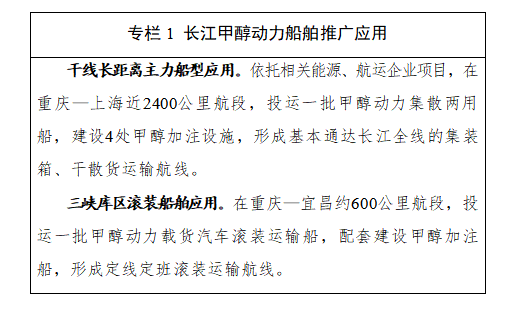
(3) Promote multi-scenario applications of electric ships.
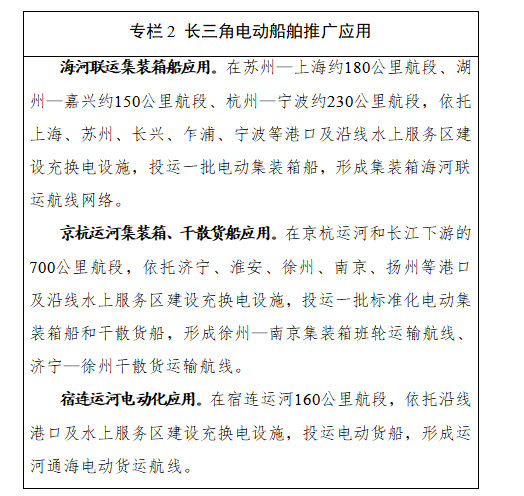
Accelerate the construction of the Yangtze River Delta Ship Electrification Pilot Zone. Focus on building zero-carbon transportation demonstration routes for containers and dry-bulk electric ships such as Suzhou-Shanghai, Huzhou-Shanghai, Huzhou-Taicang, Huzhou-Jiaxing, Suqian to Lianyungang, Changzhou-Zhenjiang, Jining-Xuzhou-Nanjing, Hangzhou-Ningbo, etc., to promote the application of standardized and serialized ship types, and promote collaborative construction of charging and switching facilities on key flight sections such as the Beijing-Hangzhou Canal, the Suzhou-Shanghai Canal, the Changhu Line, and the Hujiashen Line.
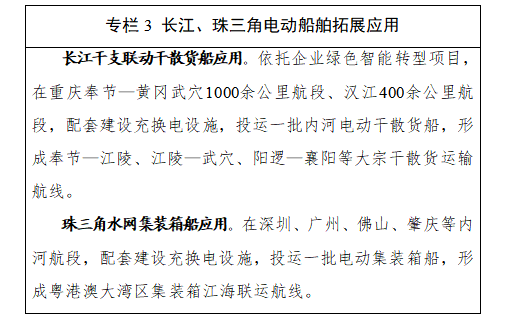
Expand the application of electric cargo ships in waters such as the tributaries of the Yangtze River and the Pearl River Delta. Focus on building zero-carbon transportation routes for containers, dry bulk electric ships such as Wuhan-Shanghai, Wuhan-Xiangyang, Jingzhou-Huanggang, Changsha-Yueyang, Jiujiang-Nanchang, Guangzhou-Shenzhen, Guangzhou-Dongguan, Shenzhen-Foshan, etc., as well as short shuttle transportation routes for electric ships in ports such as Guangzhou Port, etc., to support and improve ship charging and switching facilities. Encourage the Pinglu Canal, the Jianghuai Canal, and the Shaying River to explore electrification of all lines. Expand the scale of electric passenger ships in an orderly manner, and concentrate on building electric passenger routes for riverside trips in cities such as Chongqing, Wuhan, and Guangzhou, the Minjiang River, the Li River, the “Two Bams and One Gorge”, Danjiangkou Reservoir, Erhai Sea, and Wanlu Lake.
(4) Build a zero-carbon waterway transportation channel.
In the Yangtze River Main Line, Xijiang Shipping Line, Beijing-Hangzhou Canal, and ports or water service areas in the Yangtze River Delta and Pearl River Delta water network regions, etc., coordinate the construction of a number of ship charging and switching facilities, build integrated “landscape storage, charging and exchange” facilities according to local conditions, form a methanol filling service network with synergy and effective connection between supply and demand, and provide intensive and convenient charging and switching services. Promote the application of electric and methanol-powered ships to gradually form “two horizontal, one vertical, two networks” zero-carbon waterway transportation channels.
3. Strengthen full chain support
(5) Improve energy supply guarantees.
Strengthen collaboration between methanol filling facilities and production, supply, storage and marketing networks. Methanol filling facilities can be built on port support system shorelines or water service areas. Support the expansion of methanol filling functions in existing water refueling or gas stations (barges) and water service areas, and explore the construction of comprehensive energy supply stations. Promote the standardized construction of public shore-based charging facilities in accordance with the “Technical Specification for the Construction of Electric Ship Shore-based Charging Facilities”, etc. Research mobile charging and switching methods and fuel ethanol applications. Encourage all regions to coordinate the layout and construction of electric ship charging and switching facilities, include the energy demand for electric ships in overall power grid planning and consideration, speed up the construction of power supply and distribution facilities outside the red line, and increase support for distributed energy sources such as distribution grids and scenery to ship charging and switching facilities.
(6) Encourage innovative business models.
Support shippers, equipment, energy, port and shipping enterprises to take advantage of their advantages and explore a new model of integrated development of the whole chain. Give full play to the advantages of the battery industry, support the development of new power exchange business models such as ship electricity separation and battery banks, and carry out services such as ship financial leasing and standardized box-type power leasing. Encourage energy, port and shipping companies to establish long-term stable price mechanisms linked to traditional energy sources.
(7) Strengthen support for the manufacturing industry.
Formulate and publish a catalogue of green ship models for each watershed scenario, promote the formation of genealogical and standardized technical solutions for ship energy and power equipment, promote modular and standardized design, serialized and batch construction, and create market-competitive ship brand products and new energy power systems. Cultivate a number of leading benchmark enterprises in shipbuilding and supporting industries, guide the agglomeration and development of the entire industry chain, and achieve high standards of construction. Encourage improving the ability to guarantee NEV ship maintenance and used ship trading services.
(8) Optimizing operation management.
Guide the introduction of cooperative watershed ship crossing policies, and encourage support policies for new energy ships to cross the gate, dock, and load and unload according to local conditions. It provides services such as ship inspection, ship registration, and operation certification for newly added new energy ships in accordance with the law, conveniently and efficiently. Improve the box-type power port terminal hoisting process in accordance with the marine equipment management system. Optimize the new energy ship crew training system and increase the proportion of senior crew members owned by shipping companies. Formulate technical rules for green classification of ships and explore the establishment of corresponding policy incentive mechanisms.
IV. Promoting High Standards of Development
(9) Improve standards and specifications.
Promote the introduction of standards such as technical specifications for methanol fuel filling barges and safety procedures for water refueling operations. Continue to improve technical specifications for electric ships, optimize technical and inspection requirements such as battery capacity and type, and promote ship-to-shore connections and shared use. Accelerate the implementation of key standard work plans for electric ships, and enhance the homogeneity and uniqueness of the “ship-shore-electricity” connection. Research and formulate relevant technical standards for the use of hydrogen fuel in ships, such as internal combustion engines, hydrogen storage and dehydrogenation systems, storage and transportation, and refueling.
(10) Improve the supervision and management system.
Implement differentiated safety management for new energy ships and establish a “design-construction-operation” supervision service system. Innovate ship inspection technology and improve the level of digital intelligence. Ship inspection agencies should strengthen the construction and inspection of new energy ships to ensure that relevant ships meet the requirements of technical specifications. Implement regulations such as NEV inspection guidelines, and promote R&D, construction and data access of a national NEV operation monitoring system. Conduct research on risk assessment procedures for new energy vessels, guide shipping companies to improve safety management systems, strengthen operational risk identification and assessment, and implement risk classification control and investigation and treatment of hidden hazards. Promote local governments to establish emergency planning systems covering all scenarios such as energy supplementation, port production, and water emergencies, and carry out regular personnel training and emergency drills to enhance emergency response capabilities.
(11) Strengthen key technical research.
Accelerate the construction of science and technology innovation platforms related to new energy ships, and support the formation of technological innovation alliances. Accelerate the development and verification of key components such as marine methanol engines, alcohol injectors, high-pressure pumps, etc., strengthen technical research on battery pack structure optimization, heat loss protection, and rapid fire extinguishing for high-specific energy lithium batteries, and carry out core technology research such as ultra-high power fast charging, high energy density, high safety performance, long cycle life power batteries, lightweight and miniaturization of battery modules, and hydrogen-ammonia fuel power and storage systems. Support the development of high-safety and high-reliability DC integrated power system technology research.
5. Strengthening implementation guarantees
(12) Strengthen policy support.
Make good use of various financial channels from the central government and local authorities, and increase support for the construction and operation of new energy ships and energy supplementation facilities such as methanol and electricity. Research and implement regional energy support policies for electric ships. Include the promotion and application of new energy ships in the comprehensive assessment and assessment of carbon neutrality at the provincial level. Give full play to the incentive role of scientific and technological innovation and technological transformation and refinancing policy tools, and guide financial institutions to strengthen their support. Provincial transportation, industry, information technology, energy and other departments actively push local governments to optimize the approval process and operation management requirements for the construction of methanol filling facilities, and introduce support policies to guide the acceleration of the construction of power supply and distribution facilities outside the red line.
(13) Encourage to try first.
Organize and carry out special pilot projects to promote and apply new energy ships to powerful transportation countries. Focusing on typical scenarios, the focus is on pioneering exploration in areas such as crew staffing optimization, construction management of supporting facilities, hierarchical classification management of box-type power supplies in the port, modular standardized shipbuilding inspection and registration management, and green and intelligent collaboration to form replicable and promoted experiences. Key provinces such as Jiangsu, Zhejiang, Anhui, Shandong, Hubei, Guangdong, Guangxi, and Fujian are encouraged to increase their support and launch a model to try first and learn from experience.
(14) Strengthen organizational implementation.
Promote the establishment of cross-departmental coordination and working mechanisms, strengthen multi-party coordination among departments, localities and enterprises, and form policy synergy. The Minister of Transport's Jiang and Pearl River Navigation Administration respectively formulated implementation plans for the Yangtze River Main Line and the Xijiang Main Line shipping channel. Key provinces are encouraged to formulate implementation plans, clarify development goals, actively and steadily implement them, and carry out timely evaluation of implementation effects and experience summary and promotion.
This article was selected from the “Ministry of Transport” official website, Zhitong Finance Editor: Jiang Yuanhua.