


The Zhitong Finance App learned that Kathy Wood, founder of ARK Investment Management Company and “Sister Mu”, shunned the memory chip industry and warned that the memory chip industry could easily fall into a “cruel” boom and bust cycle, and as Chinese companies accelerate the expansion of production capacity, this problem may only worsen.
Wood told investors that once supply exceeds demand, memory chip prices may fall rapidly. Although the current supply of high-bandwidth memory (HBM) is still tight, more and more Chinese manufacturers entering the market may exacerbate price fluctuations in the entire industry. She said, “The industry trend is upward, but cyclical fluctuations are very cruel,” and if “a few more competitors, especially from China, are added, market volatility will increase.”
Wood's point of view is not without reason. For example, Chinese memory chip manufacturer Changxin Storage (CXMT) is speeding up the production of advanced memory chips to meet the soaring demand for artificial intelligence (AI). Although Changxin Storage is still lagging behind in the high-bandwidth memory (HBM) field, the company is making steady progress in the broader DRAM market. According to data compiled by Counterpoint Research, Changxin Storage's share of the DRAM market expanded to 10% in the second quarter of this year, compared to only 4% a year ago.
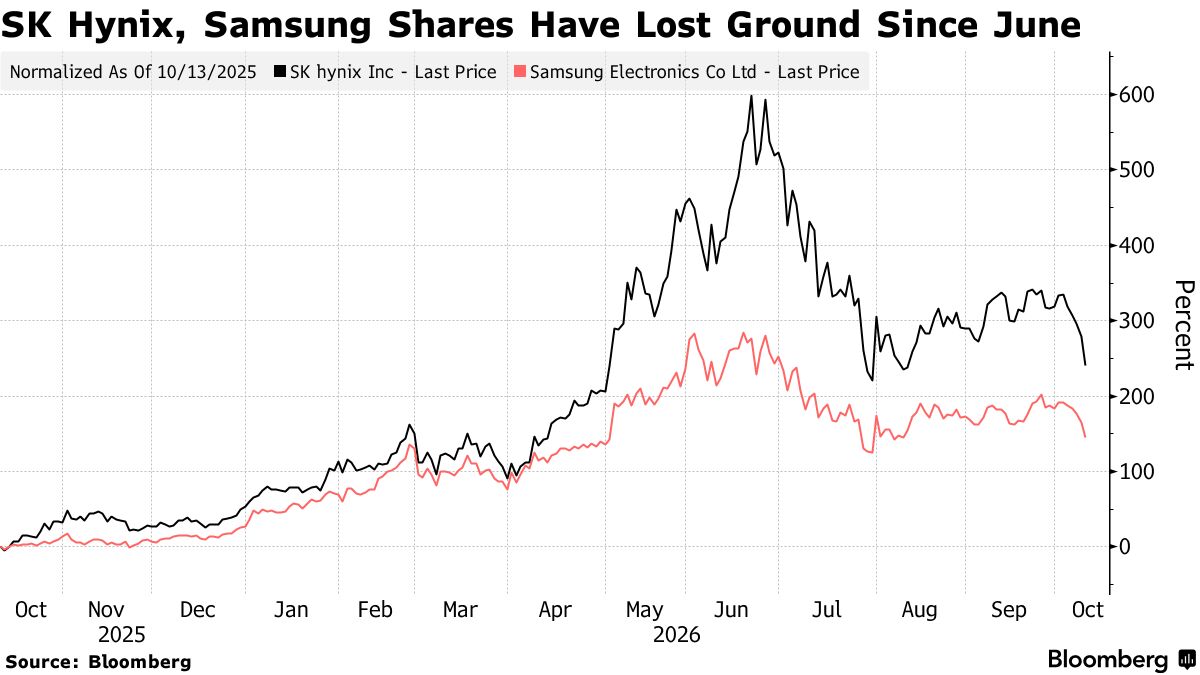
Meanwhile, news about Changxin Storage's progress in the next generation of high-density DRAM architectures also raised concerns about heated competition and dragged down shares of Samsung Electronics and SK Hynix listed in South Korea to drop sharply on Tuesday. Memory chip stocks such as Micron Technology (MU.US) and SanDisk (SNDK.US) also weakened ahead of the US market on Tuesday.
According to reports, Changxin Storage is accelerating the deployment of next-generation DRAM technology, and plans to launch DDR5 RDIMM server memory products using a 4F² storage unit architecture by the end of this year. For a long time, major global storage vendors, including Samsung Electronics, SK Hynix, and Micron, have been studying next-generation high-density DRAM architectures. However, large-scale commercialization is progressing relatively slowly due to extremely difficult aspects such as design complexity, manufacturing process, and yield control.
According to some reports, Samsung Electronics' current mass production schedule on a similar technology route is expected to take several years. If this judgment is accurate, Changxin Storage may gain a time advantage of about two years in commercializing products related to the 4F² architecture. Being able to manufacture more complex products will also give the company a better competitive position as global supply constraints begin to ease in the next few years.
In addition to the news that Changxin Storage is making progress in the next generation of high-density DRAM architectures, the reason for the sell-off of memory chip stocks also included statements made by executives of the two major chip giants. Broadcom (AVGO.US) CEO Chen Fuyang said at an event in Singapore on Monday that as the entire industry competes to build infrastructure and provide computing power support for increasingly complex AI models, financing may become a greater obstacle to AI expansion, and its impact may even exceed the shortage of semiconductors, memory chips, or electricity.
Intel (INTC.US) CEO Chen Liwu, who appeared on the same stage, also expressed concerns about financing issues. He pointed out that capital costs continue to rise, and the market is also questioning whether companies that invest heavily in AI can ultimately obtain sufficient returns. Chen Liwu said, “If there are any current challenges, they are capital and capital costs. On the other hand, in the long run, people want to see return on investment (ROI).”
Chen Fuyang also said that the AI boom has attracted a group of investors whose investment strategies are like gamblers, and he believes that some of them simply don't understand what they are betting on. Chen Fuyang said, “Many investors don't even know what they are investing in. They set extremely high expectations, only to find themselves almost like they were in a casino.” He added that many AI companies, including OpenAI, lose up to several billion dollars every year. This type of service requires huge investment in high-end chip, data center, and model development, and the entire industry has yet to find a sustainable business model.
Wood did not agree with Chen Fuyang and Chen Liwu's remarks. She dismissed market concerns about the bubble and anticipated that AI would significantly increase productivity.
Why is Wood shying away from the storage industry?
It is worth noting that as early as August of this year, Wood responded to questions from the outside world that she “missed the storage market.” Wood pointed out that memory chips are the “most commercialized and most cyclical” part of the semiconductor industry chain. Together, Samsung Electronics, SK Hynix, and Micron control about 90% of the world's DRAM production. Their products are highly standardized and highly replaceable. Historically, prices can double several times within two years, or fall short within two years. In her opinion, although HBM (high-bandwidth memory) is currently labeled an “AI core component,” its commercial properties are not separated from the essence of the storage industry — it is a link that can be standardized, compared, and circumvented.
Wood also pointed out that the sharp rise in storage prices is not a positive but a negative sign. She pointed out that when the price of a supply chain element rises three times, four times, or ten times, it will no longer be a cost item that can be accepted for a long time, but will become a technical problem that must be solved. She further pointed out that recently the free cash flow of chip stocks has shown the complete opposite trend from the free cash flow of hyperscalers (hyperscalers) — chip makers are benefiting from price increases, while cloud vendors are under pressure. However, she stressed that this state of affairs is temporary because the party under pressure has a strong motivation to change it.
Wood mentioned that demand side is eliminating dependence on HBM through “engineering.” She named two companies — Cerebras and Groq. Both focus on AI inference chips. Their architecture design does not require an external HBM, but relies on high-speed on-chip storage. She likened this process to Tesla's “engineering removal” of cobalt from battery design — when a raw material is too expensive or supply is at risk, engineers try their best to bypass it.
However, the judgment of the vast majority of seller agencies and industry parties is in stark contrast to Wood's views. Their core argument is that this round of storage is not a traditional cycle driven by the inventory rhythm of mobile phones and PCs, but rather a structural shortage driven by investment in AI computing power. The trend of rising memory chip prices will continue until at least 2027, and supply and demand are expected to substantially ease only after significant release of new production capacity in 2028.
The more important structural change is the massive adoption of long-term agreements (LTAs). Samsung, SK Hynix, and Micron reserved large production capacity in advance for major North American cloud vendors in the form of 2-5 year long contracts. Some contracts have even lifted price caps and increased prepayment terms. This is viewed by many as institutional evidence that “the storage industry is moving from a strong cycle to a long-term boom.”
Comparing Wood with mainstream market views, it can be seen that Wood cautions against treating a highly cyclical commodity as a core asset that can be held forever. The current mainstream view of the market also has a solid basis: the gap between supply and demand is the largest in 15 years, new production capacity will not be released until 2028, and long-term agreements will push visibility beyond 2027. These are facts determined by the capacity construction cycle and contract terms. The tension between the two forms the most interesting part of the current storage cycle: the reason the cycle is lengthened is because the price is too high; and the price is too high will eventually spawn the power to end the cycle. For investors, the storage supercycle may still be around, but that “buy with your eyes closed” phase is probably over.