


Why Rorze’s new guidance matters
Rorze (TSE:6323) just raised its full year earnings outlook and flagged a higher year end dividend, tying both moves directly to strong semiconductor demand feeding through to sales and profits.
The company now forecasts net sales of ¥180,007 million, operating profit of ¥53,078 million and basic EPS of ¥217.84 for the year ending February 28, 2027, along with planned year end dividend guidance of ¥28 per share versus ¥17 a year earlier.
Rorze’s raised guidance lands after a powerful share price run, with a 30 day share price return of 45.53% and a year to date share price gain of 108.31%. The 5 year total shareholder return of 403.07% points to momentum that has been building over a much longer stretch.
Scan beyond Rorze and see how other chip related plays stack up by running the curated list of 92 robotics and automation stocks tied to automation and semiconductor demand.
Bulls see Rorze’s upgraded guidance and dividend as proof that the rerating has room to run. Bears see a hot semiconductor cycle priced in. Which case fits the valuation work that follows?
Price-to-earnings of 36.4x: Is it justified for Rorze?
Rorze trades on a P/E of 36.4x, which is rich against both the JP Semiconductor industry at 24.3x and a peer average of 25.9x, so the market is clearly paying up for this story at ¥5,041 per share.
The P/E ratio compares the share price with earnings per share and, for a business like Rorze that is tied to semiconductor equipment cycles, it captures how much investors are willing to pay today for each unit of current profit. A higher multiple often lines up with expectations for faster profit expansion, stronger returns, or a balance sheet and business mix that investors see as more resilient than the pack.
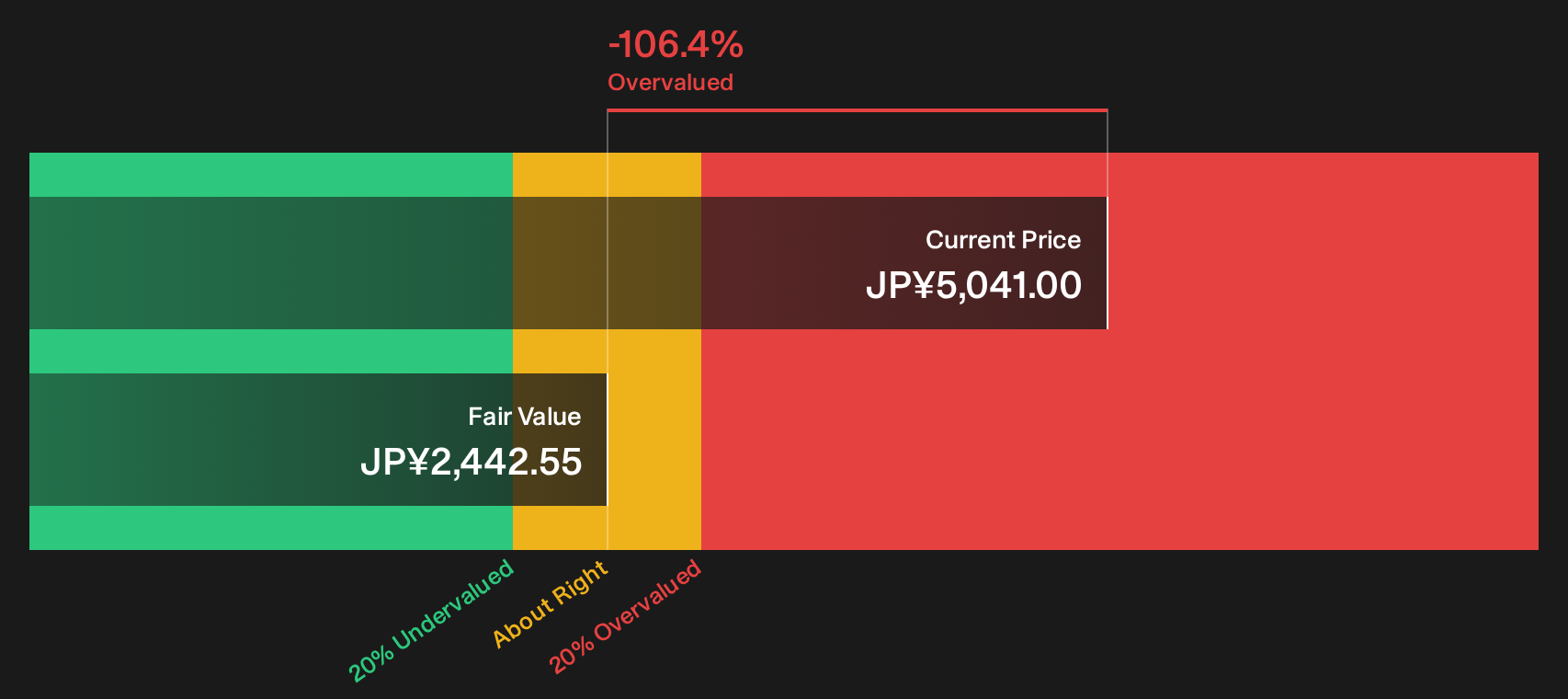
On that front, earnings grew 28.7% over the past year against a 5 year average of 9.9%. Analysts currently expect profits to rise 29.8% a year over the next three years, faster than both the JP market at 9.6% and the wider semiconductor industry at 17.8%. Revenue is forecast to increase 20% annually, also ahead of the JP market at 6.9%. Those growth forecasts go some way to explaining why the market assigns a premium multiple, although the SWS DCF model points to a future cash flow value of ¥2,442.55 per share, which is well below the current price.
The premium looks even stiffer once the estimated fair P/E is added to the picture. The same framework suggests a level closer to 31x would be more in line with the underlying drivers, a figure that is still above the industry and peer averages but meaningfully below where Rorze trades today.
Explore the SWS fair ratio for Rorze.
Result: Price-to-earnings of 36.4x (OVERVALUED)
Still, a sharp reversal in semiconductor equipment demand or a shift in dividend policy could quickly challenge the upbeat story around Rorze.
Find out about the key risks to this Rorze narrative.
Another view for Rorze’s valuation
The SWS DCF model paints a very different picture for Rorze. On this framework, estimated future cash flows point to a value of ¥2,442.55 per share, which is well below the current ¥5,041 level. That gap raises the question of whether enthusiasm has already run ahead of fundamentals.
Look into how the SWS DCF model arrives at its fair value.
Simply Wall St performs a discounted cash flow (DCF) on every stock in the world every day (check out Rorze for example). We show the entire calculation in full. You can track the result in your watchlist or portfolio and be alerted when this changes, or use our stock screener to discover 12 high quality undervalued stocks. If you save a screener we even alert you when new companies match - so you never miss a potential opportunity.
Next Steps
Rorze’s setup splits opinion, which is exactly why it pays to look through the full dataset yourself and decide if the current optimism or caution resonates more. To weigh both sides in one place, start with the 3 key rewards and 2 important warning signs.
Looking for more Rorze sized ideas?
If Rorze has you rethinking what belongs in your portfolio, do not stop here. The next move you skip could be the one that matters.
- Target steady compounding and filter for financially robust businesses through the list of solid balance sheet and fundamentals (21 results) before capital chases them ahead of you.
- Hunt for mispriced opportunities and scan the 12 high quality undervalued stocks that combine quality metrics with valuations that still leave room for upside.
- Boost your income focus and review the 27 dividend fortresses that couple 5%+ yields with an emphasis on stability.
This article by Simply Wall St is general in nature. We provide commentary based on historical data and analyst forecasts only using an unbiased methodology and our articles are not intended to be financial advice. It does not constitute a recommendation to buy or sell any stock, and does not take account of your objectives, or your financial situation. We aim to bring you long-term focused analysis driven by fundamental data. Note that our analysis may not factor in the latest price-sensitive company announcements or qualitative material. Simply Wall St has no position in any stocks mentioned.
Have feedback on this article? Concerned about the content? Get in touch with us directly. Alternatively, email editorial-team@simplywallst.com