


- Universal Health Services is contending with weak comparable store sales and limited free cash flow, which are raising questions about its current pricing and marketing approach and its ability to fund growth projects.
- The pressure on free cash flow restricts Universal Health Services' room to invest in new facilities or technology, which matters for a model that relies on expanding capacity and improving efficiency over time.
- We will look at how Universal Health Services' investment narrative is affected by lagging comparable sales and tight free cash flow.
Balance your view on Universal Health Services by scanning a curated field of financially healthier operators using our list of solid balance sheet and fundamentals (25 results), especially while concerns about cash generation and reinvestment capacity are front of mind.
Universal Health Services Investment Narrative Recap
To own Universal Health Services, you need to believe the acute and behavioral network can keep filling beds and treatment slots even while comparable sales are soft. The near term swing factor is whether pricing tweaks and refreshed marketing can lift volumes enough to rebuild free cash flow, without leaning too heavily on higher acuity mix or aggressive discounting.
The biggest operational risk right now is that weak cash generation collides with already high debt and rising liability expenses, which could pinch investment in new beds, outpatient sites and AI tools. Medicaid and ACA headwinds around US$100 million a year add another strain if payer mix and efficiency gains do not keep up.
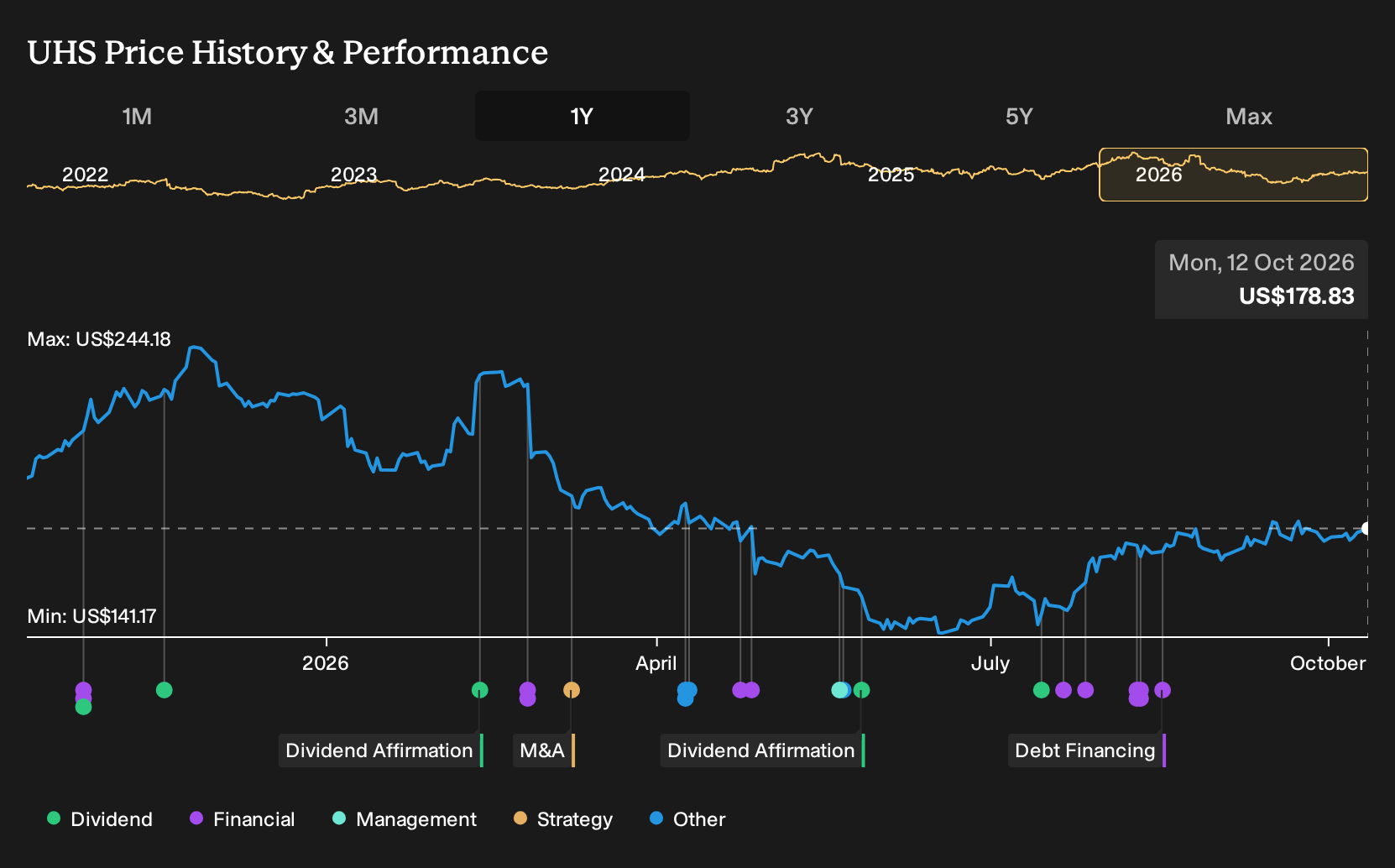
With no fresh company announcements tied directly to this slowdown in free cash flow, the most relevant reference point is still management’s prior commentary around the Talkspace acquisition and broader outpatient behavioral push. Universal Health Services now has access to roughly US$250 million of outpatient behavioral revenue and about 6,000 therapists through that deal.
Those assets matter because weaker comparable sales and tight cash leave less margin for error on integration and execution. If virtual behavioral visits and the Thousand Branches centers connect cleanly into higher acuity services, the outpatient platform can help offset Medicaid and liability headwinds. If uptake is slower or utilization drifts lower, the pressure on cash generation and reinvestment capacity stays front and center.
Universal Health Services' current analyst narrative points to revenues of US$21.0b and earnings of US$1.3b by 2029, based on revenue growth of 5.1% per year and a projected decline in earnings of US$0.2b from US$1.5b today.
Uncover why Universal Health Services' fair value indicates a 9% potential upside to its current price. This opportunity could narrow quickly.
Exploring Other Perspectives
Pessimistic analysts focus on one issue that cuts differently to the free cash flow story. They worry that Medicaid and ACA headwinds, which consensus pegs around US$100 million per year, could bite harder than expected. Before this news, the bullish camp still pencilled in US$21.9b of 2029 revenue and US$1.5b of earnings for Universal Health Services. Those views may shift, so treat them as starting points and compare several angles before deciding what this all means for you.
Explore 4 other Universal Health Services fair value estimates, including one that suggests there could be as much as 264% upside from the current price!
The Verdict Is Yours
Don't just follow the ticker; dig into the data and build a conviction that's truly your own.
- A great starting point for your Universal Health Services research is our analysis highlighting 3 key rewards and 2 important warning signs that could impact your investment decision.
- See our latest analysis for Universal Health Services. The report includes a comprehensive fundamental analysis summarized in a single visual, the Snowflake, making it easy to evaluate Universal Health Services' overall financial health at a glance.
Looking for more investment ideas beyond Universal Health Services?
Once you have a view on Universal Health Services, it helps to widen the lens and compare it with other listed businesses that fit different risk and return profiles. The Simply Wall St Screener can surface companies with the kind of balance sheet strength, valuation profile, or income potential that best matches your own plan.
- If resilience and downside protection rank high for you, start by scanning 31 resilient stocks with low risk scores that aim to keep business risk contained while still leaving room for upside.
- If you want mispriced opportunities on your radar, filter the market using our 29 high quality undervalued stocks and see which companies combine reasonable fundamentals with potentially discounted prices.
- If portfolio income matters, build a watchlist around 8 dividend fortresses that currently offer higher yields and may appeal to investors who prioritise regular cash payouts.
This article by Simply Wall St is general in nature. We provide commentary based on historical data and analyst forecasts only using an unbiased methodology and our articles are not intended to be financial advice. It does not constitute a recommendation to buy or sell any stock, and does not take account of your objectives, or your financial situation. We aim to bring you long-term focused analysis driven by fundamental data. Note that our analysis may not factor in the latest price-sensitive company announcements or qualitative material. Simply Wall St has no position in any stocks mentioned.
Have feedback on this article? Concerned about the content? Get in touch with us directly. Alternatively, email editorial-team@simplywallst.com