


The Zhitong Finance App learned that, according to people familiar with the matter, Bank of Japan officials tend to oppose the rare continuous rate hike this month, but they are still considering the possibility of raising interest rates again as early as December. People familiar with the matter said that Bank of Japan officials believe that with no indication that the upward risk of inflation will suddenly increase, there is not much need to raise interest rates continuously. People familiar with the matter added that the Bank of Japan will instead carefully review economic data to determine whether it is necessary to raise interest rates again as early as the December interest rate meeting.
However, people familiar with the matter said that the final policy decision at the October 30 meeting may still change at the last minute. This indicates that the Bank of Japan has not completely ruled out the possibility of raising interest rates in October, but at this stage it is more inclined to observe the impact of previous interest rate hikes on the economy and prices before deciding on the next steps.
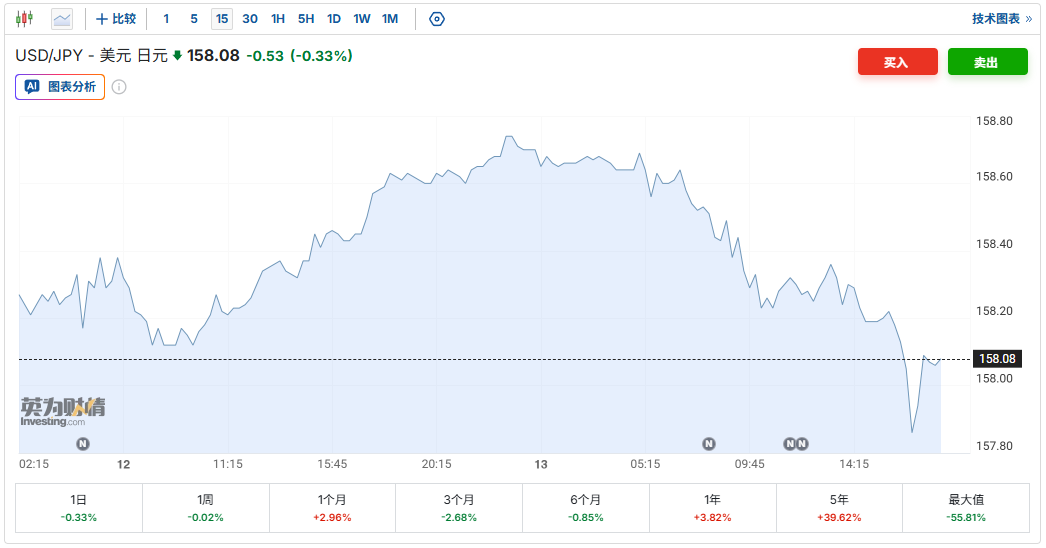
After the above news broke, the yen initially weakened, then recovered some of its losses. As of press release, the USD/JPY exchange rate declined slightly to 158.08.
The policy committee led by Bank of Japan Governor Kazuo Ueda raised borrowing costs to 1.25% last month to deal with the risk of rising inflation. The September rate hike was the second time in three months that the Bank of Japan raised interest rates. It was also the fastest rate hike since 1990.
Kazuo Ueda said that as the Bank of Japan enters a new policy phase that pays more attention to the risk of rising prices, this rate hike is reasonable. The interest rate hike also comes at a time when US Treasury Secretary Bezent continues to put pressure on the Bank of Japan to continue to normalize monetary policy and help strengthen the yen.
However, since 1980, the Bank of Japan has not raised interest rates for two consecutive months, which shows that the bank has long preferred to observe the impact of policy adjustments before deciding whether to take further action.
Prices in the overnight index swap market show that traders think the probability that the Bank of Japan will raise interest rates this month is about 10%, while the probability of raising interest rates as of December has risen to 88%. Among the economists surveyed last month, about one-third expected the Bank of Japan to raise interest rates in December, while more than half predicted that the Bank of Japan would wait until January next year before taking action.
At the end of last month, the probability of a market bet on the Bank of Japan's interest rate hike in October once rose to about 40%. However, as Federal Reserve officials sent clear signals, investors no longer expected the Federal Reserve to raise interest rates this month, and market expectations for the Bank of Japan's interest rate hike in October also weakened.
The Bank of Japan waits for the right time to raise interest rates again. Stable price trends are the key
People familiar with the matter said that the Japanese economy and inflation trends are generally in line with the Bank of Japan's expectations, and it is expected that the price trend within the next 18 months will at some point match the 2% inflation target.
Although the Bank of Japan can now consider the potential inflation rate to be around 2% after setting an inflation target for more than a decade in 2013, this does not mean that the bank has completed its mission. People familiar with the matter said that the Bank of Japan's goal is not only to achieve a 2% inflation rate, but more importantly to stabilize inflation around this level. Kazuo Ueda also spoke about this when he addressed the Diet on Tuesday. He said that it is essential to keep the price trend stable at around 2%.
The latest price data shows that Japan's inflationary pressure has not subsided. Japan's corporate price index rose 6.8% year on year in September, down from 7.6% in August — the slowdown in growth indicates that there is currently no urgent need for the Bank of Japan to take action; the import price index in yen rose 24.5% year on year, indicating that weak yen is still driving up import costs, and the Bank of Japan needs to determine the extent to which the increase in wholesale prices will spread to consumer prices.
Meanwhile, household inflation expectations also remain high. According to a survey released by the Bank of Japan, 88.6% of households expect prices to rise in the next year, down from 90.4% in the previous survey; the share of households that expect prices to rise in the next five years will rise to 86.5% from 86.1% in June.
People familiar with the matter said that with the potential inflation rate close to the Bank of Japan's target, the bank will continue to find the right time to raise interest rates again, while evaluating the impact of the rate hike so far. Furthermore, the Bank of Japan has promised to closely monitor the situation in the Middle East, artificial intelligence (AI) related needs, and changes in foreign exchange rates to determine the timing of interest rate hikes.
The Bank of Japan will release the latest quarterly economic outlook at the same time as announcing the interest rate decision on October 30. People familiar with the matter said that officials will evaluate the impact of high oil prices and consider whether it is necessary to include a temporary reduction in food consumption tax that has yet to be implemented in economic forecasts. Since the Bank of Japan prepared the latest quarterly economic forecast in late July, oil prices have risen by about 15%, increasing the inflationary pressure faced by Japan. Japan is highly dependent on natural resource imports and is therefore more vulnerable to rising energy prices.