


There was little fresh news early Tuesday morning, meaning algorithms had few triggers during the overnight session.
This allowed for some typical Turnaround Tuesday activity to be seen, a term that fittingly enough doesn't really mean anything.
Energies were lower across the board while Grains were mostly lower to start the day.
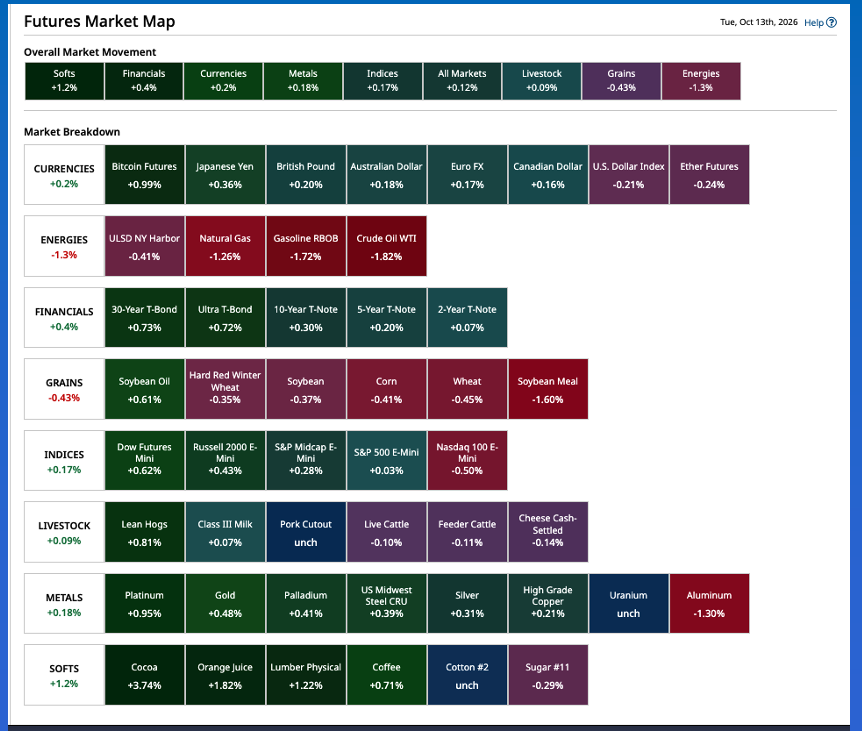
Morning Summary: My initial look across the commodity complex landscape pre-dawn Tuesday resulted in a one-word response, “Typical”. As in the overnight session looked to be nothing more than a little Typical Turnaround Tuesday activity[i]. As usual I started in the Financials sector, where this morning finds US Treasury futures higher meaning Treasury yields have inched lower, both slight Turnarounds from Monday’s close. The same could be said about the US dollar index as the greenback is showing red to start the second day of the trading week. Speaking of red, the Energies sector is lower across the board pre-dawn, though not by much. Spot-month diesel fuel (HOX26) is down 2.5 cents while WTI crude oil (CLX26) is off $1.82, generally erasing Monday’s closing gain of $1.85. Gold is getting in on the Turnaround theme early with the December contract (GCZ26) up $19.00 after settling $25.70 lower yesterday. I checked out the news, and found little of interest, which itself was interesting but fitting for what we see in commodities to start the day. The last thing I checked before diving into the Grains sector was Barchart’s Futures Market Heat Map which is nearly all green, except for the above-mentioned Energies and – you guessed it – Grains.
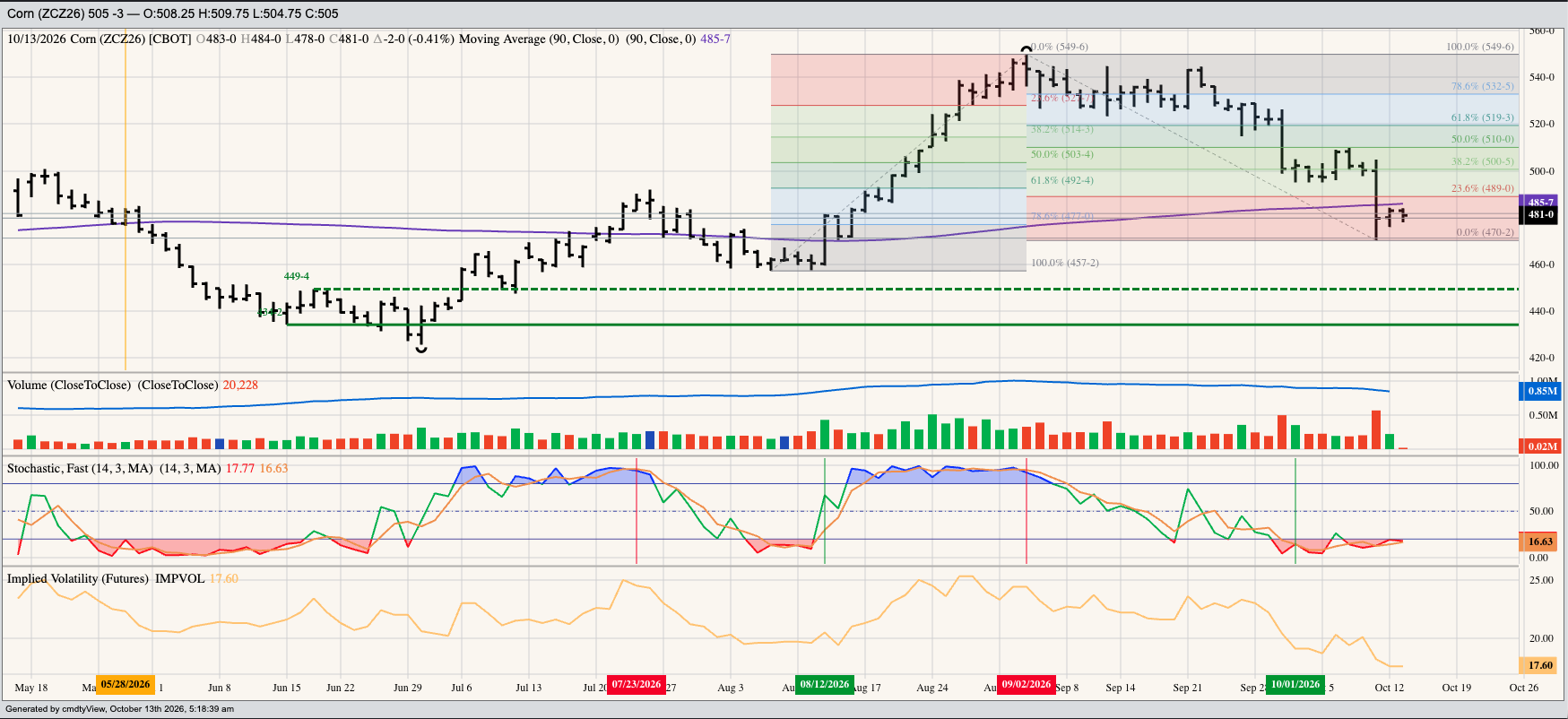
Corn: The corn market was indeed in the red at this writing. The December issue (ZCZ26) was down 2.0 cents after dropping as much as 5.0 cents overnight on trade volume of about 20,000 contracts. From a technical point of view, Dec26 is consolidating below its 90-day moving average after breaking below that statistic during last Friday’s limit-down meltdown. Before that, Dec26 had not closed below its 90-day since August 11. With REAL fundamentals not changing much as harvest rolls along, algorithm-trade will stay center stage for the time being. Given this, a couple other technical statistics are worth mentioning. Stochastics (a momentum statistic) remain below the oversold level of 20% on Dec corn’s daily chart while implied volatility is low at 17.6%. If Dec26 were to move above its 90-day moving average, combined with these other two statistics, it could trigger algorithms into short-term buying. As for fundamentals, and by that I mean REAL fundamentals, the Dec-March futures spread covered a neutral 47% calculated full commercial carry at Monday’s close as compared to last Friday’s 48% and the previous week’s settlement covering 45%. National average basis came in last night at 39.25 cents under December futures versus the previous 5-year low weekly close for this week of 40.5 cents under.
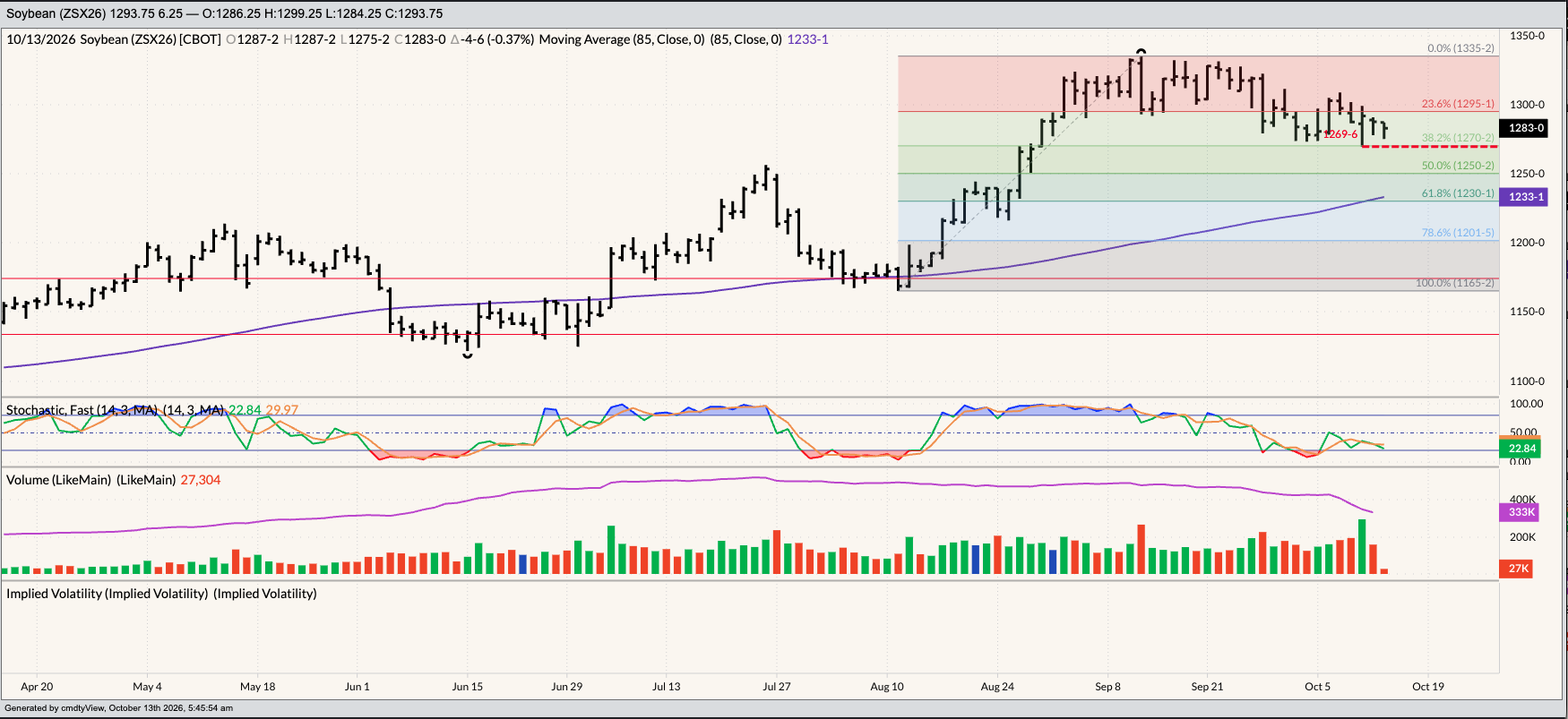
Soybeans: The oilseed sub-sector was split again with both canola and soybean oil in the green, despite the slight selloff in diesel fuel, while soybean meal and soybeans were in the red at this writing. What jumped out at me was what looked to be commercial selling in soybean meal. The Dec-January futures spread has moved into a solid inverse, adding $1.20 at Monday’s close, with the quote screen pre-dawn Tuesday showing Dec losing $0.80 to January. I’m not going to read much into this move at this time given overnight trade volume, with Dec showing 9,500 contracts traded and January fewer than 4,000 contracts changing hands. However, it will be something to keep an eye on as Tuesday’s session progresses. Over in soybeans, this is the final day of the Goldman Roll meaning the two sides of the market are now split with commercial interests still focusing on the November issue (ZSX26) while noncommercial traders are tracking January (ZSF27). Both were down 5.5 cents at this writing after both fell as much as 12.5 cents overnight. Technically, key prices for both are last Friday’s lows of $12.6975 and $12.8650 respectively. With 85-day moving averages still well below the market, a break of last Friday’s lows could be the sell trigger.
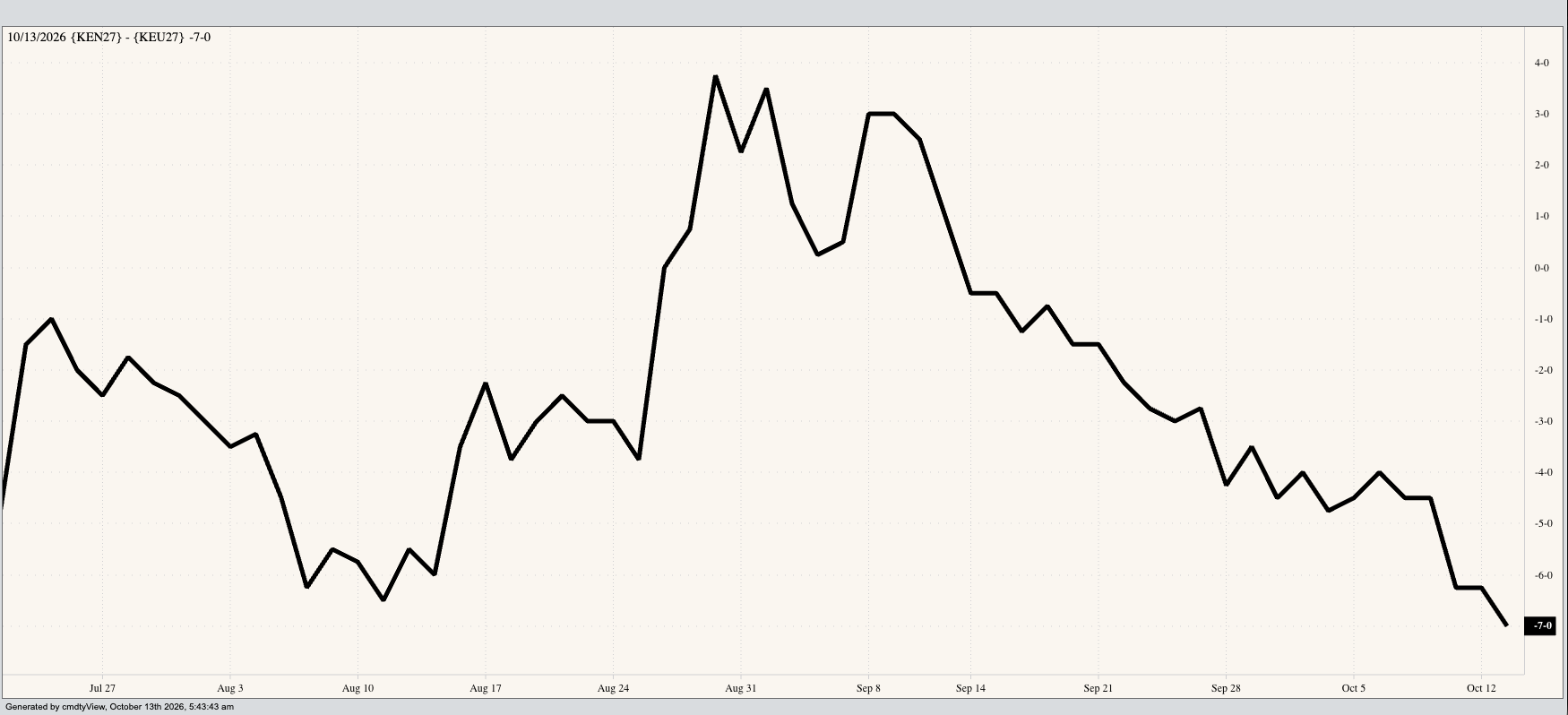
Wheat: The wheat sub-sector was in the red early Tuesday morning. Could this be considered Turnaround activity? Maybe, in the case of SRW, given it eked out a slightly higher close Monday. But it seems a bit of an exaggeration when things aren’t moving all that much. The December SRW issue (ZWZ26) dropped as much as 6.5 cents overnight and had trimmed its loss in half as of this writing, sitting 3.25 cents lower on relatively light trade volume of 7,500 contracts. Recall Dec finished Monday’s session with a gain of 1.25 cents after falling as much as 9.0 cents over the course of the day. Fundamentally, not much has changed with the Dec-March spread covering a neutral 57% calculated full commercial carry at yesterday’s close. However, as fall planting of US winter wheat crops that will be harvested next summer moves into the spotlight, we can spend more time looking at the July and September issues. Early Tuesday morning finds July SRW (ZWN27) down 3.75 cents after sliding as much as 6.25 cents overnight. Over in HRW we see the December issue (KEZ26) down 3.25 cents while July (KEN27) is off 3.0 cents. Here the focus is on the July-September futures spread where the carry continues to strengthen.
[i] With apologies to my late friend and long-time CBOT floor reporter Gary Wilhelmi, who despised that term.
On the date of publication, Darin Newsom did not have (either directly or indirectly) positions in any of the securities mentioned in this article. All information and data in this article is solely for informational purposes. For more information please view the Barchart Disclosure Policy here.