


Taiwan Semiconductor Manufacturing (TSM), or TSMC, is slated to report its third-quarter earnings on Oct. 15. The chipmaking giant, which controls roughly 73% of the global pure-play foundry market, is benefiting greatly from the AI boom.
Yet Q3 earnings will put its growth, margins, and spending plans under the spotlight, with investors looking for signs that demand for its advanced chips is still running strong.
AI Demand Remains the Central Growth Driver
TSMC supplies semiconductor manufacturing services to major technology companies, including Nvidia (NVDA), Apple (AAPL), AMD (AMD), Broadcom (AVGO), Qualcomm (QCOM), MediaTek, and Marvell Technology (MRVL). The list doesn’t end here. As of 2025, TSMC manufactured 12,682 products for 534 customers. As long as the business of its customers keeps expanding and is led by the AI boom, TSMC will keep growing too.
Furthermore, manufacturing the most advanced chips requires extraordinary precision, years of process development, and the ability to manufacture chips reliably at scale. TSMC has spent billions of dollars and has years of expertise in building and upgrading semiconductor factories. Competitors cannot quickly replicate TSMC's technology, manufacturing experience, or production capacity. This is why TSMC remains in a commanding position, with Samsung Foundry second at just 7% of the global foundry market.
The company has already set a high bar with a robust second quarter, as AI-related demand remained exceptionally strong, supported by cloud service providers and the growing need for computing power. Revenue increased by 37% year over year to $40.2 billion, while earnings per share rose by 77.4%. High-performance computing (HPC) contributed 66% to total revenue. Gross margin reached 67.7%, while operating margin came in at 60.3%, driven primarily by cost-reduction efforts and better capacity utilization.
For the third quarter, management expects revenue in the range of $44.6 billion to $45.8 billion. However, gross margin could be around 65% to 67%, as management expects the ramp-up of the 2-nanometer manufacturing technology to affect gross margin. Furthermore, overseas factory expansion may support future growth, but this is another factor weighing on profitability now.
During the Q2 earnings call, when asked about the future, CEO C.C. Wei mentioned the burgeoning agentic AI industry, in which AI systems can complete jobs through more independent, multistep processes. He believes that agentic AI can open up new options outside specialized AI accelerators. TSMC collaborates with clients utilizing several processing architectures, which may cause demand to spread over multiple categories of advanced silicon rather than relying on a single chip design.
A Bigger Investment Budget Signals Confidence but Raises the Stakes
Another important thing investors should watch out for in the third-quarter earnings is TSMC's investment plans. During the second-quarter call, management raised the full-year 2026 capital expenditure budget to between $60 billion and $64 billion, citing demand from customers and opportunities associated with AI and other computing trends. The company expects to direct 70% to 80% of its capital spending toward advanced manufacturing processes, while specialty technologies will receive about 10%. The remaining 10% to 20% will support advanced packaging, testing, mask production, and related operations.
This spending plan reflects a long-term bet on demand, but it could also put pressure on near-term cash flows and margins. New facilities and manufacturing processes require substantial investment before they can contribute meaningfully to revenue. Investors should therefore pay attention to management's comments about capacity expansion, customer commitments, and the expected pace of future investment.
What Does Wall Street Say About TSM Stock?
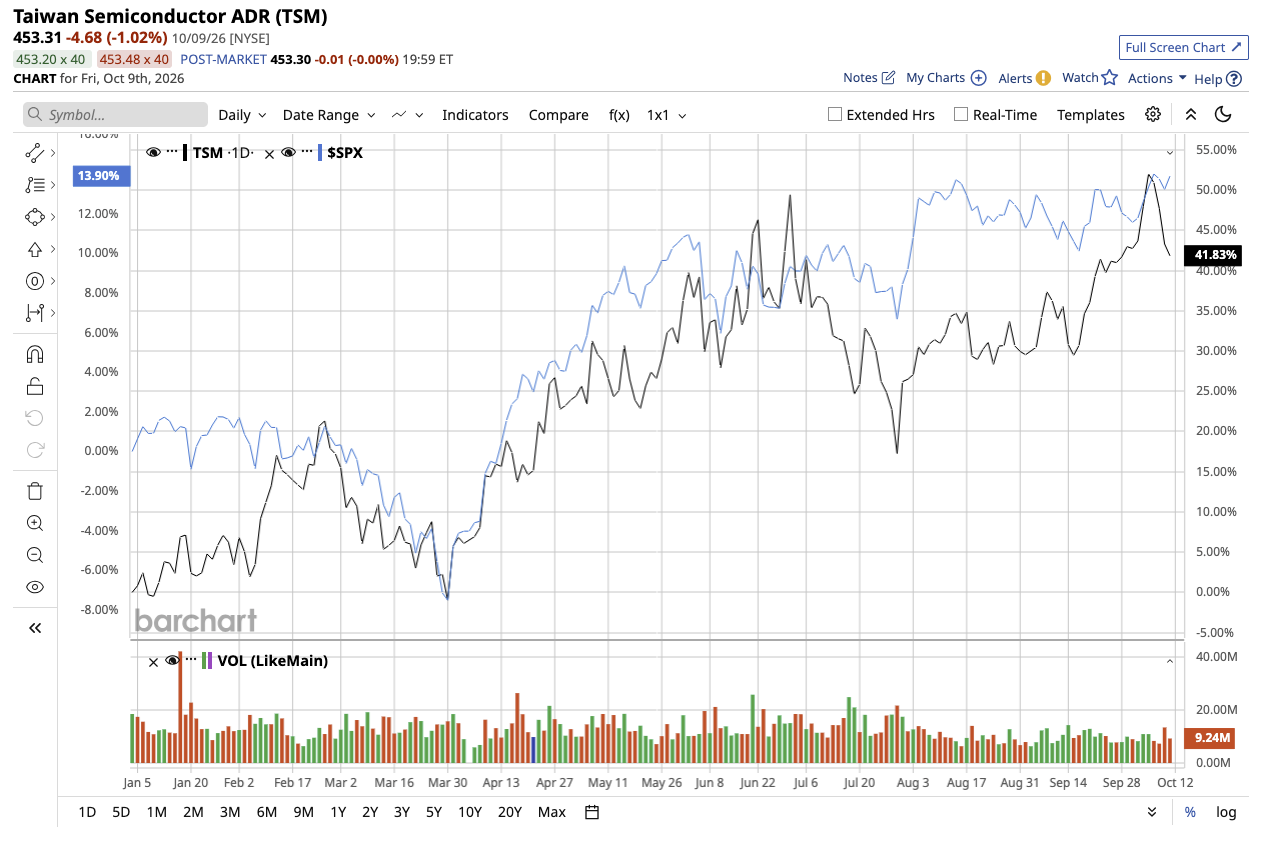
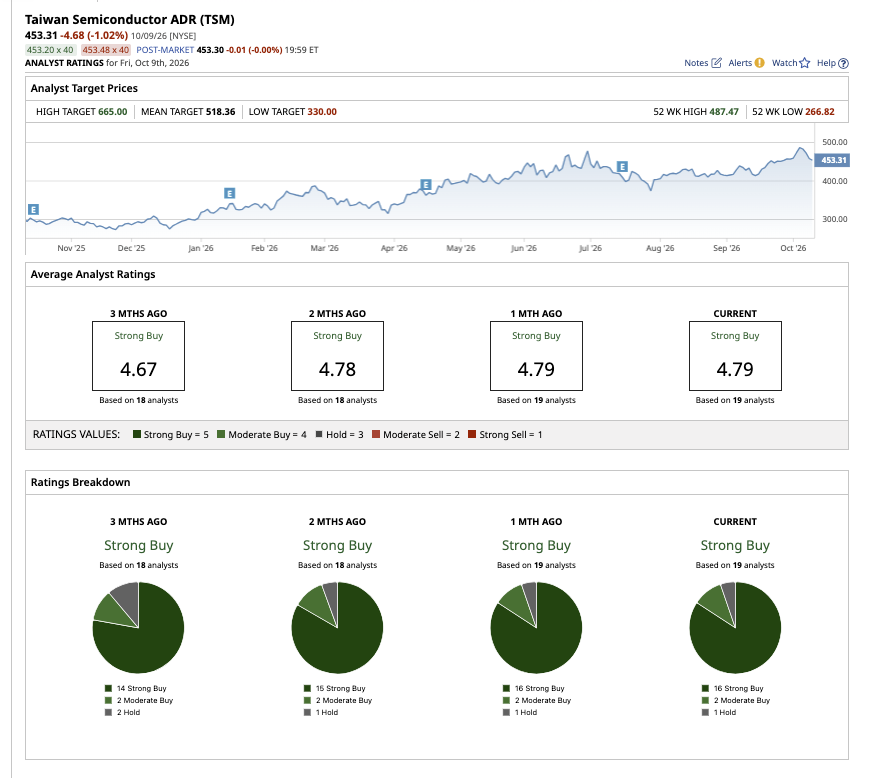
On Wall Street, TSMC holds a consensus “Strong Buy” rating. Out of 19 analysts with coverage, 16 rate TSM stock as a “Strong Buy,” two have a “Moderate Buy" rating, and one analyst offers a “Hold" rating. TSM stock has surged 41.8% year-to-date (YTD), outpacing the overall market's gain. The average price target of $518.36 suggests the stock can gain 14.3% from current levels. The high target price of $665 implies potential upside of 47% over the next 12 months.
On the date of publication, Sushree Mohanty did not have (either directly or indirectly) positions in any of the securities mentioned in this article. All information and data in this article is solely for informational purposes. For more information please view the Barchart Disclosure Policy here.