


Wall Street’s earnings season is officially underway, and the spotlight is quickly turning toward the financial sector, where a fresh batch of results could offer important clues about the health of the broader economy. Among the major banks taking center stage is Citigroup (C), which is set to unveil its fiscal 2026 third-quarter results before the opening bell on Tuesday, Oct. 13. Citigroup enters the report with plenty of momentum behind its stock.
Shares have delivered a strong performance over the past year, outperforming several of the bank’s peers as investors increasingly warm to the progress made under CEO Jane Fraser’s sweeping transformation strategy. The multiyear overhaul has focused on simplifying Citi’s sprawling operations, improving efficiency, sharpening its competitive position, and building a more streamlined financial institution. That transformation is now beginning to show up more clearly in the numbers.
Citi has delivered a string of encouraging financial results, and its strong second-quarter performance in July further strengthened the case that Fraser’s turnaround is gaining traction. With expectations rising, investors will be looking beyond the headline earnings figure this time around, paying close attention to whether the bank can sustain its momentum, improve profitability, and maintain the operational gains achieved through its restructuring efforts.
So, with Citi once again stepping into the earnings spotlight, let’s take a closer look at the stock.
About Citigroup Stock
Headquartered in New York City, Citigroup is a global banking and financial services institution with a strong presence across international markets. The company serves as a key banking partner for institutions with cross-border needs, while also maintaining a leading position in wealth management and a significant personal banking business in its home U.S. market.
Citi operates across more than 180 countries and jurisdictions, offering a broad range of financial products and services to corporations, governments, investors, institutions, and individual customers. Its client base includes approximately 19,000 institutional clients, with 85% of Fortune 500 companies counted among its customers. Beyond its core financial operations, Citi has also committed more than $1 trillion to environmental, social, and governance (ESG) initiatives.
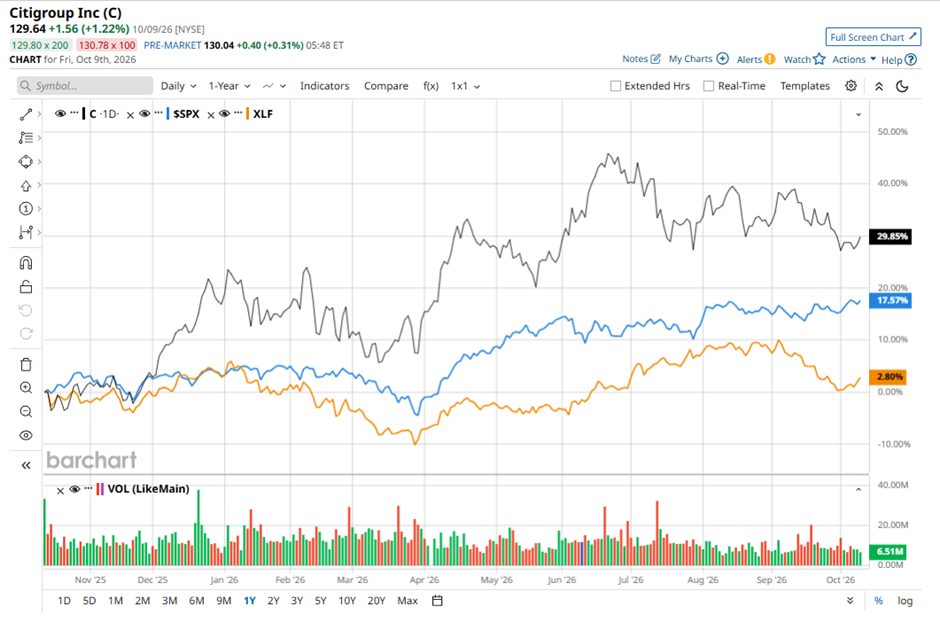
The company says it aims to play a meaningful role in addressing increasingly interconnected societal challenges by setting measurable goals and holding itself accountable for progress toward them. Citi has continued to stand out among its banking peers, with a market capitalization of roughly $217.46 billion. The stock has gained nearly 35.2% over the past year and is up 11.1% so far in 2026, maintaining a clear edge over the broader financial sector.
For context, the State Street Financial Select Sector SPDR ETF (XLF), which tracks major U.S. financial companies, is up 2.6% over the past year and has slipped marginally in 2026. Citi has also comfortably surpassed the S&P 500 Index’s ($SPX) 16% 12-month gain, although its 11.1% 2026 advance trails the benchmark’s 14.1% rise. The banking giant’s rally, however, has cooled from its recent highs. After reaching a 52-week peak of $147.96 on June 18, the stock has pulled back 12.4%.
Inside Citigroup’s Q2 Earnings Report
Citigroup came out of its second-quarter earnings with a powerful set of numbers, giving investors plenty to digest ahead of its next results. The bank reported net income of $5.8 billion, or $3.15 per diluted share, marking a 45% increase from the same quarter a year earlier and comfortably topping analysts’ estimate of $2.73 per share. Total revenue climbed 14% year over year to $24.77 billion, also surpassing the consensus estimate of $23.74 billion.
The strength extended well beyond the headline figures. Net interest income increased 13%, supported by growth across all five of Citi’s businesses as well as its Legacy Franchises. Meanwhile, non-interest revenue jumped 18%, helped by gains in All Other, Banking, Services, and Wealth, although those increases were partially offset by weaker results in U.S. Consumer Cards (USCC) and Markets.
CEO Jane Fraser underscored the breadth of the quarter’s performance, noting that Citi generated its highest quarterly revenue in a decade, with four of its five core operating segments posting double-digit revenue growth. Citi’s interconnected business lines provided much of the fuel behind that performance. Services delivered its highest-ever quarterly revenue, with average deposits rising 19% and cross-border transaction value expanding 13%.
Markets also benefited from strong performance in FX and spread products, highlighting the continued importance of Citi’s global network to its clients. Equities revenue surged 45%, adding another layer of momentum. The Banking division was yet another standout, with revenue rising 34%, while Citi participated in the majority of the top equity and debt issuances.
Investment banking revenue jumped 44% to $1.55 billion, driven by a 92% surge in equity capital markets revenue and a 65% increase in debt capital markets revenue. Wealth revenue rose 13%, marking its ninth consecutive quarter of growth, with nearly two-thirds of the increase in Net New Investment Assets coming from deeper relationships with existing clients.
Citi also continued to return capital to shareholders. The bank returned approximately $5 billion to common shareholders during the quarter through share repurchases and dividends, while announcing a $30 billion share buyback plan and a 12% increase in its dividend. Its return on tangible common equity reached 13%, landing at the upper end of the 11% to 13% target range for 2027 and 2028.
Looking ahead to fiscal 2026, Citi expects net interest income excluding Markets to increase approximately 5%-6%, while targeting an efficiency ratio of around 60%. The bank also expects share repurchases in 2026 to exceed 2025 levels, keeping capital returns firmly in focus as it continues to execute on its broader transformation strategy.
How Do Analysts View Citigroup Stock?
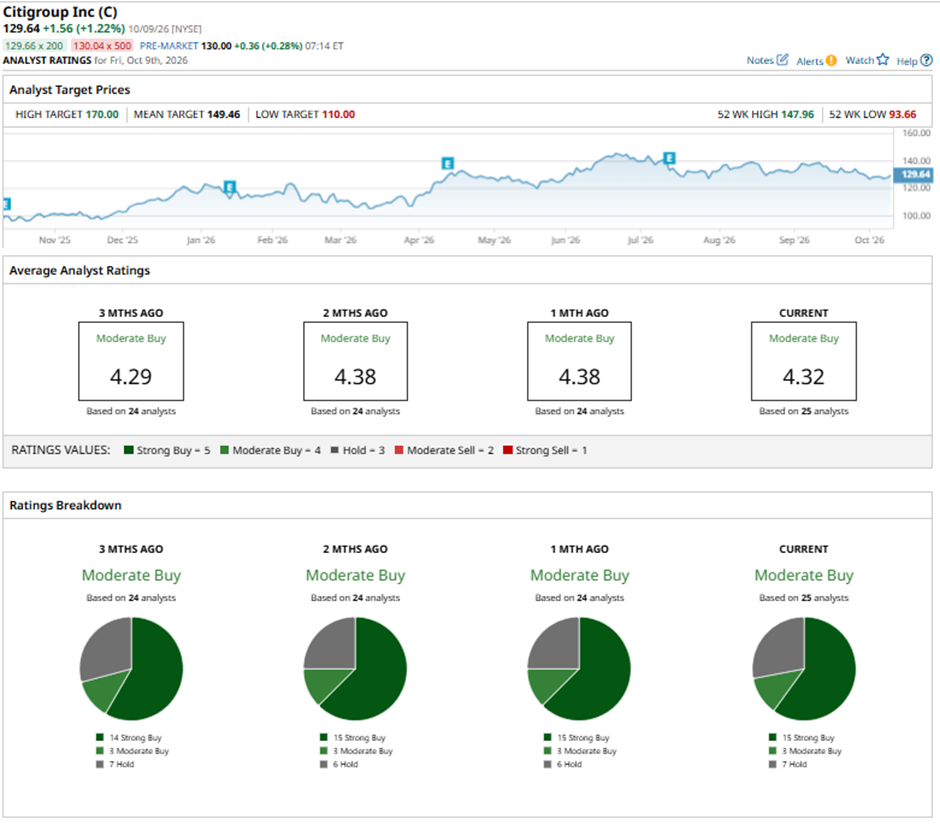
With Citi’s upcoming quarterly results on the horizon, Wall Street’s stance on the stock remains firmly constructive. The bank carries a consensus “Moderate Buy” rating based on recommendations from 25 analysts, including 15 “Strong Buy” calls and three “Moderate Buy” ratings, while seven analysts recommend “Hold.” The optimism is also reflected in the Street’s price targets. The average target of $149.46 points to roughly 15.2% upside from current levels, while the most bullish target of $170 implies potential gains of about 31%.
On the date of publication, Anushka Mukherji did not have (either directly or indirectly) positions in any of the securities mentioned in this article. All information and data in this article is solely for informational purposes. For more information please view the Barchart Disclosure Policy here.