


Something interesting is happening in tobacco stocks right now. Investors are warming up to the sector after spiking Treasury yields put the broader market in the red. Philip Morris International (PM) is right in the middle of that conversation.
The worry is simple. Higher interest rates can pressure dividend stocks because bonds suddenly offer real competition for income seekers. But tobacco stocks have a secret weapon. They generate huge cash flows today, not years from now. They don't need cheap financing to grow, and they have pricing power that helps offset inflation. So, the question is whether PM stock is a victim of rate anxiety or a hiding spot from it. The answer might surprise you.
PM stock offers an interesting case. Shares of Philip Morris International are up roughly 26% year-to-date (YTD) in 2026, supported by strong demand for smoke-free products. But at $202 per share, PM stock is approaching its 52-week high of $207.76, leaving investors to weigh its growth prospects against a less attractive dividend yield.
For dividend investors, that creates a difficult choice between locking in bond income and owning a business that can grow earnings over time.
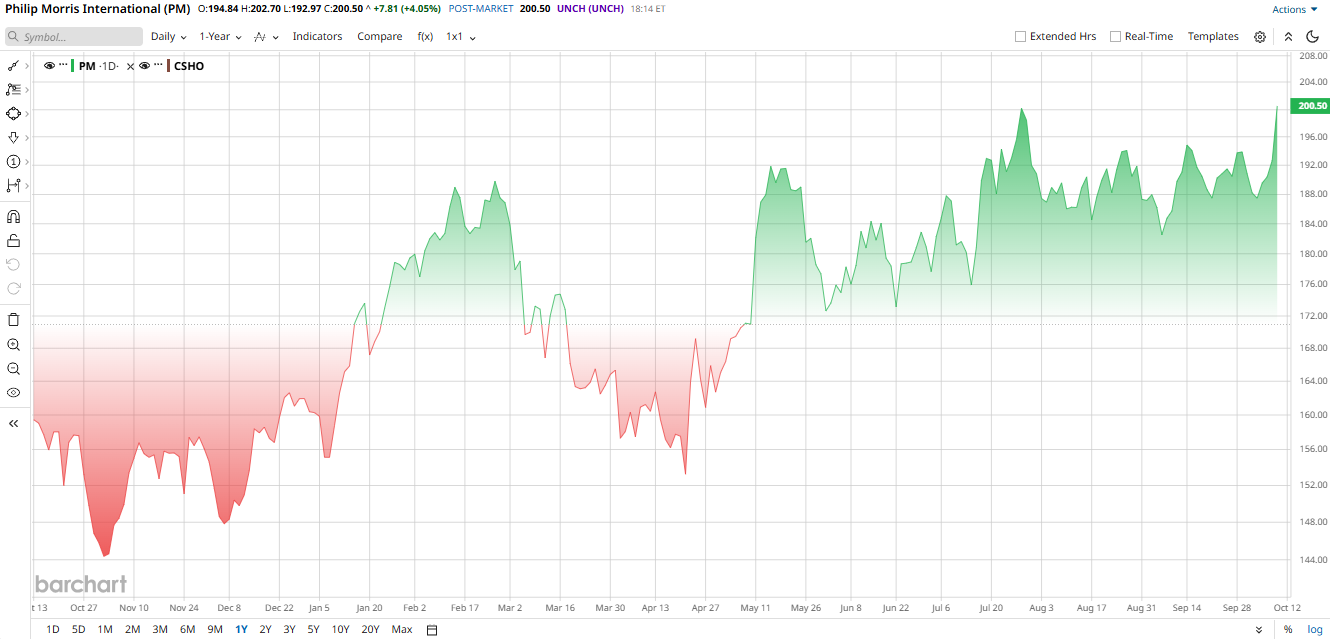
Rising Rates Put PM Stock to the Test
Stocks that pay a dividend may be less desirable when Treasury yields are higher, since there are other ways to earn income. PM stock now has a forward dividend yield of around 3.19%, which is below the 10-year Treasury bond yield of around 5.23%.
That difference matters. When an investor purchases a stock like PM stock, they are taking on the risk of a purchase and expect to receive dividends and the possibility of capital gains. Hence, a given company needs to grow earnings to justify its valuation.
Shares of Philip Morris International trade at roughly 24.7 times trailing earnings, which is close to the tobacco sector's median multiple of around 23 times. Its enterprise value-to-EBITDA multiple of approximately 18.3 times is also above the sector median of roughly 13 times.
However, Philip Morris has characteristics that could help it withstand higher financing costs. The company has strong cash generation, relatively low capital investments in comparison to many other growth firms, and allows its business to absorb some cost increases through pricing. Those benefits are not without the risk of interest-rate variability, but they do provide some flexibility.
Smoke-Free Growth Is Philip Morris International's Biggest Advantage
Philip Morris International's biggest virtue is its focus on taking the company beyond traditional cigarettes. In addition to its combustible tobacco sales business, the company has a growth opportunity through its IQOS heated-tobacco products and ZYN nicotine pouches, bringing it closer to diversifying its earnings.
The company's U.S. expansion recently benefited from a series of regulatory moves from the U.S. Food and Drug Administration (FDA). The FDA reportedly approved 20 ZYN variants as modified risk tobacco products and issued marketing authorizations for 11 ZYN ULTRA products earlier this year. Globally, IQOS is generating demand as well.
The second quarter of 2026 was a testament to the momentum. Revenue grew 10% year-over-year (YOY) to $11.2 billion, surpassing estimates of around $10.6 billion. Adjusted EPS rose 15% YOY to $2.20, beating the $2.05 estimate. Smoke-free revenue also grew nearly 12% YOY while adjusted operating income grew 12% to $4.8 billion.
CEO Jacek Olczak said the Q2 results were “outstanding” and pointed to the continued growth of the company's smoke-free enterprise. Management projects full-year organic sales growth of 5% to 7%, as well as adjusted EPS growth of 9.5% to 11.5% for 2026. That offers investors a more compelling earnings growth outlook relative to the dividend.
What Does Wall Street Think of PM Stock?
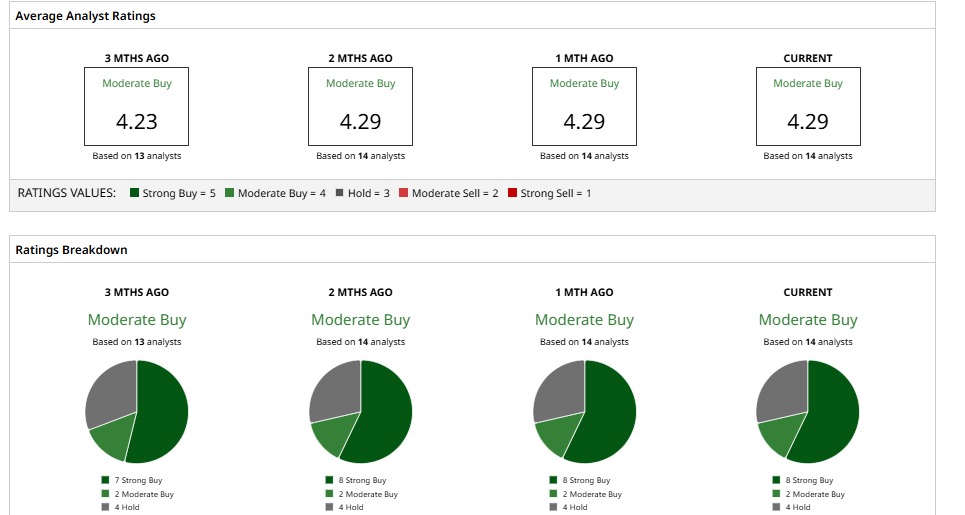
Overall, the outlook for Philip Morris remains fairly upbeat, albeit with more subdued gains based on the current stock price. PM stock has a consensus “Moderate Buy” rating on Wall Street based on 14 analysts with coverage. The average price target of $207.86 suggests potential upside of about 3% from current levels.
Both Citi and Barclays have a $225 price target on PM stock, while Goldman Sachs holds a $222 price target. Likewise, Stifel has a “Buy” rating and a $205 price target. However, UBS is less enthused, recently raising its price target for PM stock to $193 from $182 while maintaining a cautious outlook.
All told, in my view, Philip Morris International has more going for it than its dividend. Smoke-free products are fueling growth, profits continue to increase, and there is cash flow to sustain the business. But next to the high Treasury yield, PM stock doesn't necessarily appear to be a good steal while trading in the vicinity of its own highs. When it comes to the company's smoke-free transition, long-term investors should also consider whether the earnings growth is really worth the premium price tag as higher interest rates contend for their investment dollars.
On the date of publication, Nauman Khan did not have (either directly or indirectly) positions in any of the securities mentioned in this article. All information and data in this article is solely for informational purposes. For more information please view the Barchart Disclosure Policy here.