


The Zhitong Finance App learned that the nature of France's fiscal pressure is changing: it is no longer just a political problem in Paris, but has become a pricing issue for Eurozone assets. Blackstone Group President Jon Gray (Jon Gray) and Federal Reserve Governor Christopher Waller (Christopher Waller) announced on Tuesday that the Western government is facing a “liquidation”; on the same day, a Bank of America fund manager survey showed that the proportion of investors planning to under-allocate French stocks set a record.
“Liquidation” Is Coming: Grey and Waller's Same Judgment
Gray called the current situation “a bit like going through a liquidation.” He pointed out that the problem of Western governments' financial unsustainability has been reflected in rising bond yields in developed countries. In his view, large war-related spending, and investment in technology and AI have combined to create the perception that some countries are “running deficits at a level far higher than their inherent growth rate — and you would be worried that an impact could come at any time.”
Gray's judgment is clearly differentiated: the riskier ones are countries that are growing slowly and have huge deficits; while the US has a higher growth rate and still has large capital inflows to support investment in technology and AI, the risk is relatively low. “At the end of the day, America will face difficult choices, but I think right now this is more of a challenge for France, the United Kingdom, and mainland Europe,” he said. “Judging from past experience, these issues are often only addressed when crises occur. We saw this scene in Greece, and unfortunately now it feels like we are moving in that direction.”
Waller echoed this logic later in the same forum: America's higher growth rate, combined with capital inflows from other countries, should help the world's largest economy be protected from French-style fiscal difficulties. “Oh my god, the situation suddenly exploded,” he said.
Waller provided an actionable criterion: when rising bond yields are driven by inflation expectations and fiscal concerns (as in France), that is a problem; if driven by higher growth, that is a good thing. “If you're facing higher yields because of higher growth, that's a good thing for me; if it's because you're more afraid of inflation, that's not a good thing,” he said. As for the US, he believes there is no “fiscal dominance” — that is, a situation where monetary policy must be used to finance the government. “So far, at least for the US, we haven't reached that point.” He also pointed out that America's deficit concerns have not yet been reflected in the demand for treasury bond auctions.
Why is France a bullseye?
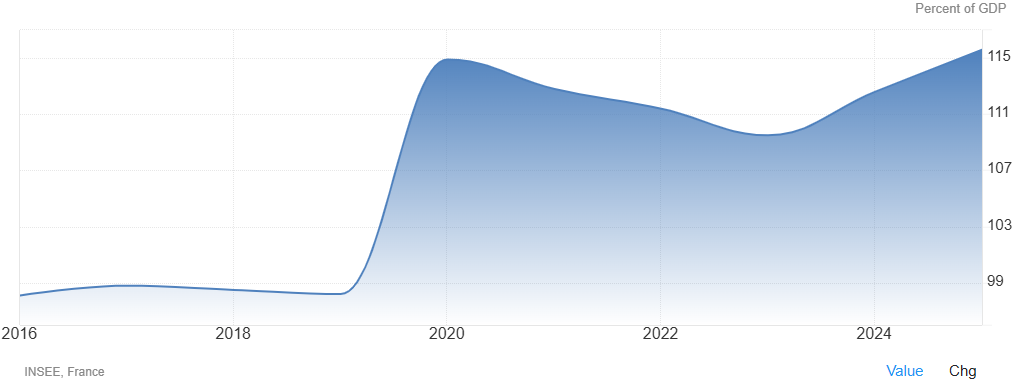
What Gray called the “French Challenge” is supported by specific figures. France's deficit is expected to reach 5.4% of GDP in 2026, and the 2027 target is still well above the EU's 3% reference limit; government debt has risen to 119% of GDP (second quarter 2026, a record, around 3.6 trillion euros), almost double that of Germany, and is expected to rise further to 121.7% in 2027.
French Prime Minister Sébastien Lecornu (Sébastien Lecornu) submitted a draft 2027 budget on October 1, which includes savings and tax increases of about 54 billion euros, but the plan assumes 1% economic growth — an assumption that the French financial watchdog says is “optimistic”; without introducing these savings, the deficit will approach 6.5%. The International Monetary Fund (IMF) is more pessimistic: if policies are not adjusted, the deficit rate could expand to 6.2% from 2027 to 2028 and remain above 6% until 2030.
Politics is the biggest discount on execution. After the 2024 legislative election, there was no majority in parliament, and five prime ministers were replaced within two years (Barnier stepped down in December 2024 and Beiro stepped down in September 2025); Le Corney used section 49.3 of the Constitution to bypass the vote and suspend the 2023 pension reform before barely passing the current year's budget in February 2026. The presidential election in April next year has further amplified uncertainty — recent polls suggest that the election could evolve into a second round of confrontation between far-right National Union Marine Le Pen (Marine Le Pen) and far-left Jean-Luc Mélenchon (Jean-Luc Mélenchon). Meanwhile, a nationwide protest against school funding by young French people is demanding an additional 10 billion euros.
The market is already pricing: from “core country” to “heterogeneous”
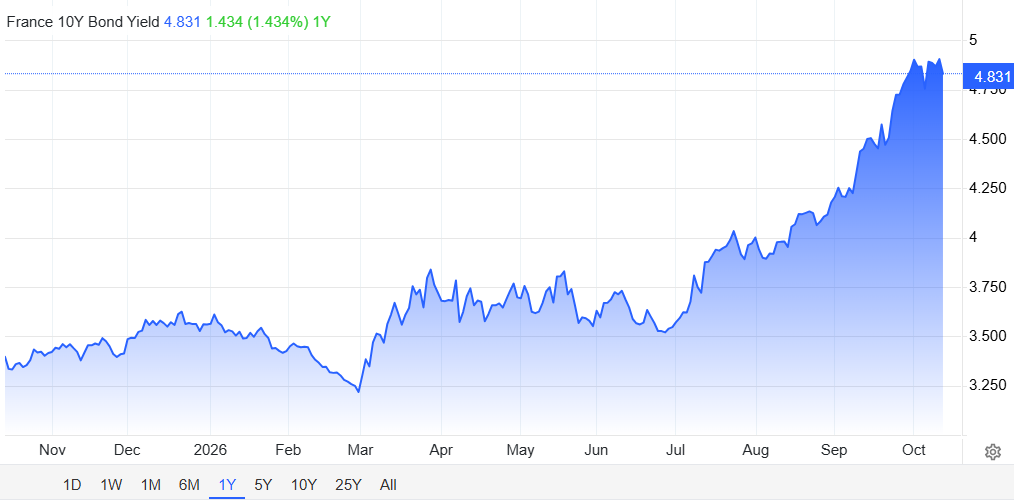
The bond market gave a clearer signal than the parliamentary debate. The yield on 10-year French treasury bonds recently rose to 4.91% to 4.92%, the highest since July 2002; the spread with German treasury bonds once exceeded 150 basis points, making it the widest since the 2012 Eurozone debt crisis. What is even more interesting is the “inverted rating”: France's sovereign rating is Moody's Aa3 (negative outlook), Fitch and S&P A+, which is significantly higher than Italy (Moody's Baa2), but the cost of borrowing money for France is now higher than Italy.
Equities are similarly aggressively priced. The French blue chip index CAC fell 3.8% in 40 years, while the pan-European benchmark Stoke Europe 600 index rose 7.8% over the same period. Selling pressure from the bond market and stock market was further transmitted to the exchange rate: the euro fell to 1.116 against the US dollar in early October, the weakest since May 2025, and was still above 1.20 at the beginning of the year. Speculative positions have reached the extreme — as of September 29, the US Commodity Futures Trading Commission (CFTC) data shows that as of September 29, the Euro short contracts reached 301,439, the highest number on record (around €38 billion); however, it is important to note that net Euros are actually only 63,256 lots, the lowest since April 2025 — the market is not bearish on either side, but rather crowded on both sides of the long and short sides.
Signs of contagion are beginning to appear but are limited: Italian 10-year treasury bond spreads rose from 102 basis points to 109 basis points on October 1, the biggest single-day jump since 2020; Greek interest spreads also rose at the same time. The Bank of America estimates that for every 10 basis points of increase in the French and German spread, the euro falls by about 0.4% against the US dollar; Goldman Sachs points out that the impact of interest spreads on the euro during normal periods is close to zero, but it will increase significantly when the market is under severe pressure. Furthermore, French treasury bonds account for about a quarter of the Morningstar Eurozone Treasury Bond Index (Morningstar Eurozone Treasury Bond Index), and weigh more than Italian treasury bonds and German treasury bonds — this means that European savers with “safe” Eurozone government bond funds or default pension options have a greater risk exposure to Paris than to Berlin.
Connecting to the main lines of the global bond market: AI debt and “money grabbing”
France's plight is not isolated. The bond market is being driven by three forces simultaneously: geopolitical conflicts driving up energy prices, rising inflation expectations, and long-term capital requirements for AI infrastructure — governments and tech giants are competing head-on for capital in the long-term capital market.
Former British Prime Minister Rishi Sunak (Rishi Sunak) made an amazing judgment at the same forum: AI will drive a record scale of financing, and technology companies are expected to become the largest issuers of long-term bonds next year. “The net issuance of such bonds by technology companies will surpass that of the US government,” he said. This is in line with the IMF's previous warning in the Financial Stability Report — AI-related debt issuance has jumped from less than 1% of global investment-grade issuance to an important share of about 10%, and is squeezing the financing space for sovereign bonds.
As a result, the ECB's situation is even more difficult. Although France is under pressure, it does not meet the condition that “there is no fundamental basis for widening interest spreads” — France is in the EU's excess deficit process, making it difficult to use the ECB's Transmission Protection Tool (TPI); the ECB Governing Council will meet on October 29. In terms of ratings, the market is awaiting two key dates: Moody's October 23 (Aa3, the outlook is negative, which means there is a greater probability of a downgrade) and S&P's November 27 assessment.
The other half of the round table: AI governance and the battle for employment
In the same discussion, AI was not only the “greatest survival risk” (in Grey's words, he emphasized that it “slowly evolves” and “will force people to make very difficult choices”), but also the focus of the governance and employment debate. Former US Secretary of Commerce Gina Raimondo (Gina Raimondo) said that what she is more concerned about is the governance challenge. “We need to establish a governance framework with the same urgency and intensity of AI researchers when developing technology.”
N. Chandrasekaran (N. Chandrasekaran), chairman of Tata Sons (Tata Sons), is concerned about the malicious use of AI and the restructuring of the workforce in the short term, but believes “it will be extremely powerful” in the medium to long term. Infosys Chairman Nandan Nilekani (Nandan Nilekani) bluntly stated that “AI will replace a large number of human jobs” is “nonsense,” and he expects technology to activate small businesses and spawn new skill requirements. Speaking at the forum, Indian Prime Minister Narendra Modi said that technology is transforming various industries in India, and the country already has more than 2,000 global competency centers serving international companies.
Bank of America Survey: Record “Voting with Your Feet”
Institutional investors' attitudes are quantified by Bank of America's monthly surveys. The survey covered regional fund managers and was conducted from October 2 to 8. The results showed that 56% of respondents plan to undersell French stocks over the next 12 months — making France the least popular market in Europe. A higher percentage of respondents (net 63%) believe that “French fiscal sustainability and the 2027 election cycle” is the biggest political risk in the European market in the coming year. The Bank of America team (including Paulina Strzelinska and Sebastian Raedler) wrote this conclusion into the client report.
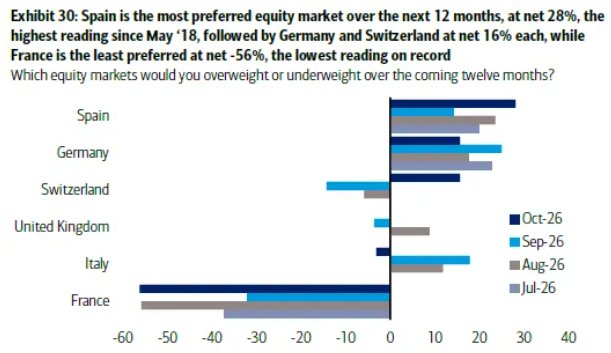
Notably, Raedler himself on the team is more optimistic: he upgraded the French stock rating to “overrated” last week, citing limited room for further upside due to the French spread. This disagreement just shows that current pricing has taken into account a significant degree of political risk.
Institutional views
Judgments about France itself are still divided. Stéphane Colliac (Stéphane Colliac), a senior economist at BNP Paribas, believes that France is not facing a debt crisis because the actual cost of interest payments on France's debt is only around 2%, which is significantly lower than the rising market yield; however, he also pointed out that France failed to meet the budget target for 3 out of 4 years from 2023 to 2026.
Furthermore, Gian Marco Salcioli (Gian Marco Salcioli) of Italy's Bank of San Paolo suggested that such widening interest spreads “tend to turn interest rate risk into a broader risk,” that is, credit risk. Nicolas Forest (Nicolas Forest), chief investment officer of Belgian asset management firm Candriam, put it more bluntly: France “has reached a level close to the European debt crisis.” Fitch, on the other hand, listed “continued political divisions” as France's key weakness.