


At first glance, circumstances don’t look appealing for aeronautics giant Boeing (BA). While it may be a titan of industry, BA stock has been blasted with a 100% Strong Sell rating by the Barchart Technical Opinion indicator. Ahead of its Oct. 27 earnings disclosure, the company has plenty to prove. Still, if you’re a half-glass-full type, Boeing just might be among the more intriguing contrarian ideas.
First, there is a technical case to be made. While it’s true that BA stock represents one of the key laggards among major publicly traded enterprises, the rate of negativity appears to be fading. In the trailing six months, Boeing slipped about 15%. In the past 30 days, it fell nearly 10%. However, in the trailing week, the ticker is up roughly 1%.
It’s possible, then, that we could be in the early stages of a transition — a transition from an extremely bearish state to a more optimistic one. This point segues into the core quantitative argument for Boeing stock.
As you know, equity valuations are usually never static — they constantly fluctuate due to robust negotiations between bulls and bears. Sometimes, there are periods when order flows are heavily biased toward one side. When such acute behavioral states materialize, there may be added pressure to rebalance sentiment.
However, during this course of mean reversion, equities rarely seem to reach equilibrium in an orderly fashion. Instead, what we often witness are volatility spikes, resulting in sharp movements before stabilization. Personally, I'm convinced that there’s a higher probability of such a response from Boeing stock.
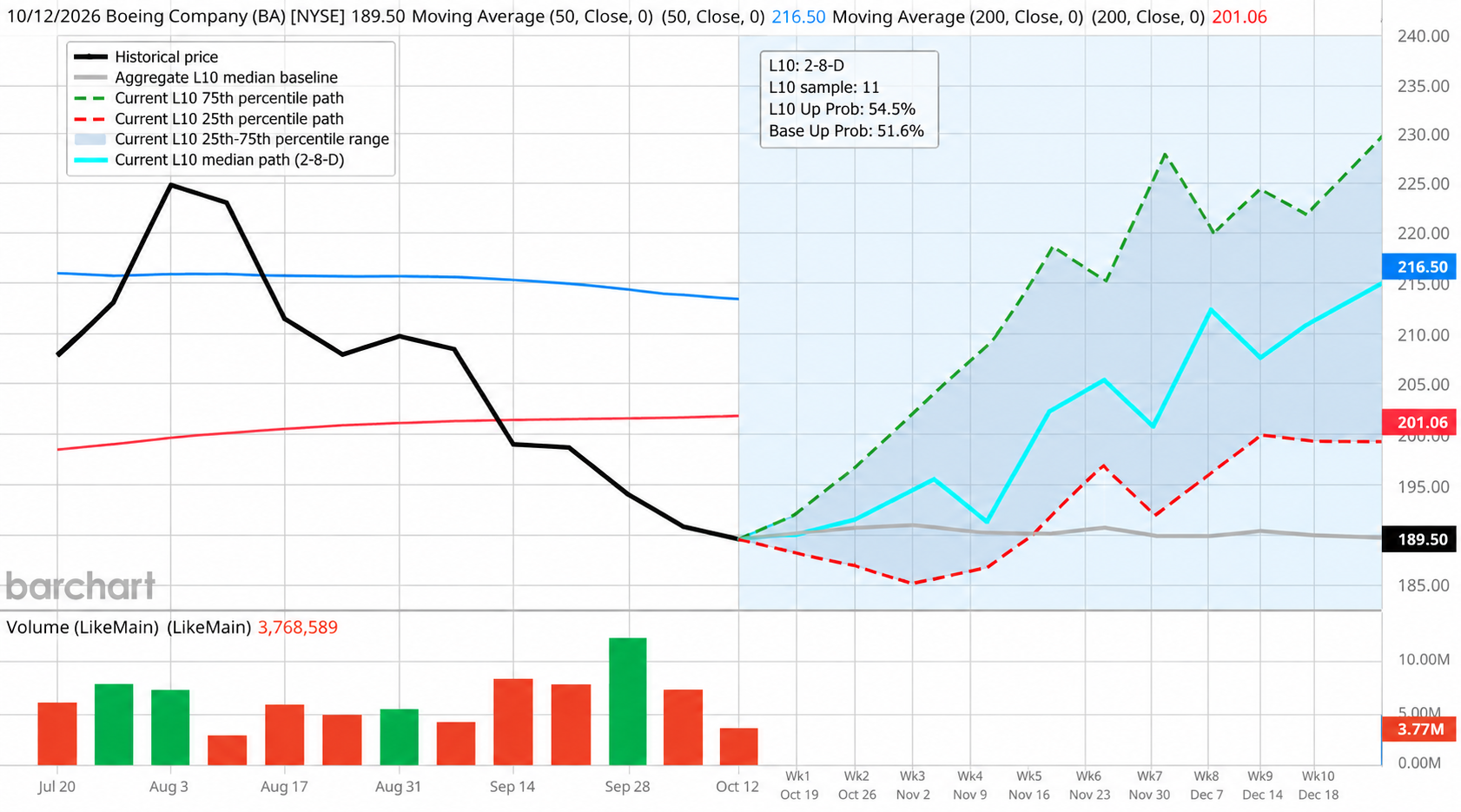
Right now, the state is uniquely bearish, with only two of the last 10 weekly candlesticks resulting in net positive price action. Historically, we know that under this sequence, BA stock tends to swing higher, enough so that the 200/205 bull call spread expiring Dec. 18 might be realistically in play.
Why the $205 Strike is Enticing for BA Stock
When looking at the various strike selections for the December monthly chain, the $205 second-leg strike price may seem like an odd choice. Boeing stock is currently priced at $189.50. Using the logic of technical analysis, many experts would surely argue that the $200 price level represents a psychologically attractive, round-number target.
What also seemingly elevates the case for the $200 strike is that it’s the lowest strike possible among bullish vertical spreads that facilitates a triple-digit payout. Specifically, the 195/200 bull spread offers a maximum payout of over 108%. While it’s not as attractive as the 163.16% payout offered by the 200/205 spread, the probability of overall success is also higher.
With the $205 second leg, the probability of profit (breakeven) lands at 33.1%, whereas the probability of full profitability is 28.32%. In contrast, the $200 leg offers a PoP of 38.9% and a full-profit probability of 34.39%. Therefore, one might assume that the $200 leg is the more conservative wager and the $205 is the more aggressive.
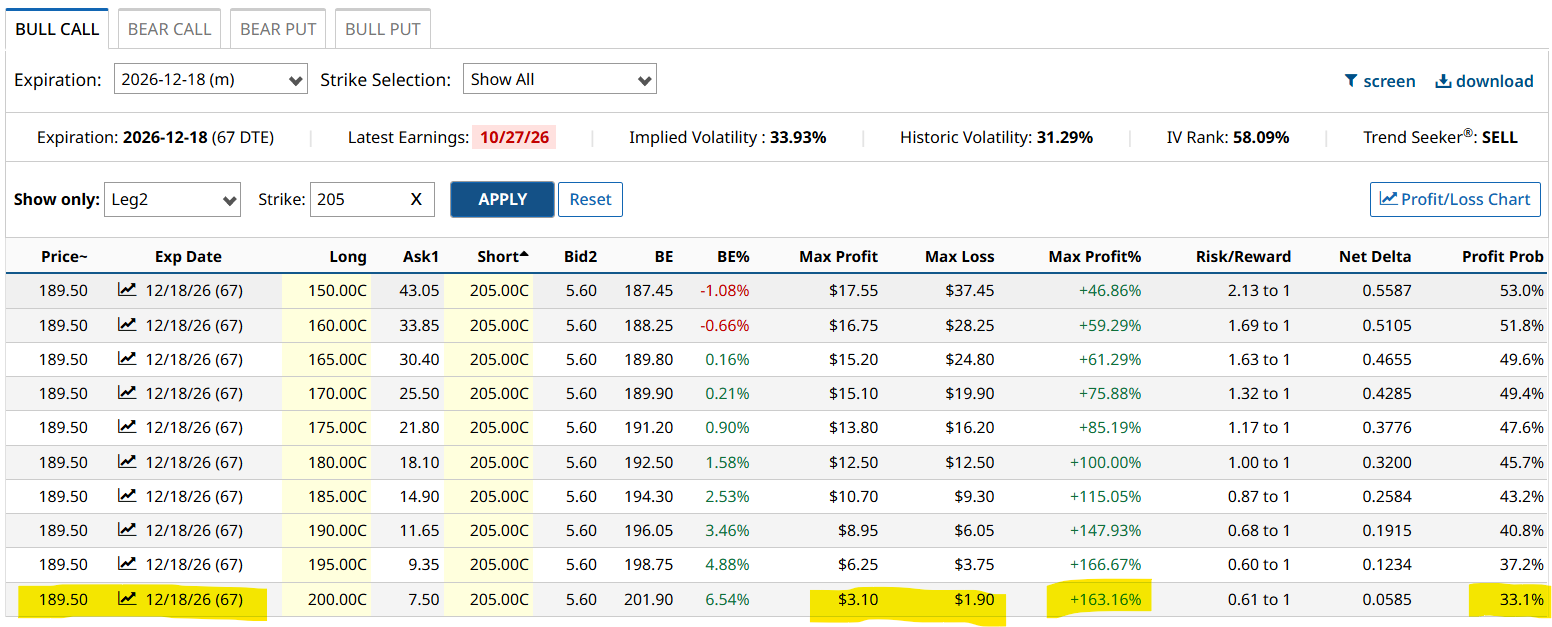
These two trades could be framed that way. However, it’s mathematically more efficient to select the $205 given the defined parameters. If you plug the necessary metrics into an expected value (EV) calculator, you’ll discover that the $205 leg has an expected return on capital (ROC) of -25.46%, whereas the $200 leg has an ROC of -28.37%.
Even if the net debit of the $200 leg was dropped to $190 — thus matching that of the $205 leg — the ROC would be little changed. The probabilistically riskier trade would still have a better expected return. Therefore, from a risk-management perspective, a higher probability alone does not necessarily make a trade better.
How much you’re getting offered for accepting the risk also plays heavily into the equation. This changes the strategy on how we need to approach BA stock.
Changing Probability Over Payouts
In an ideal world, we would attempt to convince the market to give us a higher payout for the same amount of risk. Of course, Wall Street is not in the business of giving out free lunches — and such types of outright mispricings are extremely rare, if not nonexistent. Subsequently, the only thing that we can change is the probability of the trade.
Immediately, the concept sounds absurd but it really isn’t. Payouts ultimately represent a derivative of the share price, which is an observable event. Therefore, the market will determine what the payout of a BA stock debit spread will maximally generate. It’s out of your individual control.
Probability, though, is a different animal. There is no such thing as a universal or epistemologically neutral probability. Instead, this mathematical discipline rests on some assumption or framework. And that’s also where the potential opportunity may lie.
When it comes to the probabilities of Boeing stock hitting the desired strike targets for the December monthly chain, these calculations are made assuming that BA will undergo a random walk between now and the expiration date. So, if the equity indeed responds randomly, the given odds simply reflect the mathematical distribution of randomness.
The meta question you need to ask, though, is this: how sure are you that BA stock will trade randomly?
History Suggests a Nonrandom Walk for Boeing Stock
Remember the extreme bearish state of BA stock, that it printed only two up weeks in the course of the last 10 weeks? This particular state has only materialized a total of 11 times on a rolling basis since January 2019. Yes, that’s a wildly small sample size but it also means that such a quantitative condition is a very rare event.
To me, the question isn’t so much about the current bearish state of Boeing stock. Everybody knows it’s a terrible name. Rather, it’s what typically happens after this quant signal flashes in the chart. Does BA tend to fall further into the abyss or does it bounce back?
History is not guaranteed to repeat — that’s the obvious risk factor in going contrarian on BA stock. But if it rhymes, there’s reason to believe that the 200/205 bull spread expiring Dec. 18 could be in play. Based on the available data, there’s a 50% to 64% chance that Boeing triggers the $205 strike on expiration.
On the date of publication, Josh Enomoto did not have (either directly or indirectly) positions in any of the securities mentioned in this article. All information and data in this article is solely for informational purposes. For more information please view the Barchart Disclosure Policy here.