


AST SpaceMobile (ASTS) found itself in investors’ crosshairs on Friday, with shares plunging as much as 10.5% on Oct. 9 after SpaceX (SPCX) struck a deal that raised fresh questions about competition in the satellite communications market. Elon Musk’s company agreed to acquire Grain Management’s nationwide portfolio of 800 MHz spectrum, a set of low-band frequencies that AST SpaceMobile had also been pursuing.
Grain Management is a privately held spectrum owner, and while the acquisition’s financial terms remain undisclosed, the deal must still clear Federal Communications Commission (FCC) approval. Even so, the announcement was enough to rattle ASTS investors and spark a sharp selloff. Deutsche Bank, however, sees the pullback as an opportunity rather than a warning sign. On Monday, the firm upgraded AST SpaceMobile to “Buy” from “Hold,” with analyst Bryan Kraft keeping his $93 price target unchanged.
Kraft believes the recent share-price weakness offers an “opportune time” to turn bullish, pointing to an improving growth outlook and several positive developments that he says have “gone under the radar.” More importantly, Deutsche Bank challenged the market’s assumption that SpaceX’s spectrum acquisition puts AST SpaceMobile at a competitive disadvantage.
The firm argued that the deal would not strengthen SpaceX’s standing as a satellite partner for traditional telecom operators relative to AST SpaceMobile. It also highlighted a potential shift in the competitive landscape. The firm sees the potential for T-Mobile (TMUS) to eventually replace SpaceX’s Starlink with AST SpaceMobile for its direct-to-device satellite services. So, with Deutsche Bank seeing opportunity where investors see risk, here’s a closer look at ASTS stock.
About AST SpaceMobile Stock
Headquartered in Midland, Texas, AST SpaceMobile is a satellite communications company focused on developing space-based cellular broadband technology. Its planned network uses satellites in Low Earth Orbit (LEO) to connect directly with standard smartphones, with the aim of extending cellular coverage beyond the reach of traditional ground-based infrastructure.
The company works with mobile network operators to integrate satellite connectivity with existing cellular services. Its business model centers on building and operating the satellite network while collaborating with telecom partners to deliver connectivity to their subscribers. It maintains partnerships with more than 50 mobile network operators, including AT&T (T), Verizon Communications (VZ), and Vodafone (VOD).
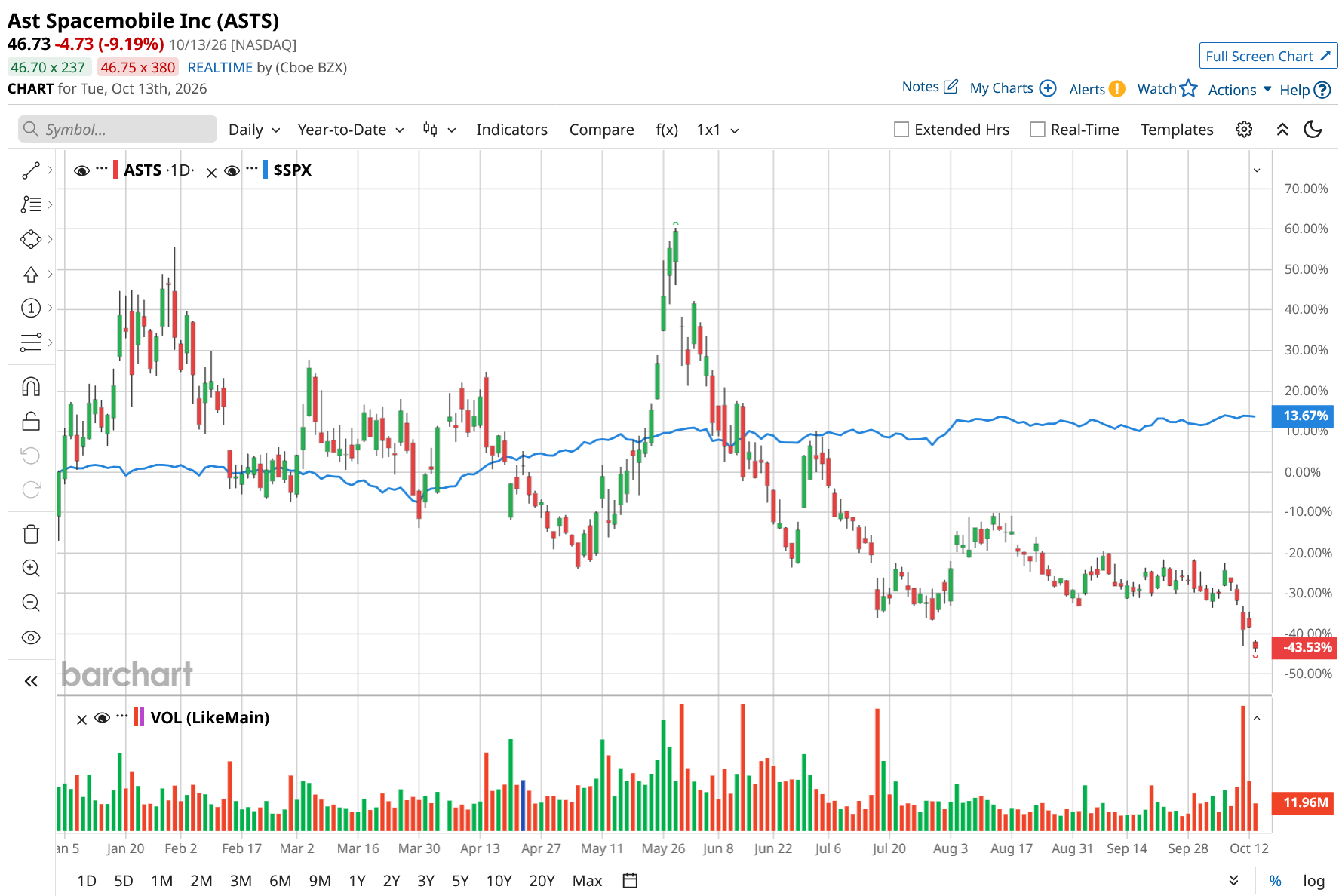
With a market capitalization of roughly $20.03 billion, AST SpaceMobile has had a rocky run, weighed down by heavy cash burn, valuation concerns, operational setbacks, and mounting competition from SpaceX. The stock has tumbled 65% from its 52-week high of $133.86, reached on May 28, as investor optimism has given way to growing concerns over its growth trajectory and competitive position.
The selloff has also left ASTS trailing the broader market by a wide margin. After another rough morning of trading today, down another 9% as of this writing, shares have now plunged almost 48% over the past year and are down another 36% in 2026. ASTS has sharply been underperforming the broader S&P 500 Index’s ($SPX) respective gains of 17% over the past 12 months and 14% year-to-date (YTD).
Inside the Q2 Earnings Report
AST SpaceMobile’s second-quarter 2026 results delivered a mixed financial picture, with revenue surging significantly but falling short of Wall Street expectations. Revenue reached $31.52 million, a substantial increase from the year-ago quarter’s $1.16 million, driven by gateway deliveries and the achievement of U.S. Government milestones. However, the figure missed analysts’ consensus estimate of $33.86 million. The bottom line also came under pressure, with the company reporting a loss of $0.77 per share, wider than the $0.41-per-share loss recorded in the same quarter last year.
On the operational front, AST SpaceMobile made progress in expanding its satellite constellation and advancing its deployment pipeline. Following the successful deployment of BlueBirds 11 through 13, the company’s orbital constellation grew to 13 spacecraft, underscoring its advancing capabilities in building and launching large commercial phased arrays. Meanwhile, the next batch, BlueBirds 14 through 16, reached the final testing and assembly stages, while component manufacturing extended further down the pipeline through BlueBird 46.
On the ground, the company continued building out the infrastructure needed to support its satellite network, establishing nearly 50 global gateway sites to facilitate seamless integration with partner mobile networks. AST SpaceMobile also strengthened its liquidity position, giving it substantial financial resources to support its ambitious deployment plans. As of June 30, 2026, the company reported approximately $3.7 billion in pro forma cash, cash equivalents, and restricted cash, while its balance sheet held around $2.7 billion in cash and restricted cash at quarter-end.
The financial cushion grew further in July 2026, when the company raised $1.15 billion in gross proceeds through an offering of convertible senior notes. Looking ahead, management remains on track to achieve its full-year 2026 revenue guidance of $150 million to $200 million, supported by additional contract awards from the U.S. government. Adding to its longer-term revenue visibility, AST SpaceMobile’s revenue backlog climbed to approximately $1.30 billion in aggregate contracted revenue from commercial partners and contract awards with the USG.
Wall Street’s Consensus Opinion on ASTS Stock
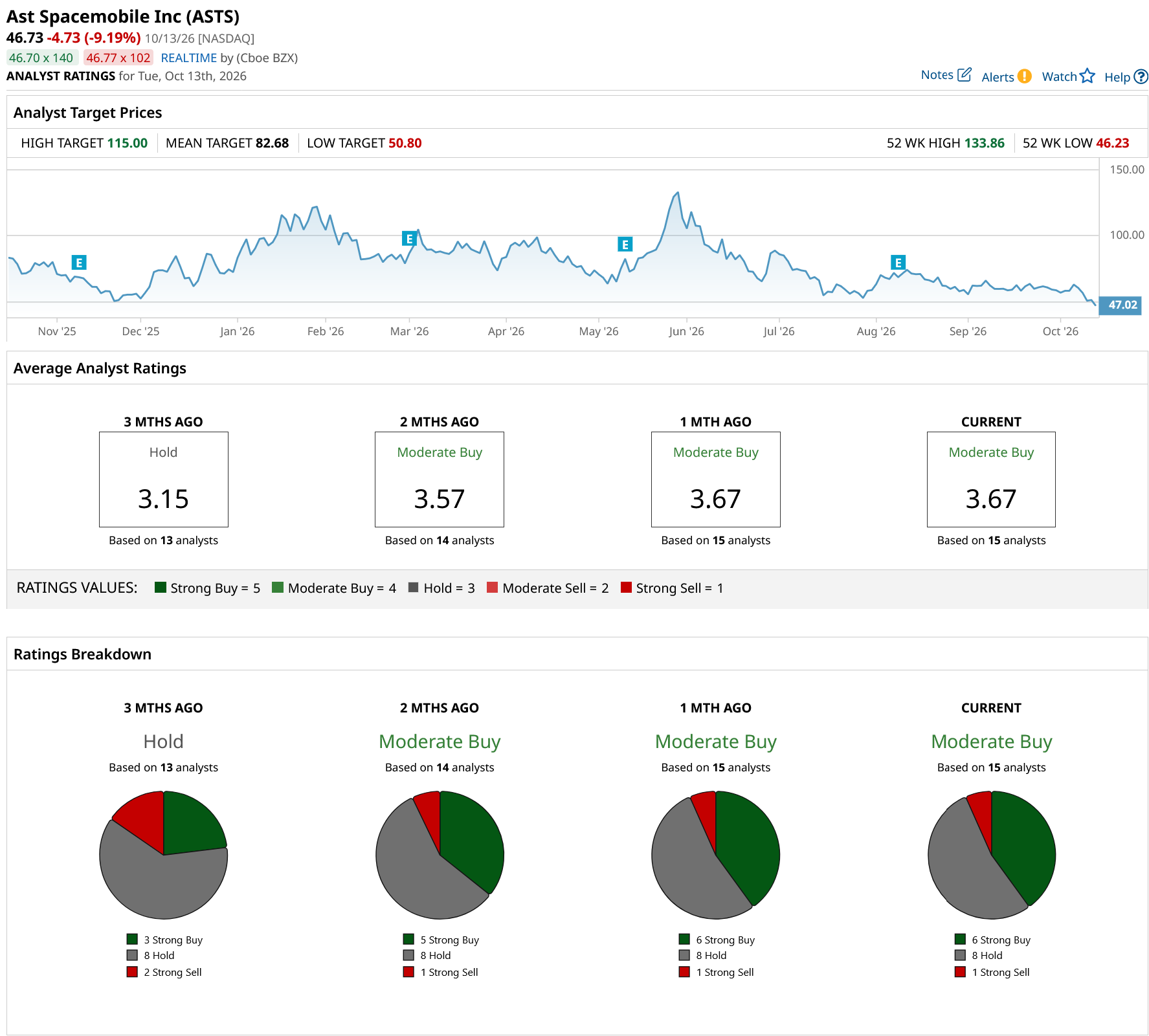
Despite ASTS stock’s steep decline, Wall Street still sees substantial upside ahead. The stock carries a consensus “Moderate Buy” rating, with six of the 15 analysts covering it recommending “Strong Buy,” eight opting for “Hold,” and just one issuing a “Strong Sell.” The average price target of $82.68 points to a potential rally of 77% from current levels, while the Street-high target of $115 signals a possible upside of 146%, suggesting analysts believe the beaten-down stock could have significant room to rebound.
On the date of publication, Anushka Mukherji did not have (either directly or indirectly) positions in any of the securities mentioned in this article. All information and data in this article is solely for informational purposes. For more information please view the Barchart Disclosure Policy here.