


ChangXin Memory Technologies (CXMT), China's largest memory chipmaker by valuation, ignited a sweeping global semiconductor selloff after its president revealed at a Shanghai industry conference that the company had achieved significant progress on a compact 4F² DRAM cell architecture — a design that reportedly boosts memory density by roughly one-third — and plans to launch DDR5 server memory modules before the end of 2026, a timeline arriving approximately two years ahead of Samsung Electronics' publicly stated roadmap for the same technology.
Micron Takes the Hardest Hit
Micron Technology (MU) bore the most direct impact, falling roughly 4% on Monday and extending losses by a similar magnitude on Tuesday to trade near $940 — still up more than 228% year to date — while SK Hynix (SKHY) plunged over 10% in Seoul and Samsung Electronics dropped 7.4%, illustrating how tightly the market trades memory names as a single group.
MU has now broken below its 50-day simple moving average, as well as the major exponential moving averages that underlined the stock’s high-velocity rally earlier this year.
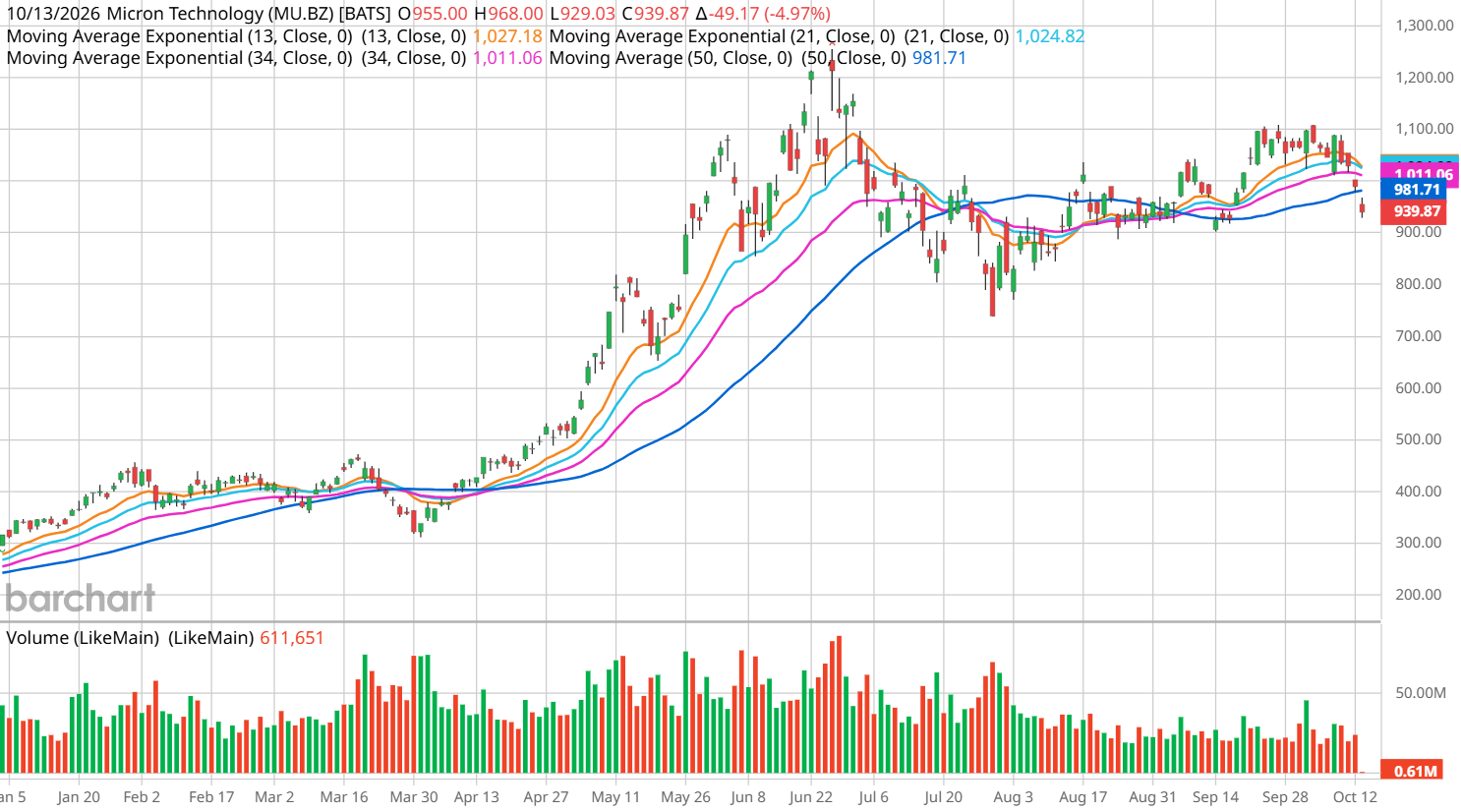
Storage-focused companies including Western Digital (WDC) and Seagate (STX) fell between 3% and 7%, and the Roundhill Memory ETF (DRAM) declined about 5%, even as the Nasdaq-100 ($IUXX) lost less than 1%, confirming the damage was concentrated squarely in the chip sector.
South Korea's Circuit Breaker Fires
South Korea's KOSPI index suffered a 5.5% decline, briefly crashing more than 7% intraday and triggering a sell-side circuit breaker for the first time in two months, as Samsung and SK Hynix together account for nearly half the benchmark's market capitalization. Foreign investors dumped more than 5 trillion Korean won in Korean equities, underscoring the severity of the global reassessment.
The contagion spread to Europe, where ASML Holding (ASML) fell over 3%, and to Japan, where SoftBank Group (SFTBY) sank 8.5% and Tokyo Electron (TOELF) lost nearly 7%.
Broadcom's CEO Adds Fuel to the Fire
Compounding the CXMT shock, Broadcom (AVGO) CEO Hock Tan warned at a Singapore conference that many AI investors were "behaving like casino gamblers with extreme expectations," while both he and Intel (INTC) CEO Lip-Bu Tan highlighted capital access as the biggest constraint on AI expansion.
A Bank of America fund manager survey showed technology allocations at their highest level since the post-COVID rebound, with 45% of respondents predicting an AI bubble by 2027 — creating a potent one-two punch against semiconductor sentiment when paired with a credible new memory competitor.
The Caveats Traders Must Weigh
CXMT's threat, however, comes with significant asterisks: the company has yet to demonstrate it can manufacture the 4F² design at commercial scale with competitive yields, and its cost per bit of DDR5 memory is estimated to remain more than 30% above that of Samsung, SK Hynix, and Micron.
Micron's own management has stated that cleanroom construction takes years and production ramps only gradually, suggesting even a successful CXMT launch would not flood the market with supply overnight.
Apple (AAPL) recently abandoned negotiations to source DRAM from CXMT after discovering its pricing was no cheaper than incumbent suppliers — a notable but underappreciated signal about the gap between laboratory breakthroughs and commercial viability.
Micron's Numbers Tell a Different Story
On the fundamental side, Micron's fiscal Q4 2026 revenue of $54.23 billion represented nearly fivefold year-over-year growth, with adjusted gross margins reaching a commanding 87%, and management guided fiscal Q1 2027 revenue to $61.5 billion.
The company also announced a $35 billion share buyback authorization, settled patent litigation with Netlist for $600 million, and received a D.A. Davidson price target of $3,000 — the highest on Wall Street — reflecting confidence in a multi-year AI-driven growth cycle in which demand is expected to exceed supply through at least 2028.
What Comes Next
The key checkpoint for investors is whether CXMT can actually ship server-grade DDR5 on schedule and win qualification from major cloud and AI customers, as that would represent the first genuine erosion of the incumbents' pricing fortress.
For now, a 30%-plus cost disadvantage suggests the moat remains deeper than this week's panic implies.
This article was created with the support of automated content tools from our partners at Sigma.AI. Together, our financial data and AI solutions help us to deliver more informed market headline analysis to readers faster than ever.
On the date of publication, Sarah Holzmann did not have (either directly or indirectly) positions in any of the securities mentioned in this article. All information and data in this article is solely for informational purposes. For more information please view the Barchart Disclosure Policy here.