


Helen of Troy (HELE), best known as the parent of OXO kitchen gadgets, reported Q2 2027 earnings on Oct. 8 before the markets opened. They were better than expected. Yet shares rose only 3.9% on heavy volume.
Fast forward to Monday’s trading. HELE’s volume was less than half of the 2 million shares traded last Thursday, yet its shares gained more than 7%, making it one of the top 100 bullish price surprises with a standard deviation of 2.38.
I can’t remember the last time I discussed Helen of Troy. I’m sure it was long before it went on a crazy run during Covid, hitting an all-time high of $265.97 on Jan. 21, 2021. Sadly, it’s lost 89% of its value in the nearly six years since.
I’ve always liked Helen of Troy’s OXO products. We use several in our kitchen.
Over the years, it has added several brands through acquisitions or licensing agreements. It now operates its business through two segments: Home and Outdoor (48% of revenue), which includes OXO, and Beauty and Wellness (52%).
While you have to like the revenue balance, profitability has sometimes been elusive, making it an unreliable long-term investment.
Earlier this year, HELE hit a 10-year low of $13.85. It’s more than doubled in the seven months since.
The question now is whether this signals more good times ahead or merely an exhaustion rally ready to peter out.
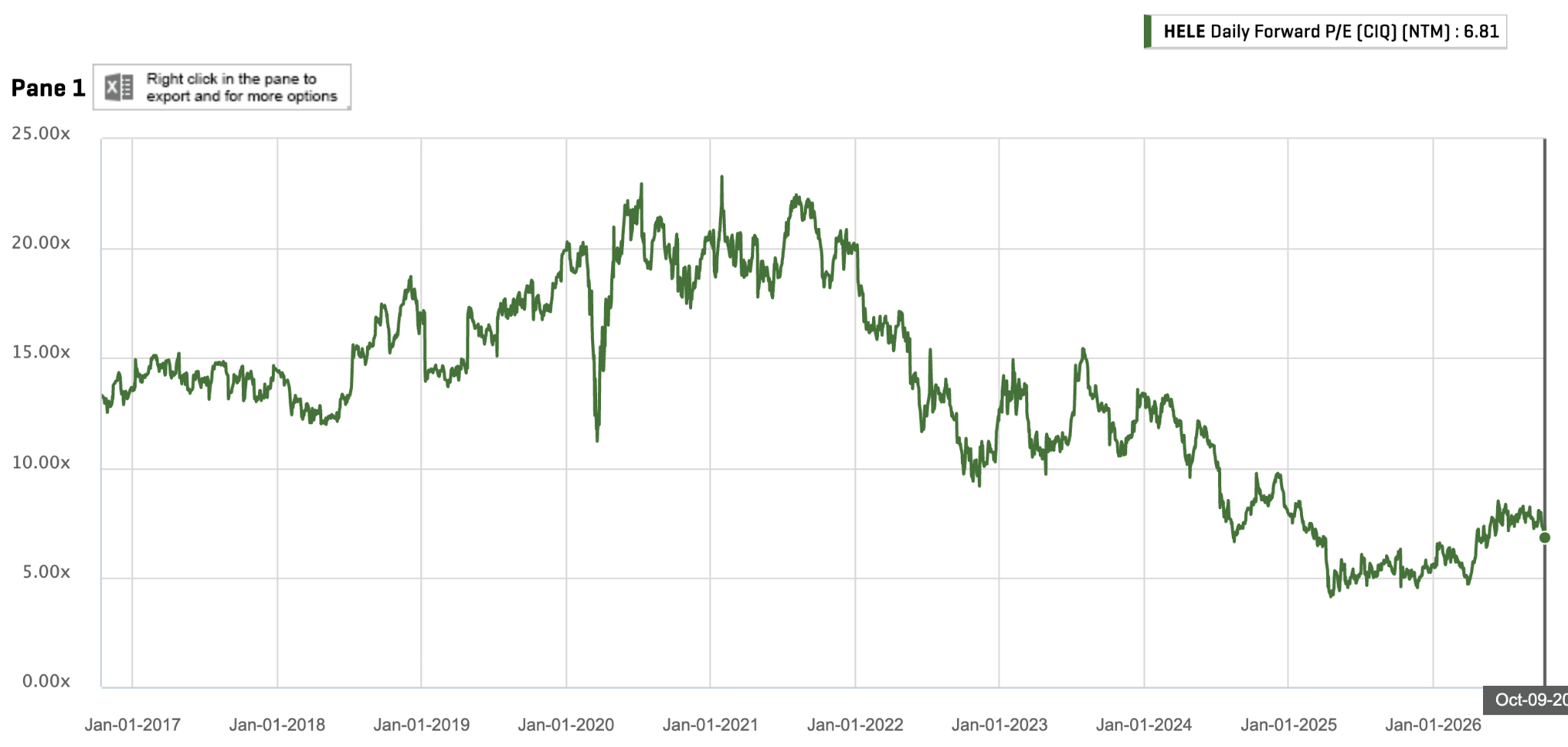
Valuations Near Decade Lows
Only five analysts cover HELE, with 1 Strong Buy (3.40 out of 5) and a $30.50 target price, about $2.50 above the current share price. Analysts expect earnings of $2.96 per share in fiscal 2027 (February year-end) and $3.30 in 2028.
Source: S&P Global Market Intelligence
Based on the chart above, it’s trading at one of the lowest multiples in the past decade. Its current forward P/E of 6.81x is well below the 10-year average of 13.48x and the January 2021 all-time high of 23.29x.
Multiples don’t just happen in a vacuum. Even though I haven’t spent a minute on Helen of Troy in the past five years, I know there have to be reasons for this. It comes with a reputation for inconsistent profitability. Let’s start there.
It’s Faced Four Issues In Recent Years
In the past decade, its highest annual operating profit was $291 million on $2.1 billion in revenue in fiscal 2021 during Covid. That’s an operating margin of 13.9%, 200 basis points higher than the 10-year average of 11.9%. Not coincidentally, it was the same time its stock hit an all-time high.
In the 12 months ended Aug. 31, its operating margin was 5.5%, with operating profit of $100.3 million and revenue of $1.83 billion. That’s less than half the 10-year average.
Four things have hurt margins: non-cash impairment charges, softness in the Beauty and Wellness business, tariff costs, and investing more in key brands such as OXO.
The fiscal 2026 10-K mentions the word “impairment” 178 times. That’s never a good thing. Last year, it recorded $886 million in pre-tax asset impairment charges, with $333 million for Home & Outdoor and $553 million for Beauty & Wellness.
By segment, the former reported asset impairment charges of $184.4 million for Hydro Flask and $148.1 million for Osprey Packs. The latter had asset impairment charges for four brands: Health & Wellness ($242.2 million), Drybar ($154.5 million), Curlsmith ($133.0 million), and Revlon ($23.5 million).
The company acquired four of these brands: Hydro Flask ($210 million in March 2016), Drybar ($255 million in January 2020), Osprey Packs ($414.7 million in December 2021), and Curlsmith ($150 million in April 2022).
That’s $1.03 billion in acquisitions between 2016 and 2022. Impairment charges for the four acquisitions totalled $620 million, accounting for 60% of acquisition costs. This illustrates the danger of overpaying for acquisitions.
In Q2 2027, Helen of Troy’s revenue rose 2.1% to $440.9 million. Home & Outdoor rose 9.2%, driving growth, while Beauty & Wellness fell 4.5% as consumers cut spending on discretionary items.
For all of 2027, Helen of Troy management expects the segment’s sales to fall 2.3% at the midpoint of its guidance. On the bright side, it expects its Home & Outdoor segment’s sales to grow by 3.7% over 2026.
That brings me to tariffs and the effect on non-GAAP profits. In its Q2 2027 press release, it said it expects to earn $3.88 a share in 2027 on an adjusted basis, up from its previous estimate of $3.50 a share. Nearly 10% of the estimate comes from tariff refunds; excluding the refunds, earnings will fall 1.1% from $3.55 a share in 2026.
The good news is that it plans to reinvest 85% of the $80.5 million in Phase 1, Phase 2, and Phase 3 tariff refunds in growth initiatives for its top brands. That should help grow its sales for both segments over the next year.
Helen of Troy ended Q2 2027 with $27.3 million in unrestricted cash and cash equivalents, $676.5 million in debt, and net debt of $649.2 million, about the same as its market cap.
Its net debt as a percentage of EBITDA (earnings before interest, taxes, depreciation, and amortization) is at its highest level in the past decade. Unsurprisingly, its Altman Z-Score, which indicates a company’s long-term solvency, is 1.78, suggesting bankruptcy is possible within the next 24 months.
The Bottom Line for HELE Stock
The company’s non-GAAP operating margin in the second quarter was 8.6%, up 240 basis points from a year earlier. It expects a 2027 EBITDA margin of 11.1% at the midpoint of its guidance, up from 4.2% in its previous guidance.
Margin improvement is key to a higher share price in calendar 2027. In fiscal 2021, when its share price was well over $200, its EBITDA margin was 16.9%, 580 basis points higher than its 2027 estimate.
Despite significant value destruction in several of its brands in recent years, Helen of Troy still has a shot at moving higher in 2027.
But it has to return to organic growth in both operating segments to deserve a more historically typical forward P/E in the teens.
I can’t tell you if it will succeed.
What I do know is that it hired Scott Uzzell a year ago, a highly qualified CEO, and he's stabilized the business. With high-profile gigs at Nike (NKE) and Coca-Cola (KO), he has the leadership chops to return Helen of Troy to business success and growth.
If, and it’s a big if, HELE can grow into the company it was back in 2021, its current valuation is dirt cheap.
If you’ve got some fun money that you can afford to lose, HELE is a buy for aggressive investors only.
On the date of publication, Will Ashworth did not have (either directly or indirectly) positions in any of the securities mentioned in this article. All information and data in this article is solely for informational purposes. For more information please view the Barchart Disclosure Policy here.