


The war for artificial intelligence (AI) supremacy has a new central battleground, and it is inference. Apart from the established winners of the training era, such as Nvidia (NVDA) and AMD (AMD), hyperscalers are increasingly becoming important players here by making their own custom AI chips.
Alphabet's (GOOG) (GOOGL) Google, with its TPUs, got a head start; however, Microsoft (MSFT), with the launch of the Maia 300 AI chip in 2027, is not willing to cede ground. Promising 40% more token output per megawatt than the GPU systems dominated by Nvidia and AMD, the company has developed the chip with a focus on inference. To be manufactured through TSMC's (TSM) leading 2nm process, Microsoft said in a statement, “Maia 300 is designed with an inference-first architecture optimized for long-context, memory-intensive and decode-heavy AI workloads. This involves balancing compute, memory bandwidth, networking and power efficiency at cloud scale.”
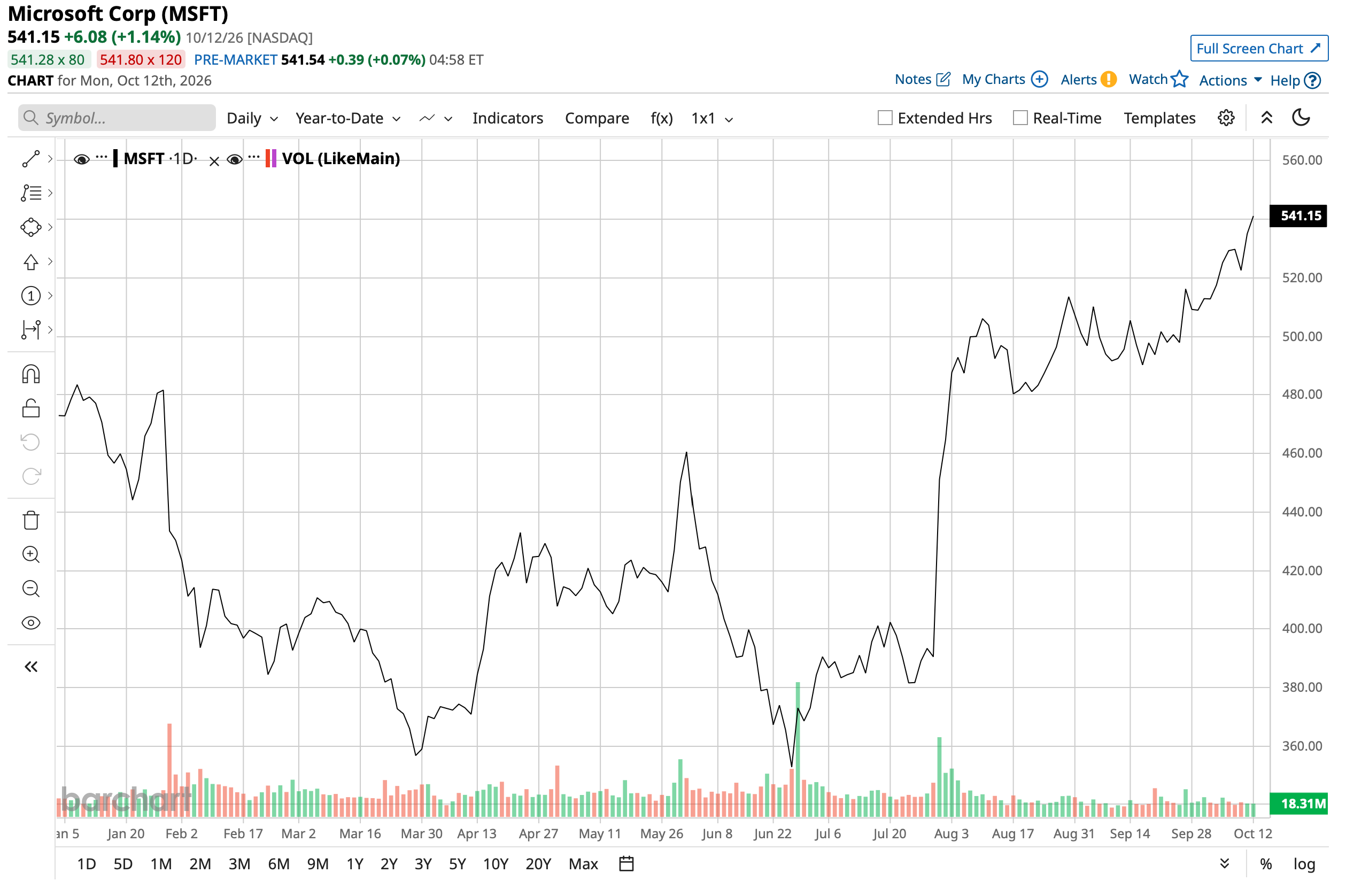
Shares of Microsoft ended 1.1% higher on this news in yesterday's trading session to come, very close to regaining its $4 trillion market cap. Currently valued at a market cap of $3.97 trillion, MSFT stock is up 11.9% on a year-to-date (YTD) basis. The stock also offers a dividend yield of 0.7% and has been raising dividends consecutively for the past 21 years, with $10.2 billion returned to shareholders in the form of repurchases in Q2 2026.
Having said that, how does Maia 300 fit into Microsoft's wider AI strategy? Let's find out.
Mai(a) Own
Why are hyperscalers like Google, Microsoft, and Amazon (AMZN) spending billions to build their own chips? The chips from Nvidia and AMD are fulfilling their needs quite well at the moment, and the duo is in a constant mode of building new and more powerful generations of chips. Moreover, the hyperscalers are buying them as well, clearly signalling that even if they are developing their own chips, they will continue to source the ones produced by Nvidia and AMD.
Then, why? Well, there are a few reasons. First, the companies want to reduce their dependence on outsiders, specifically Nvidia, which has an almost hegemonic presence in the GPU market, which in turn gives it immense pricing power, leaving the hyperscalers vulnerable. Secondly, custom chips are cheaper (in terms of cost per AI workload) than those from the likes of Nvidia and AMD, and thirdly, the companies can build their own chips to cater to their particular needs and focus on aspects they want to. Finally, designing their own chips facilitates tighter integration between their processors, software, and broader data-center infrastructure, potentially improving performance while creating differentiated offerings for cloud customers.
Specifically with Microsoft, Maia 300 is a continuation of its attempt to get more AI work done inside the power and cooling limits of its data centers. Each Maia 300 accelerator is designed with 288 gigabytes of HBM4 memory and 18 TB/s of peak memory bandwidth. That bandwidth is two and a half times Maia 200’s. Notably, Microsoft plans to put 96 accelerators in a rack drawing 167 kilowatts, with 27.6 terabytes of memory across the rack. It says that the configuration can generate up to seven times as many tokens per rack as Maia 200.
Ultimately, Microsoft intends to make Maia its primary inference system as it expands the family beginning in 2027. It names Microsoft 365 Copilot, GitHub Copilot, Microsoft Foundry, and Dragon Copilot among the services that could benefit from the architecture. For a customer, the expected result is quicker responses or greater capacity when many people are using those services, not a new processor they must install. Lower serving cost might also allow Microsoft more room to price AI features competitively, though it has not promised a customer price cut yet.
Microsoft's Outstanding Q2
Microsoft reported solid financial performance as revenue advanced 18% year-over-year (YoY) to $90 billion, coming in $2.4 billion ahead of forecasts. The Intelligent Cloud segment, which includes Azure, grew 31.5% YoY to $39.31 billion. While operating margins for the segment remained roughly unchanged from the previous year, absolute operating income increased 31.4% to $15.96 billion. Azure revenue specifically rose 43% YoY, exceeding the expected range of 39% to 40%. For the full year, Azure crossed a $100 billion run rate for the first time. Commercial backlog nearly doubled YoY to $684 billion, with about 30% of that total expected to convert to revenue over the next twelve months, highlighting strong demand for the company’s cloud products and services.
Earnings per share increased 23% to $4.74, surpassing the consensus estimate of $4.24 and extending the streak of consecutive earnings beats to nine quarters. This result includes a $3.2 billion gain associated with the company’s investment in Anthropic, the developer of Claude.
Cash flow stayed robust, as net cash from operations climbed to $55.44 billion, reflecting a 30% rise from the year-earlier period. Microsoft ended the quarter with $76.8 billion in cash, substantially higher than its short-term debt of $9.23 billion.
From a valuation perspective, MSFT appears reasonably valued. The forward P/E and P/S of 27.07 and 10.15 are above the sector medians of 23.29 and 3.53, respectively, while on a forward P/CF basis, MSFT stock is trading at 17.43, lower than the sector median of 20.95.
What Do Analysts Think of MSFT Stock?
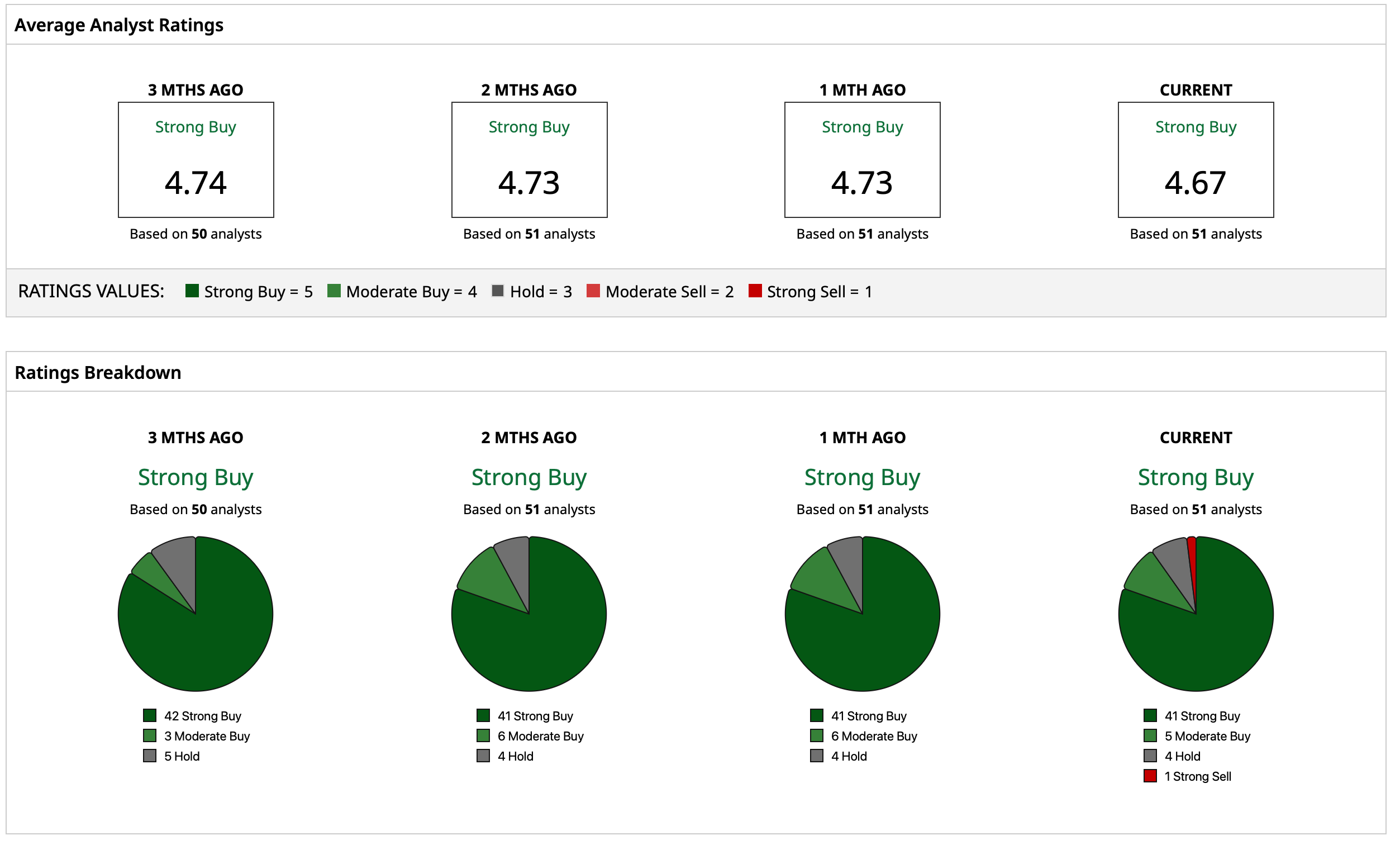
Thus, analysts have earmarked an overall rating of “Strong Buy” for MSFT stock. The mean target price of $579.78 indicates a potential upside of about 6% from current levels. Out of the 51 analysts covering the stock, 41 have a “Strong Buy” rating, five have a “Moderate Buy” rating, four have a “Hold” rating, and one has a “Strong Sell” rating.
On the date of publication, Pathikrit Bose did not have (either directly or indirectly) positions in any of the securities mentioned in this article. All information and data in this article is solely for informational purposes. For more information please view the Barchart Disclosure Policy here.