


SpaceX (SPCX) — Elon Musk's space company that has a whole chunk of its valuation attached to artificial intelligence (AI) — will likely not find Firmus' recent initial public offering (IPO) cancellation pleasant. Why might that be, and why did Firmus cancel its IPO in the first place?
The answer to the second part of that question comes straight from the company itself. Highlighting market volatility and prevailing conditions, the Australian data-center operator noted that its board “concluded that proceeding with the offer was not in the best interests of the company and its shareholders.” Firmus continued by saying it will now "pursue capital from the private markets and consider alternative public and private market options.” Reportedly, the proposed $5 billion IPO would have been the second-largest in Australian history, and would have valued the company at just shy of $31 billion.
Why could SpaceX be uncomfortable with this failed IPO news? Let's take a closer look.
The $40 Billion Question
After raising close to $86 billion through its June IPO, the largest public offering ever, SpaceX is in need of funds again. This time, the company is reportedly in early talks to raise about $40 billion — $10 billion in bank loans and $30 billion in bonds — through a debt offering to buy Nvidia (NVDA) chips. Apollo Global Management is expected to lead the round, and PIMCO will be one of the potential participants, with the raise expected to be completed in 2027.
Back in June 2026, just a couple of weeks after its IPO, SpaceX also raised a $25 billion multi-tranche senior unsecured notes offering. Originally targeted at about $20 billion, the offering was upsized due to strong demand of nearly $90 billion in orders. Moreover, SpaceX has a cash balance of about $100 billion.
What would make a high-growth name like SpaceX wary of the Firmus IPO cancellation? Well, it's about perception.
Data centers are the lifeblood of the AI revolution, and an exciting company from this domain cancelling its IPO raises potential questions about demand and may revive concerns around an AI bubble. Further, we are in a rising interest rate environment, and taking on a debt burden of $40 billion as a loss-making company whose operations are already capital-intensive does not paint a pretty picture.
Another concern hanging over the proposed $40 billion debt raise would be the continually widening credit default spreads of SpaceX. As of October 2026, SpaceX's five-year CDS spread has reportedly climbed to around 195 basis points, reaching an intraday high on Oct. 7. Incidentally, the latest spike followed reports of the $40 billion debt raise to buy Nvidia chips.
Firmus' IPO withdrawal may seem to have no direct link with SpaceX or its fundraising, but it certainly does have an impact on SpaceX's ambitions to raise debt in an environment that is increasingly becoming hostile amid rising rates and the company's own widening credit spreads.
A Recap of SpaceX's Q2 Report
SpaceX has delivered meaningful revenue growth in recent years, advancing from $10.4 billion in 2023 to $18.7 billion in 2025. The firm generated net income of $791 million in 2024 before posting a net loss of $4.9 billion last year. Cash flow from operations improved over the three-year period, however, rising to $6.8 billion in 2025 from $4.5 billion in 2023. SpaceX ended 2025 with a solid cash position of $24.7 billion and limited short-term debt, easing liquidity concerns.
In the second quarter of 2026, SpaceX reported revenue of $7.8 billion, representing a 92% year-over-year (YOY) increase. Connectivity remained the leading top-line contributor with $4.29 billion in revenue, followed by the AI segment's $2.56 billion in revenue and Space's contribution of $962 million. In Q2, net loss narrowed to $541 million from a loss of $1 billion in the comparable period a year earlier.
Capital expenditures have risen markedly over the past three years, increasing from $4.4 billion in 2023 to $20.7 billion in 2025. Spending related to AI has expanded particularly rapidly, starting at $463 million in 2023 before climbing to $12.7 billion in all of 2025 and $15.8 billion in Q2 2026 alone. This shift illustrates how SpaceX is increasingly treating AI as foundational for its future development.
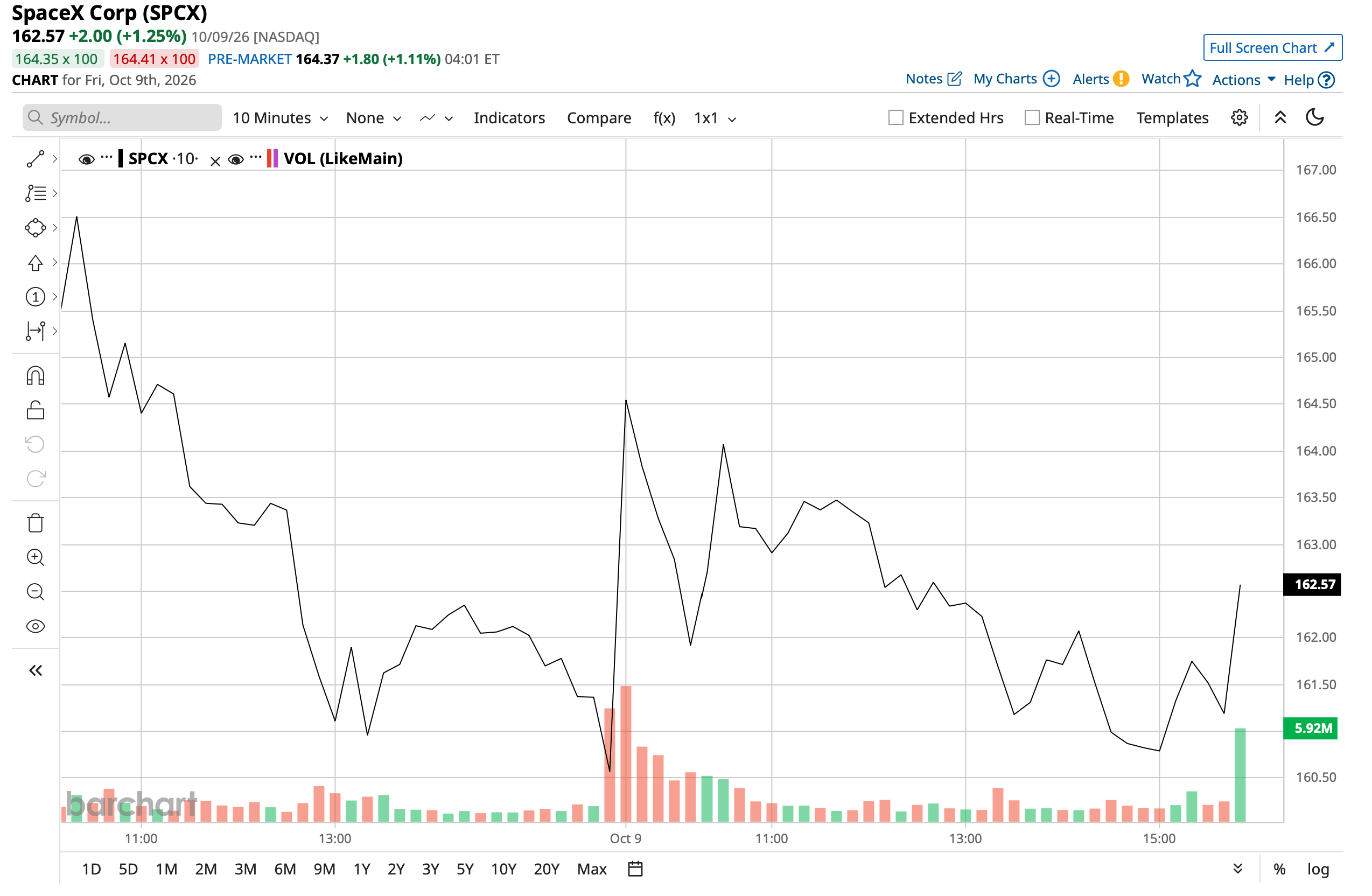
From a valuation perspective, SPCX stock continues to appear significantly overvalued relative to industry peers. For instance, the forward price-to-sales (P/S) ratio of 114.7 times is well above the sector median. SpaceX currently has a market capitalization of roughly $2.1 trillion.
What Do Analysts Think of SPCX Stock?
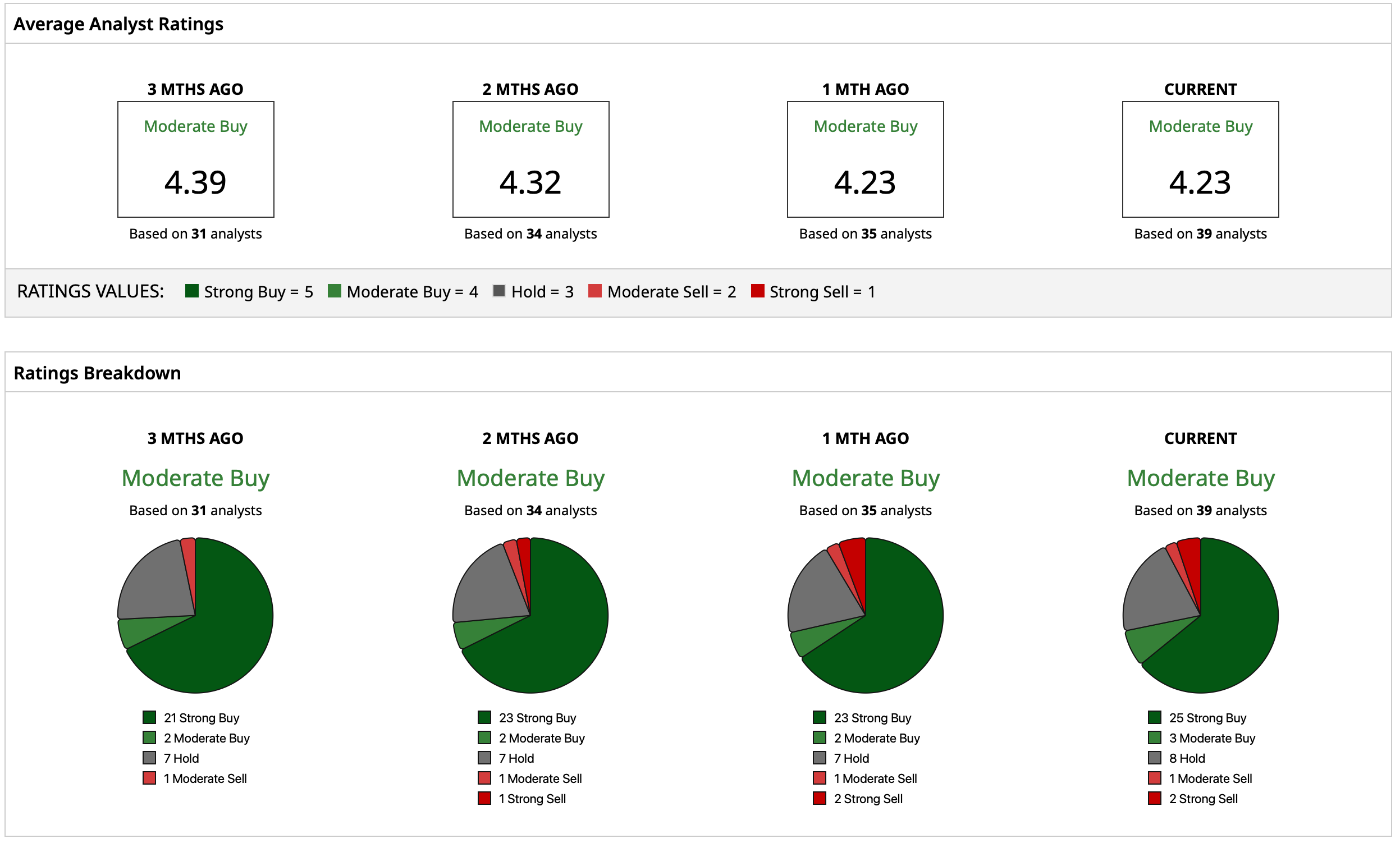
Overall, analysts appear to remain optimistic on SpaceX, offering a consensus “Moderate Buy” rating. Out of the 39 analysts covering SPCX stock, 25 have a “Strong Buy” rating, three have a “Moderate Buy” rating, eight have a “Hold” rating, one has a “Moderate Sell” rating, and two analysts have a “Strong Sell” rating.
The mean target price of $224.86 denotes potential upside of 44% from current levels. SpaceX stock has a high price target of $800 and a low price target of $75 per share, reflecting a wide range of opinions.
On the date of publication, Pathikrit Bose did not have (either directly or indirectly) positions in any of the securities mentioned in this article. All information and data in this article is solely for informational purposes. For more information please view the Barchart Disclosure Policy here.