


Gold has historically attracted investors seeking safety amid geopolitical uncertainty. Yet, despite the ongoing Russia–Ukraine war, the U.S.–Iran conflict, and expanding Middle East hostilities involving Houthi attacks on Saudi Arabia, gold futures continue to decline.
If multiple wars cannot sustain a rally in gold, what will?
It's a question worth asking, especially when many investors still view gold as a safe-haven asset. However, markets don't always respond to world events as conventional wisdom suggests. Sometimes, price action tells a very different story.
Gold's Technical Picture
Gold futures have established a series of lower highs and lower lows since reaching their all-time high earlier this year. The weekly chart reflects deteriorating bullish momentum, with prices trading below a declining 20-week simple moving average (SMA). Adding to the bearish outlook, the 20-week SMA has crossed below the 50-week SMA. The daily chart reinforces this weakness, displaying a similar pattern of lower highs and lower lows, with prices trading below both the 20-day and 50-day SMAs.
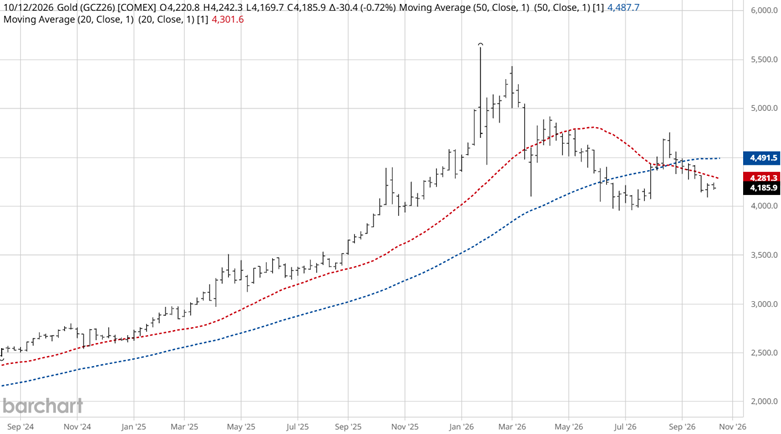
Source: Barchart (Nearby Weekly Gold Chart)
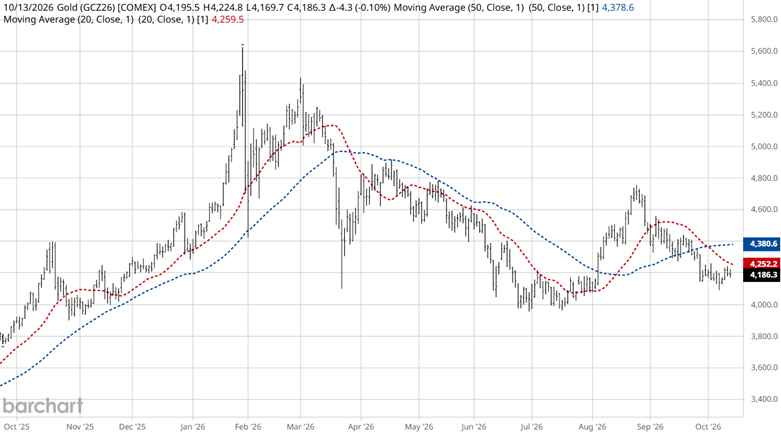
Source: Barchart (Nearby Daily Gold Chart)
Despite gold's reputation as a safe-haven asset, trying to catch a bottom simply because geopolitical tensions remain elevated can be costly. Markets can remain in established trends much longer than traders anticipate. Rather than trying to predict when gold will rally, traders may be better served waiting for price action to confirm a reversal through improving market structure and a sustained recovery above key moving averages. Price, not your emotions, is the final determinant.
Could Declining Diesel Prices Offer Gold Bulls Some Hope?
While gold's technical outlook remains bearish, declining energy prices could eventually give bulls a reason to reconsider. According to the U.S. Energy Information Administration (EIA), average retail diesel prices fell from about $6.53 per gallon on September 21 to $6.20 on October 5, a 5.1% decline in just two weeks.
On October 9, President Trump announced an agreement with Russian President Vladimir Putin to release additional Russian diesel supplies into global markets. The U.S. Treasury Department temporarily eased sanctions to facilitate those shipments. Although analysts question whether the additional supply will significantly lower prices, the announcement adds another potential downward pressure on diesel prices.
On the demand side, the approaching end of the fall harvest could complement that potential supply increase. Harvesting and transporting crops to grain elevators, processors, and export facilities generate seasonal diesel demand. As the Corn Belt harvest winds down toward late October and early November, that demand should diminish. Together, additional global supply and reduced agricultural demand could help moderate diesel prices and, potentially, inflationary pressures.
In my recent article, "What Record Heating and Diesel Oil Prices May Be Telling Other Markets," I explored the seasonal influences on distillate fuels and their potential implications for other markets.
The Dollar Connection
With the September Consumer Price Index (CPI) report scheduled for October 14, traders will be watching for signs of persistent inflation. However, continued weakness in diesel prices could help moderate inflation in subsequent months.
If inflation eases, the Federal Reserve may be more inclined to lower interest rates. Lower-rate expectations could weaken the U.S. dollar, which has recently pressured precious metals and grain prices. A weaker dollar could eventually provide support for both markets.
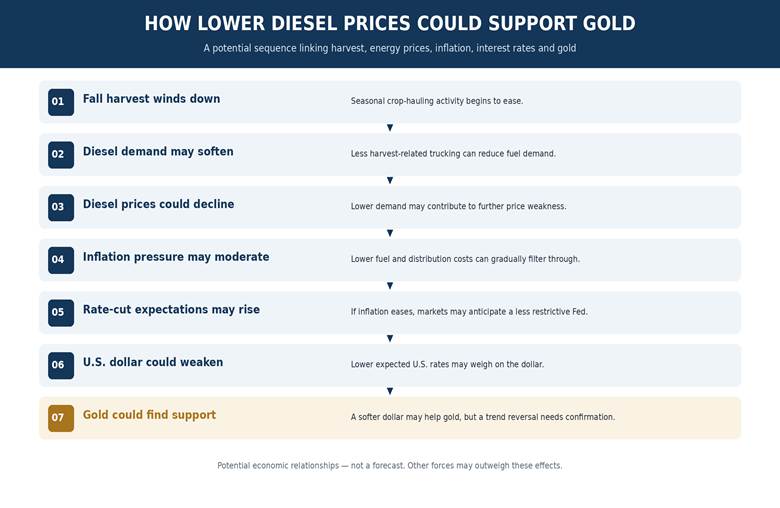
Figure 1: How declining seasonal diesel demand could influence inflation, interest-rate expectations, the U.S. dollar, and gold prices. These relationships are potential outcomes, not forecasts.
The Market Has the Final Word
Geopolitical uncertainty, declining energy prices, and shifting interest-rate expectations may eventually give gold bulls reasons to be optimistic. But a compelling fundamental argument does not guarantee a trend reversal.
For now, the weekly and daily charts continue to favor the bears. Rather than trying to predict what gold will do next, traders may be better served by respecting the prevailing trend until price action proves otherwise.
On the date of publication, Don Dawson did not have (either directly or indirectly) positions in any of the securities mentioned in this article. All information and data in this article is solely for informational purposes. For more information please view the Barchart Disclosure Policy here.