


- Industry research released in 2026 points to strong future expansion in the UAV radar segment, identifying Saab alongside RTX, Leonardo, HENSOLDT and Israel Aerospace Industries as key suppliers into unmanned and counter drone defense programs.
- The focus on radar payloads for both UAVs and counter UAS systems highlights Saab’s embedded role in defense customers’ long term shift toward autonomous and remote sensing capabilities.
- We will now assess how Saab’s investment narrative is influenced by its position in the growing UAV radar market for defense customers.
Scan beyond Saab and see how other defense and autonomous systems suppliers stack up in our curated list of 91 robotics and automation stocks.
Saab Investment Narrative Recap
For an investor to stay with Saab, the core belief is that defense demand for advanced systems, including UAV and counter drone radar, supports a long pipeline of projects across Aeronautics, Dynamics and Surveillance. The recent UAV radar focus reinforces that story but does not fundamentally change the near term picture, which is still driven by backlog conversion and execution.
The main short term swing factor remains Saab’s ability to deliver on capacity expansion and complex programs without squeezing margins, given heavy R&D and factory investments. The biggest risk is that government orders slow or export controls tighten while these costs remain high, which could pressure cash flow and limit financial flexibility.
Company communication has recently highlighted strong order books and ongoing investment in AI, autonomous systems and digitalization rather than specific one off UAV radar deals. That context matters. The new UAV radar market commentary simply fits into an already declared push toward autonomous platforms and advanced sensors across the Surveillance segment.
For you as a shareholder, the link is straightforward. Interest in radar equipped UAVs supports the logic of Saab’s upfront spend on R&D, digital capabilities and new capacity, even though those commitments increase near term execution and margin risk. The key question is whether order intake in areas like Surveillance and Combitech keeps pace with the higher cost base tied to these programs.
Saab's current earnings of SEK 7.1b are projected by analysts to rise to SEK 13.3b by 2029, an earnings increase of about SEK 6.2b, supported by assumed revenue growth of 18.9% per year and implying forecast 2029 revenues of SEK 148.2b.
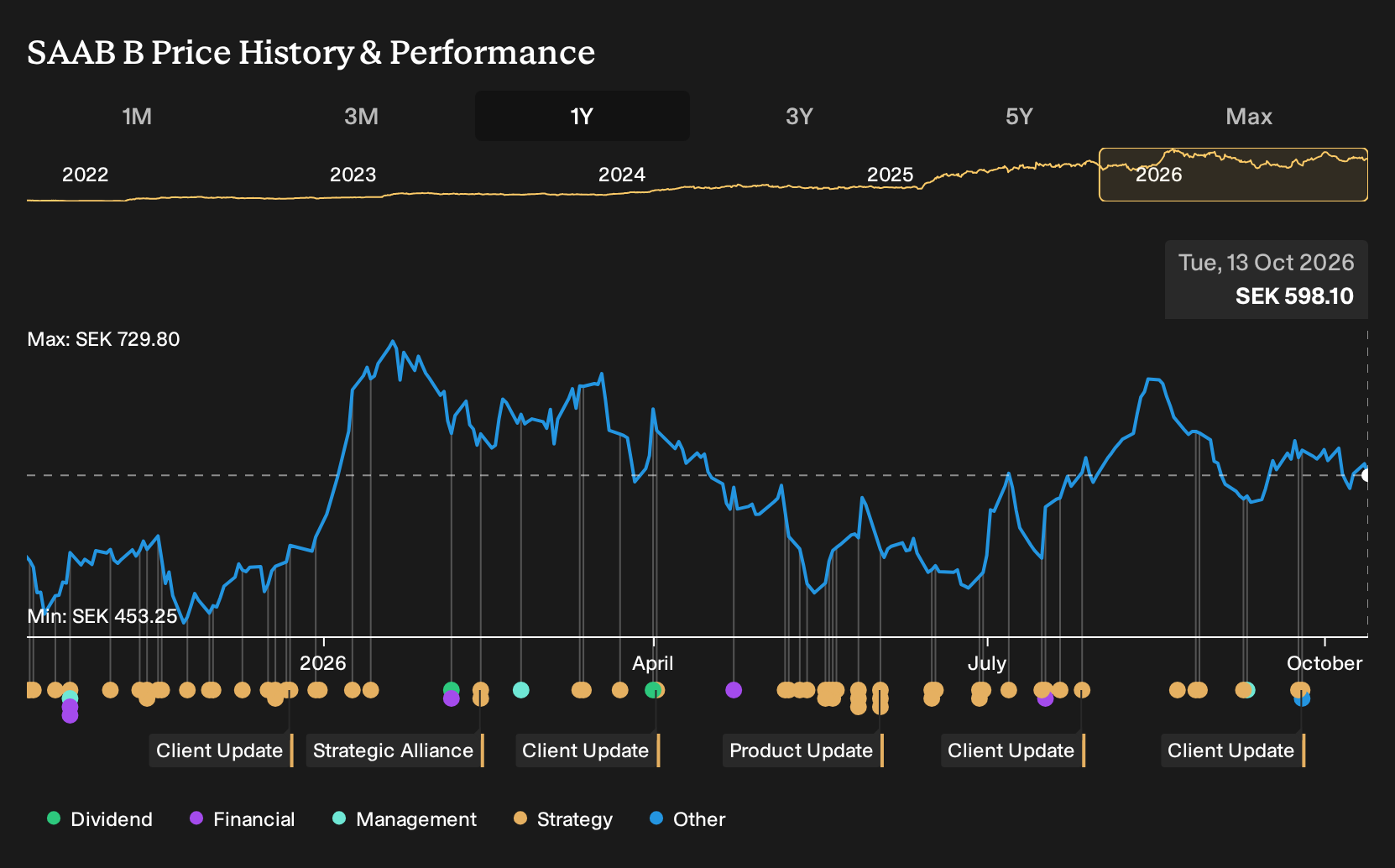
Uncover why Saab's fair value indicates a 6% potential upside to its current price that may not last much longer.
Exploring Other Perspectives
You are now seeing a different storyline around Saab. The most cautious analysts emphasize contract volatility as the key risk, which sits awkwardly next to fresh enthusiasm for UAV radar. Their pre news view still pencilled in SEK 146.5b of 2029 revenue and SEK 12.7b of earnings, yet implied a much lower valuation. That spread in expectations is wide. Use it as a prompt to explore several competing narratives and then decide which assumptions feel closest to your own.
Explore 5 other Saab fair value estimates, including one that suggests as much as 65% downside from the current price.
The Verdict Is Yours
Disagree with existing narratives? Extraordinary investment returns rarely come from following the herd, so go with your instincts.
- A great starting point for your Saab research is our analysis highlighting 3 key rewards and 1 important warning sign that could impact your investment decision.
- See our latest analysis for Saab. The report includes a comprehensive fundamental analysis summarized in a single visual, the Snowflake, making it easy to evaluate Saab's overall financial health at a glance.
Looking for more Saab-adjacent investment ideas?
If the Saab story has sharpened your thinking about defense and advanced technology, you can use that same framework to scan for other opportunities that fit your risk and return preferences using the Simply Wall St Screener.
- If you want potential mispricing with quality in focus, start with a curated set of 185 high quality undervalued stocks that pair strong fundamentals with discounted valuations.
- If resilience and balance sheet strength matter most to you, filter for companies in our list of solid balance sheet and fundamentals (202 results) that can better handle funding needs and economic strain.
- If you prefer searching for future standouts before they gain broad attention, spend time with a focused pool of 621 high quality undiscovered gems backed by solid underlying metrics.
This article by Simply Wall St is general in nature. We provide commentary based on historical data and analyst forecasts only using an unbiased methodology and our articles are not intended to be financial advice. It does not constitute a recommendation to buy or sell any stock, and does not take account of your objectives, or your financial situation. We aim to bring you long-term focused analysis driven by fundamental data. Note that our analysis may not factor in the latest price-sensitive company announcements or qualitative material. Simply Wall St has no position in any stocks mentioned.
Have feedback on this article? Concerned about the content? Get in touch with us directly. Alternatively, email editorial-team@simplywallst.com