


Starbucks (SBUX) is giving investors a small dividend increase ahead of a bigger test. The coffee chain is scheduled to report its fourth-quarter and full-year fiscal 2026 results on Oct. 29, putting its financial progress back in focus.
Before those numbers arrive, management has offered shareholders a modest sign of confidence through a higher quarterly payout. The company, which operates through a global network of more than 41,000 company-operated and licensed coffeehouses, announced a roughly 1.6% dividend increase to $0.63 per share.
Chief Financial Officer Cathy Smith linked the decision to confidence in the company’s “Back to Starbucks” strategy and its ability to generate sustainable growth. Yet the key question remains: Is this small dividend hike a reason to buy into Starbucks’ recovery, or should investors wait for more convincing results? Let’s dig in.
Starbucks’ Dividend Growth
Seattle-based Starbucks roasts, markets, and sells specialty coffee through company-operated and licensed coffeehouses worldwide. Its business also includes packaged coffee, ready-to-drink beverages, and food sold through retail and distribution partnerships.
With a $103.455B market capitalization, the company combines an extensive physical store network with a globally recognized consumer brand.
Starbucks shares ended Oct. 9 at $90.75, gaining 7.77% YTD and 13.75% over the past 52 weeks.
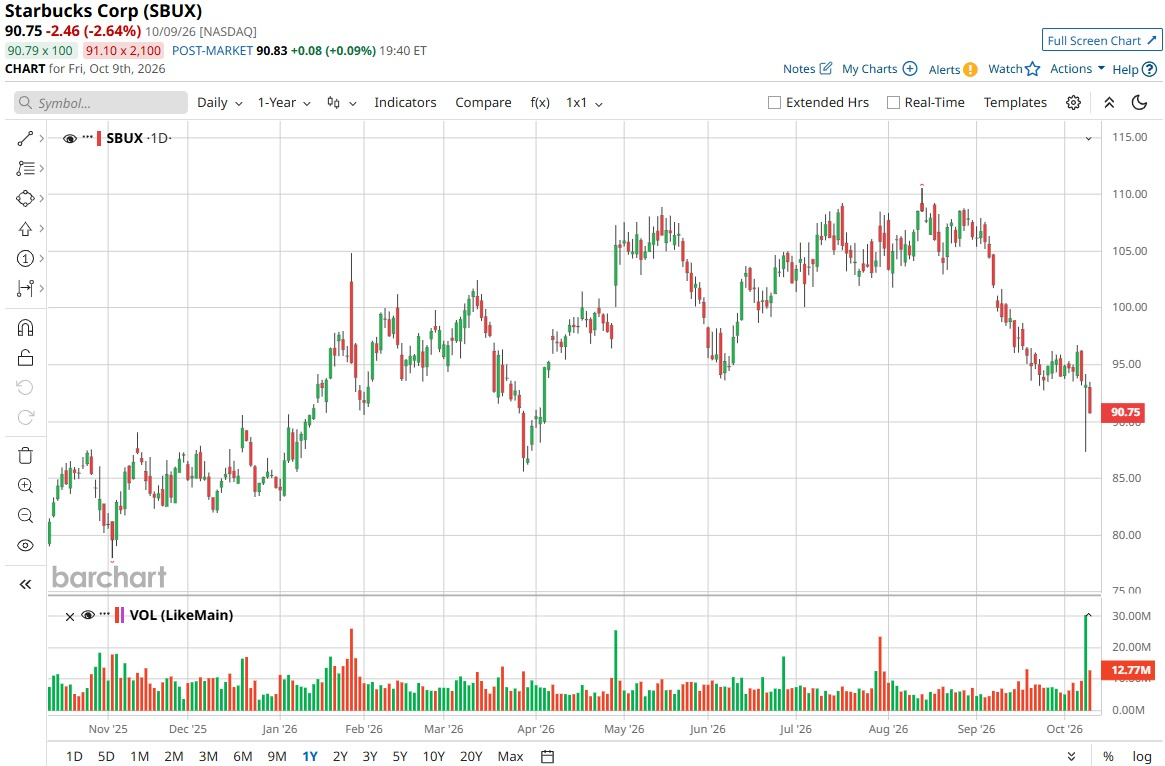
The stock commands a premium at 29.52x forward earnings and 2.70x sales, compared with sector medians of 14.77x and 0.86x, respectively.
Starbucks raised its quarterly dividend 1.6% to $0.63 per share, bringing the annualized payout to $2.52. Shareholders of record Nov. 13 will receive the increased payment on Nov. 27, 2026. Since introducing a $0.05 quarterly dividend in 2010, the company has grown its payout at approximately 17% annually, compounded.
Starbucks released fiscal Q3 2026 results on July 29, reporting $9.32 billion revenue, down 1.4% annually, with China’s licensing transition weighing on reported sales. Their global comparable sales increased 7.9%, supported by 4.2% transaction growth and 3.5% higher average spending.
That earnings recovery supported $2.55–$2.65 full-year adjusted EPS guidance, while approximately $1.3 billion of notes were repurchased using China sale proceeds, strengthening financial flexibility.
This improvement included 8.1% North American comparable-sales growth and 5.7% internationally, while North American operating income increased to $1.009 billion from $918.7 million. SBUX reported GAAP EPS of $0.91, up 86%, and adjusted EPS of $0.85, up 70%, highlighting stronger profitability despite lower consolidated revenue.
It opened 175 net new stores, finishing with 41,304 locations, comprising 33% company-operated and 67% licensed stores, including 16,933 U.S. locations.
Starbucks Cuts Costs and Rethinks Expansion
Starbucks is trimming its corporate workforce and closing weaker stores under Brian Niccol’s “Back to Starbucks” strategy as he works to improve profitability and restore the coffeehouse experience. The company identified 224 Seattle-headquarters job separations, including 104 tied to organizational changes and 120 involving employees who declined Nashville transfers.
Scheduled for Oct. 19 through Nov. 1, these departures follow May’s restructuring, which included 300 corporate layoffs. Expected restructuring charges totaled $400 million, including $120 million in employee-separation benefits.
Store closures are another part of the cleanup. Starbucks planned to shut 250 North American locations, following 627 closures across North America and Europe the previous September.
Chief Operating Officer Mike Grams said the targeted stores either fell short financially or could not deliver the intended customer experience. This latest round carries $300 million in charges, including $200 million for lease exits and employee benefits.
Meanwhile, Starbucks is preparing a cheaper expansion. Smaller-format cafes would cost 20% less to build while retaining seating, drive-thrus, and mobile pickup. Plans include up to 175 new U.S. cafes in 2026 and approximately 400 in 2028.
Together, Starbucks is building a leaner store network while leaving room for expansion. That balance could improve profitability, provided the savings outweigh restructuring costs.
Wall Street Sees Upside, With Reservations
Starbucks will report fiscal fourth-quarter earnings after market close on Oct. 29. Analysts expect September-quarter EPS of $0.72, versus $0.52 a year earlier, representing 38.46% growth.
Still, improving earnings do not automatically make the shares inexpensive. UBS analyst Dennis Geiger maintained a “Hold” rating and $105 price target, approximately 15.70% upside, on July 24. He cited improving U.S. same-store sales, turnaround progress, and cost-saving initiatives as potential drivers of margin recovery and long-term growth.
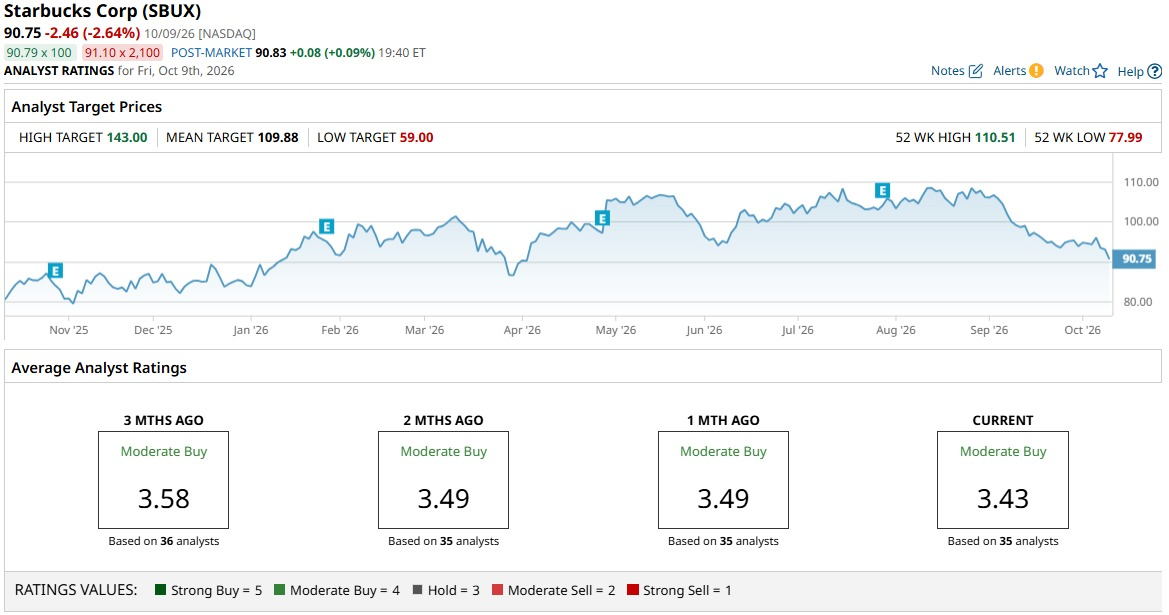
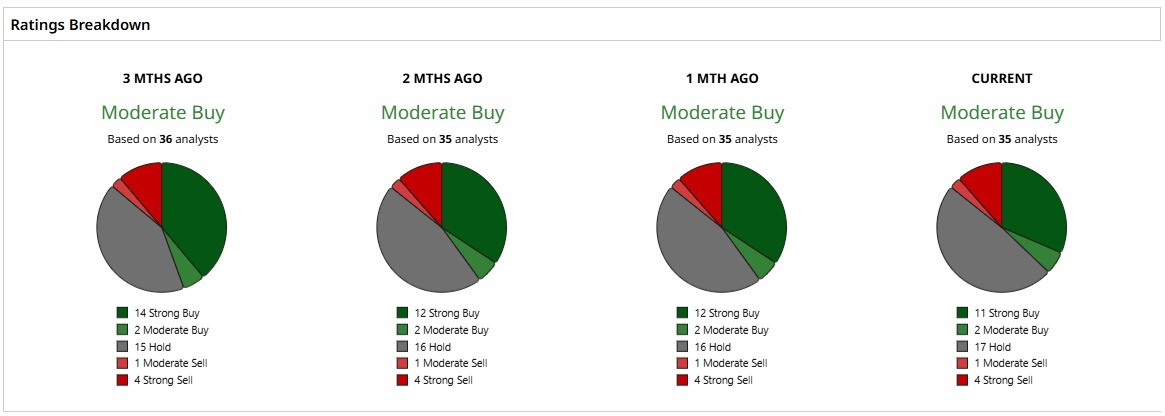
The broader analyst outlook is more positive, with a “Moderate Buy” consensus across 35 analysts rather than unanimous Buy recommendations. Their average price target of $109.88 implies approximately 21.08% upside from the Oct. 9 closing price. That potential appreciation adds to Starbucks’ appeal beyond its modest dividend increase.
Conclusion
Starbucks earns a “Moderate Buy” consensus from analysts, but that does not make it an obvious buy here. Its recovery offers potential, while the premium valuation and modest dividend increase argue against rushing in. Improving sales and cost savings could gradually strengthen earnings, though a sharp acceleration looks less likely. Patient investors could consider a small position, but waiting for a better price offers a more cautious approach. The dividend alone is not enough to make Starbucks a compelling purchase.
On the date of publication, Ebube Jones did not have (either directly or indirectly) positions in any of the securities mentioned in this article. All information and data in this article is solely for informational purposes. For more information please view the Barchart Disclosure Policy here.