


The Zhitong Finance App learned that Morgan Stanley's global theme and technology research team held the Spark Private Company Conference in Dana Point, California from October 13 to 15, bringing together the founders and chief financial officers of more than 100 leading private companies. The bank pointed out in its newly released conference outlook report that the private technology sector has become a key leading indicator for open market investors to judge the flow of capital, talent and technology. Currently, the AI cycle is rapidly penetrating from the infrastructure layer to the application layer, and eight core themes will dominate the market narrative for the next 12 to 18 months.
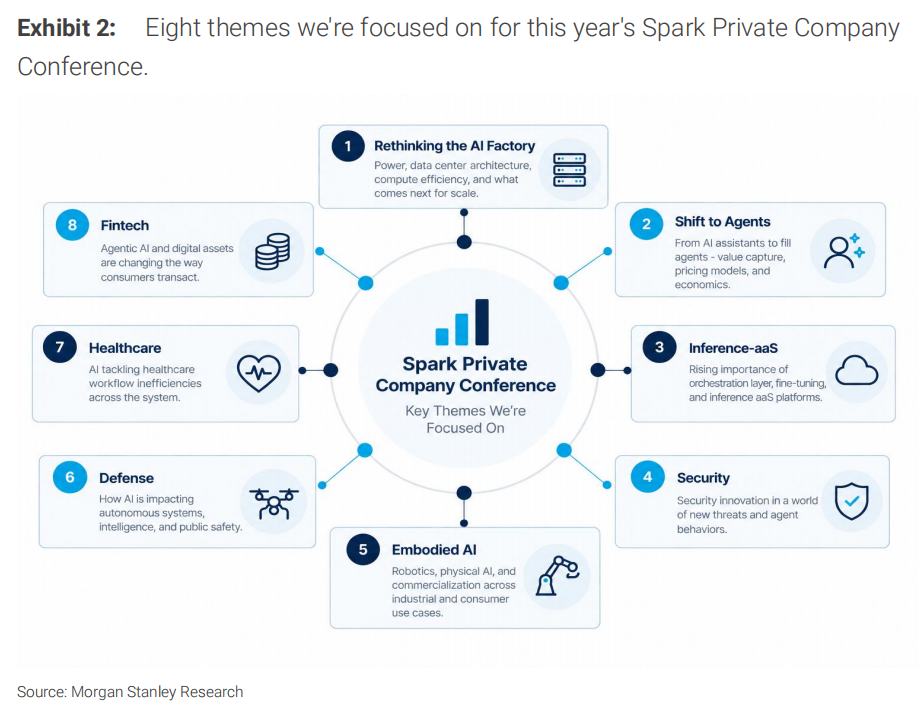
In the report, Morgan Stanley emphasized that in a world of rapid innovation, private ecosystems are more important than ever for open market investors. Some of the most impactful technological changes are often first seen in startups, becoming leading signals of capital, talent, and technology flows. The bank pointed out that the current market is having key debates on power acquisition, computing power efficiency, the transformation of AI from an assistant to an agent, the role of cybersecurity in the AI world, the rising value of inference, and its impact on vertical fields such as defense, logistics, and robotics.
Citing data, the report said that up to 2026, the scale of AI-related financing in the private market has reached US$33.5 billion, double that of 2025. Among them, electricity and computing power — the most scarce investment elements in the ecosystem — account for more than 80% of capital in 2026. However, Morgan Stanley has observed that capital is beginning to spread to the fields of “power and computing power integration” and “data center redesign”. This trend deserves close attention from investors.
Topic 1: Reimagining AI Factories—System-Level Reconstruction from Electricity to Computing Power
Morgan Stanley has listed “The Rise of the AI Factory” as its primary focus. The bank notes that new business models are emerging around rearchitecting data centers and coordinating increasingly complex infrastructure—power, computing power, networks, cooling, and data. This topic covers four types of companies: companies that accelerate access to electricity, companies that improve the effective computing power per unit of electricity, companies that redesign electricity and computing power as a single integrated system, and companies that reimagine data center architectures.
At the specific company level, Morgan Stanley focuses on the layout of AI chip startup D-Matrix in the distributed inference solutions market and the advantages of its digital memory computing (DIMC) architecture over traditional SRAM and HBM solutions. In the networking field, the bank has shown strong interest in the direction of US silicon light startup Lightmatter deploying optical interconnection closer to computing power units and reducing optical fiber requirements through bidirectional optics, Upscale AI constructing open network solutions to connect different accelerators, and Ayar Labs directly integrating optical I/O into accelerator packages to overcome electrical connection limitations.
The report also suggests that the impact of power shortages on the semiconductor industry, strategies to deal with memory bottlenecks, and optical market opportunities are all key backgrounds for understanding this topic.
Topic 2: AI's Transition from Assistant to Smart Body - Expanding Potential Software Market Space to Labor Budget
Morgan Stanley believes that with the launch of products such as Meta (META.US) Muse and Google (GOOGL.US) Gemini AI smart devices, consumer and enterprise AI agents have become the focus. On the enterprise side, the bank is concerned about how AI native software vendors can monetize intelligence that performs work on behalf of customers. This step goes beyond the assistant products that defined the first wave of enterprise AI and pushes the potential market space for software to a larger labor budget than the IT budget.
The report raised three key questions: the first is value capture, that is, how suppliers define their fee-able share of labor costs, which will eventually approach 5% or 50%; second, the evolution of pricing models, where suppliers are shifting from per-seat charges to models based on usage and results, and the market will focus on how results are defined and validated in contracts and the impact on revenue visibility; and third, unit economics, where gross margin depends on how efficiently suppliers route each task to the lowest-cost, capability-matching model and shift workloads to smaller or proprietary models.
Morgan Stanley will be watching presentations from companies such as Cognition, Replit, Legora, Mercor, Genspark, Elise AI, Cresta, and Pallet during the conference.
Topic 3: Reasoning as a Service - Model Customization and Highlighting the Value of Inference Platforms
As enterprise AI moves from experiments to production, and the world becomes more modeled, Morgan Stanley expects a larger share of the value in the model stack to flow to the level of services and customized models. Two inference platforms, Fireworks AI and Baseten, will provide key insights.
The bank points out four core trends: first, the importance of the orchestration layer, which determines which model handles each request and how to scale the workload on hardware. As enterprises seek to use both open and closed source weighting models to rationalize token spending, the value of this layer will only increase; second, deployment efficiency, customers want to obtain more output with less computing power through smaller distillation models and higher GPU utilization. The open question is how much cost reduction the platform retains as profit; third, the value of post-training increases compared to pre-training, and customers use fine tuning and reinforcement learning in proprietary Open data models are adjusted to suit specific tasks; fourth, token cost monitoring and budgeting. Businesses are increasingly seeking solutions to monitor token spending and rationalize spending in a more detailed manner.
Topic 4: Rebuilding Security: New Threats and New Defenses in the Intelligent Era
Morgan Stanley points out that security in the AI era has become an increasingly important issue in view of the large number of proxy vulnerabilities that have occurred in the past few months. The bank believes that an increase in autonomous agent attacks, unpredictable agent behavior, and an increase in the speed/frequency of vulnerabilities require new technology to identify and defend against these threats.
According to IDC data, the approximately $300 billion cybersecurity market (software and services) is expected to grow at a CAGR of 15% over the next few years, and this figure could accelerate to 23% under the Morgan Stanley benchmark scenario, as amplified threats increase demand for next-generation security.
Among the participating companies, the bank paid special attention to Island and Verkada. Island has traditionally focused on enterprise browsers, but has expanded to a more powerful platform; Verkada is a cloud-based physical security platform, and its Command platform integrates decentralized security systems.
Topic 5: Physical AI Goes Mainstream—From Big Language Models to the Evolution of Sports Devices
According to Morgan Stanley, physical AI has finally become mainstream. The bank expects a number of major new entrants to the physical AI debate over the next 12 to 18 months, including large private laboratories and the Big 7 US stocks. This will increase competition among startups, but it will also bring substantial credibility to the topic.
The bank believes that the laboratory will shift from pure competition at the cutting edge to focus on commercialization, and will eventually enter the physical world to seek greater potential market space expansion opportunities (big language models > coding agents > proxy platforms > consumer devices > sports equipment, that is, robots). The gap in enthusiasm for physical AI between early venture capital contacts and open market clients suggests that this trend has yet to be fully priced.
In specific directions, the bank focuses on distributed computing (SiMa.ai, Liquid.AI), manufacturing platforms redesigned from first-principles (Hadrian), visual capture (Flock Safety, Verkada), and physical AI basic models (Genesis AI, Nuro). Additionally, the bank will host a Bay Area “RoboFest” bus tour from October 12 to 13 to visit companies such as Applied Intuition, Bright Machines, Genesis AI, Matter, Nuro, Physical Intelligence, and Waabi.
Topic 6: Autonomy and Software Redefining Defense - Blurring the Boundaries between Business and National Security
Morgan Stanley pointed out that the line between commercial technology and national security is blurring, and the speed of geopolitical tension, drone warfare, and modern threats are driving the government to shift to software-defined, AI-enabled systems and stay away from traditional platforms. The bank believes that the shift to autonomy, real-time intelligence, and low-cost scalable systems is creating a new class of defense and public safety technology companies.
The participating companies covered the entire stack, from autonomous systems to intelligence to public safety. The bank focuses on how Anduril builds autonomous defense systems on a general software layer, how Shield AI applies AI pilot technology to autonomous flights (including in GPS and communication denial environments), how Vantor provides satellite images and geospatial intelligence, how Dataminr provides real-time event and risk detection, how Flock Safety supplies public security cameras, sensors, and cloud software, and how Varda makes recyclable capsules for in-orbit pharmaceuticals and hypersonic re-entry tests for US defense customers.
Topic 7: Medical Technology - AI Targets Administrative Burdens
Morgan Stanley believes healthcare is a regulated, labor-intensive industry, and clear AI use cases are administrative tasks such as documentation, scheduling, admissions, insurance verification, and revenue cycles. The bank sees this as a close parallel to the shift from assistant to agent in software, and the potential market space comes from human resources rather than IT budgets.
The bank notes that healthcare revenue cycle management has huge opportunities to address serious inefficiencies faced by the system, and that automation has the highest potential for pre-authorization, coding, and chargebacks. An environmental recorder was another early AI use case, and the bank wanted to understand how suppliers viewed pricing, differentiation, and the risk of EHR vendors bundling competing products. The bank is watching to see if proprietary data becomes a lasting moat and how it views competition between existing businesses and new entrants.
Topic 8: Fintech revolves around agency and rebuilding new tracks
Morgan Stanley sees three themes in the field of fintech: first, smart finance, as AI agents increasingly represent consumers and businesses to access data and manage funds and transactions; second, digital assets and stablecoins are moving from the edge to mainstream payment and capital market infrastructure; third, vertical fintech companies are embedding payments, credit, and insurance directly into industry workflows to serve underserved customers of traditional enterprises.
The bank focuses on Moonpay (cryptocurrency payment infrastructure) and Mercury (banking, payment, and financial software), as well as AtoB (vertical fintech for trucking workflows).