


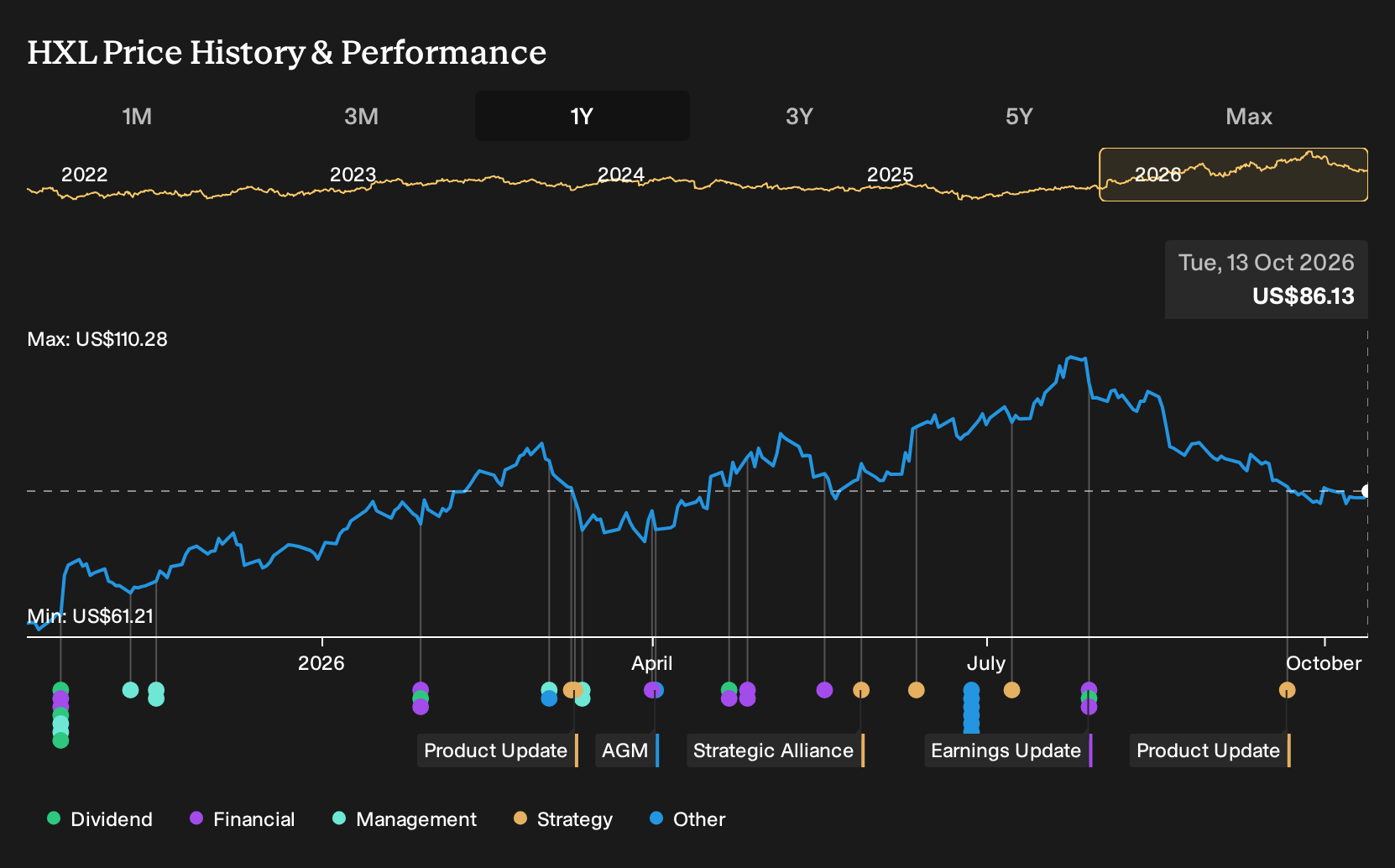
- Seaport Research Partners recently upgraded Hexcel after citing expectations for stronger military aircraft demand alongside recovering commercial aerospace production, both closely tied to Hexcel's composite materials business.
- The upgrade highlights how Hexcel's existing capacity and exposure to long running aerospace programs could matter more for future earnings mix than short term sentiment shifts.
- We will look at how Hexcel’s investment narrative lines up with expectations for stronger military aircraft demand highlighted in the recent upgrade.
Scan other aerospace exposed materials players that could also benefit if defense and commercial build rates trend higher, starting with our curated list of 20 high quality undiscovered gems.
Hexcel Investment Narrative Recap
To own Hexcel, you need to believe that higher build rates in commercial and defense programs eventually flow through its composite materials and structures without margin slippage. The key near term swing factor is how efficiently the extra capacity and roughly 400 new hires are absorbed as volumes move. The Seaport upgrade itself does not change that operational test in a material way.
The biggest risk right now is that inflation and start up costs keep operating margins stuck below the former 18% level for longer, especially with long term Airbus contracts signed before recent cost pressure. If military or commercial ramps come in choppy, that mismatch between fixed costs and revenue timing matters most.
The Seaport Research Partners call leans heavily on expectations for stronger military aircraft demand alongside recovering commercial production. This ties directly to Hexcel contracts on Airbus and Boeing platforms. That same backdrop underpins management commentary that reaching OEM peak build rates could add about US$500 million of commercial sales and roughly US$200 million of Defense and Space revenue over several years.
For you, the practical question is execution against those volume opportunities. Hexcel is targeting a return toward about 18% operating margin and roughly 25% EBITDA margin by the end of the decade, while holding annual capex under US$100 million. Progress on those internal goals, not the rating change, remains the cleaner way to track whether the aerospace demand story is turning into better cash generation.
What The Current Hexcel Forecasts Assume
Hexcel's current analyst framework leans heavily on a set of fairly specific numbers rather than vague optimism. Consensus modeling points to revenue growing by 11.2% a year over the next three years, with profit margins moving from 7.8% today to 13.1% on roughly the same timeline. Earnings are forecast to reach US$355.8 million by 2029, compared with earnings today of US$153.5 million, which implies a little more than a doubling of profit over that period. Those projections sit alongside an assumption that Hexcel can use a leaner share count, as analysts also bake in a 5% annual decline in shares outstanding over the next three years.
Hexcel's narrative projects US$2.7b revenue and US$355.8 million earnings by 2029. That profile assumes 11.2% yearly revenue growth and an earnings increase of about US$202 million from US$153.5 million today.
The valuation overlay then asks investors to weigh what they are willing to pay for that earnings stream. On the Simply Wall St scenario, the stock would trade on a P/E of 25.1x based on the 2029 earnings estimate, compared with 41.3x today and against an industry P/E of 34.7x for GB Aerospace & Defense. The same set of inputs, including a discount rate of about 8.3% to 8.35%, underpins a consensus 2029 view that Hexcel delivers the projected US$2.7b in sales and US$355.8 million in profit.
Uncover why Hexcel's fair value indicates a 26% potential upside to its current price, a valuation gap that could narrow quickly.
Exploring Other Perspectives
One alternate angle on Hexcel leans hard into the replacement cycle as a catalyst. The most optimistic analysts were already penciling in about US$3.0b of revenue and US$435.7 million of earnings by 2029, far above the baseline. Those views were formed before the Seaport upgrade, so you should expect opinions to shift and compare several versions of the story yourself.
Explore 2 other Hexcel fair value estimates, including one that suggests as much as 58% upside from the current price.
Form Your Own Verdict
Disagree with existing narratives? Extraordinary investment returns rarely come from following the herd, so go with your instincts.
- A great starting point for your Hexcel research is our analysis highlighting 4 key rewards and 1 important warning sign that could impact your investment decision.
- See our latest analysis for Hexcel. The report includes a comprehensive fundamental analysis summarized in a single visual, the Snowflake, making it easy to evaluate Hexcel's overall financial health at a glance.
Looking for more Hexcel-sized investment ideas?
If the Hexcel story has sharpened your thinking about aerospace exposure and earnings quality, use that same lens across the wider market with the Simply Wall St Screener. You can quickly filter for different return profiles, balance sheet strengths, and payout styles to build a watchlist that fits your own risk tolerance.
- For investors who want quality and value in the same place, start with companies that screen as 32 high quality undervalued stocks and see which businesses match your return and risk preferences.
- If capital preservation sits high on your checklist, filter for 32 resilient stocks with low risk scores and focus your research on businesses where balance sheet strength and stability score well.
- Income focused investors can zero in on reliable cash returns by scanning 8 dividend fortresses that might warrant a closer look for yield plus resilience.
This article by Simply Wall St is general in nature. We provide commentary based on historical data and analyst forecasts only using an unbiased methodology and our articles are not intended to be financial advice. It does not constitute a recommendation to buy or sell any stock, and does not take account of your objectives, or your financial situation. We aim to bring you long-term focused analysis driven by fundamental data. Note that our analysis may not factor in the latest price-sensitive company announcements or qualitative material. Simply Wall St has no position in any stocks mentioned.
Have feedback on this article? Concerned about the content? Get in touch with us directly. Alternatively, email editorial-team@simplywallst.com