


The Zhitong Finance App learned that Pierre Weinsch, a member of the ECB Governing Council and the President of the Bank of Belgium, said that the ECB may need to raise interest rates further. “We may have to raise interest rates again,” he said in an interview. But I'm not betting anymore because there's so much uncertainty about energy, and probably the same goes for artificial intelligence (AI).”
Weinsch declined to say whether this meant that the ECB would act later this month, or whether it would raise interest rates on the last interest rate decision of the year. He said, “At the end of the day, it doesn't really matter if it's October or December. The market's current pricing shows we'll have to do more. So this seems like a reasonable benchmark scenario, but then again, we're in a highly uncertain world.”
The ECB is currently discussing whether to raise interest rates further on top of the two rate hikes this year to curb inflation, which is approaching 4%. Economists expect the ECB to raise interest rates for the last time in December, which will raise deposit interest rates to 2.75%. The market estimates that once this level is reached, interest rates will begin to restrict economic activity.
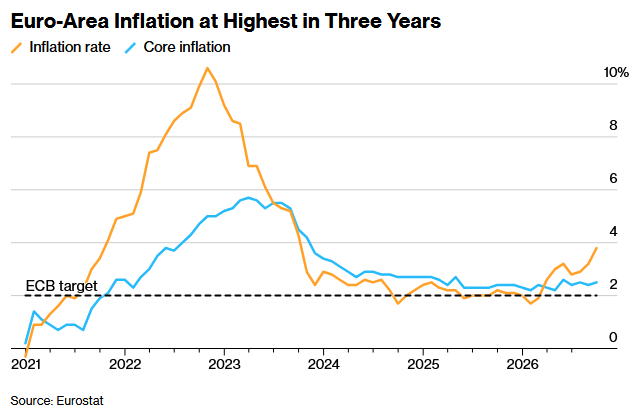
Eurozone inflation rises to highest level in three years
Eurostat data shows that the Eurozone inflation rate rose to 3.8% in September, up from 3.2% in August; energy prices rose 18.8% year on year, which is an important factor driving up inflation. Faced with rising energy prices, many European governments have responded by reducing fuel taxes, interfering with energy prices, and providing subsidies to residents and businesses. However, subsidies can only ease short-term burdens; it is difficult to eliminate the root causes of rising energy prices.
“Inflation is too high,” Wenshi said. He added, “Market expectations have changed,” and now “interest rate hikes in October are no longer expected,” and “we said we will rely on data to make decisions one meeting at a time. We may get some new data, so I'm not ruling out any possibility”.
The sharp rise in energy prices caused by the Middle East conflict is putting pressure on inflation in the Eurozone. However, policymakers emphasized that they have yet to see second-round effects such as wage increases. Some officials, including ECB chief economist Philip Lane, said that adopting a “controlled” policy response should be sufficient to restore price stability.
ECB President Lagarde said in another speech that high inflation in the Eurozone, driven by high energy prices, has not yet spread to the wider economy. She said that ECB officials are evaluating “how much indirect impact is being transmitted through the economy and see how we can best make early judgments if the second round of effects begins to appear.” She said, “We haven't seen any such phenomenon yet, but we must be extremely careful to ensure that we can observe these minor signs and indicators.”
Despite the unexpected resilience of economic growth in the Eurozone, further escalation of tension in the Middle East and high bond yields remain key risks. Lagarde warned that soaring bond yields would weigh more on economic activity than previously anticipated. Bank of France Governor Emmanuel Moulin expressed similar views on Wednesday. “Higher yields are putting pressure on the financial situation,” he said. “This is likely to have an impact on demand and may prompt us to respond more moderately to inflationary shocks, as rising yields themselves are also playing a role.”
Moulin also took a position similar to Lagarde's on the issue of inflation. He said that the ECB expects “indirect effects and second-round effects to continue to be controlled,” while Eurozone core price indicators will only accelerate “moderately”. He said, “What we have seen also — I think this is an important factor — medium term inflation expectations for both businesses and households are well anchored.” He added that the market “already has a full understanding” of the ECB's response function.
Furthermore, the French government's sharp rise in financing costs has refocused the market's attention on the ECB's crisis response tools, including the so-called “transmission protection tool” (TPI) designed by the bank in 2022. The tool is designed to curb unreasonable market fluctuations and allow the ECB to buy unlimited amounts of government bonds.
“I don't want to speculate if and when the ECB might step in,” said Winsch. We have this tool, and you mentioned it, also known as TPI. There are some grey areas here, and I'm not going to guess all of the potential gray areas. But this tool does exist, and if developments become unreasonable, we have the right tools.”
However, the current situation seems unlikely to meet the conditions for using this tool, as investors are reacting, at least to some extent, to France's political impasse over the budget. Mulan has also warned that the ECB is not here to “deal with countries' financial problems.”
“To some extent, there is some market pressure and even helping, because the government can say to its voters, 'Look, if we don't do that, then we'll have to face higher debt interest costs, '” Weinshi said. He added: “But we know that from a political perspective, it's not easy to cut the deficit, and that's the reality.”