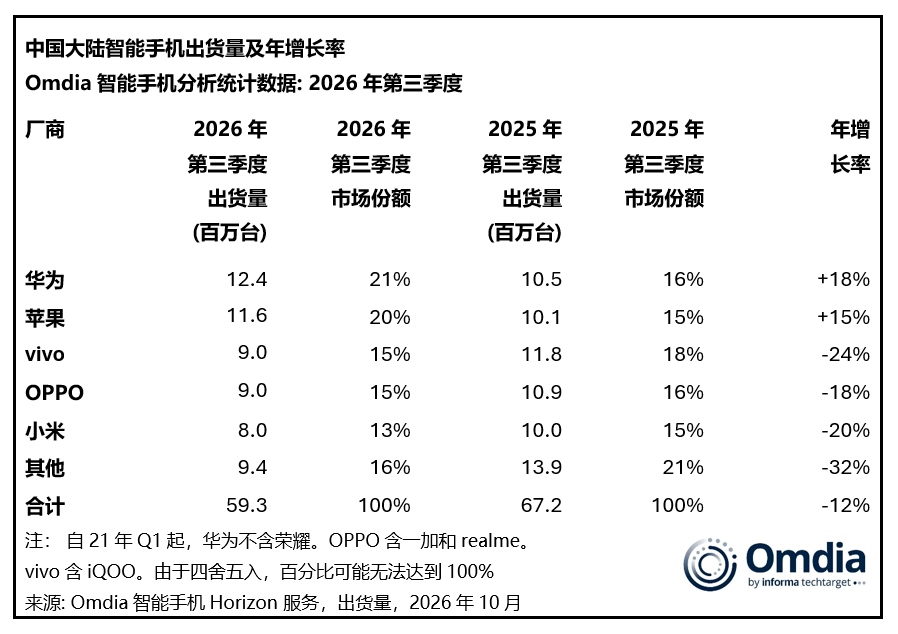
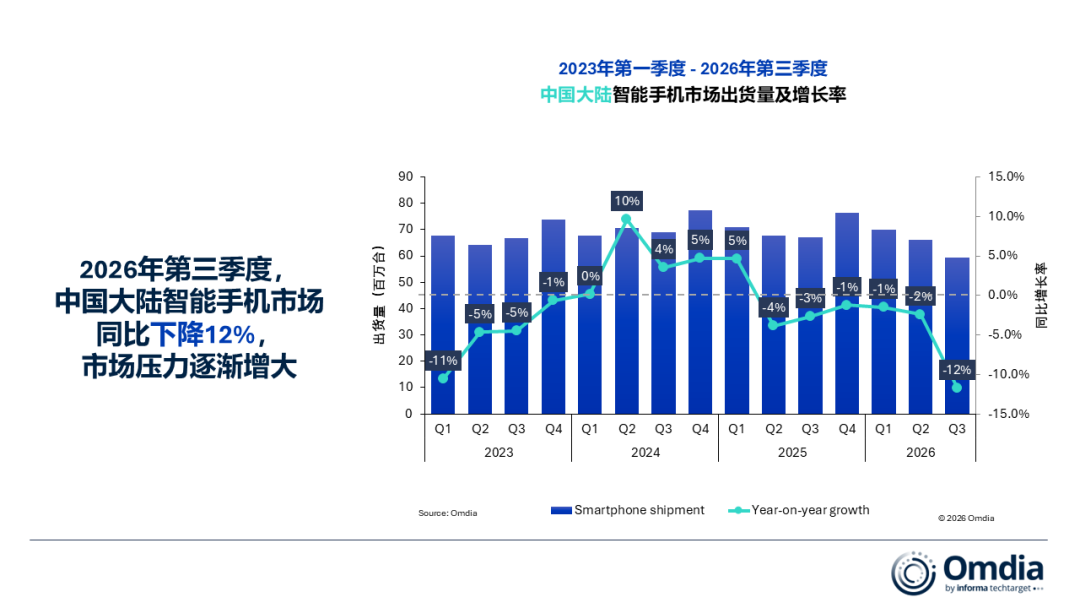
The Zhitong Finance App learned that Omdia's latest research shows that mainland China shipped 59.3 million mobile phones in the third quarter of 2026, down 12% year on year, a record low since 2013; high storage costs suppressed demand, leading the total share of Huawei and Apple (AAPL.US) with 41%. Other manufacturers are under pressure, and are expected to drop by about 7% for the whole year.
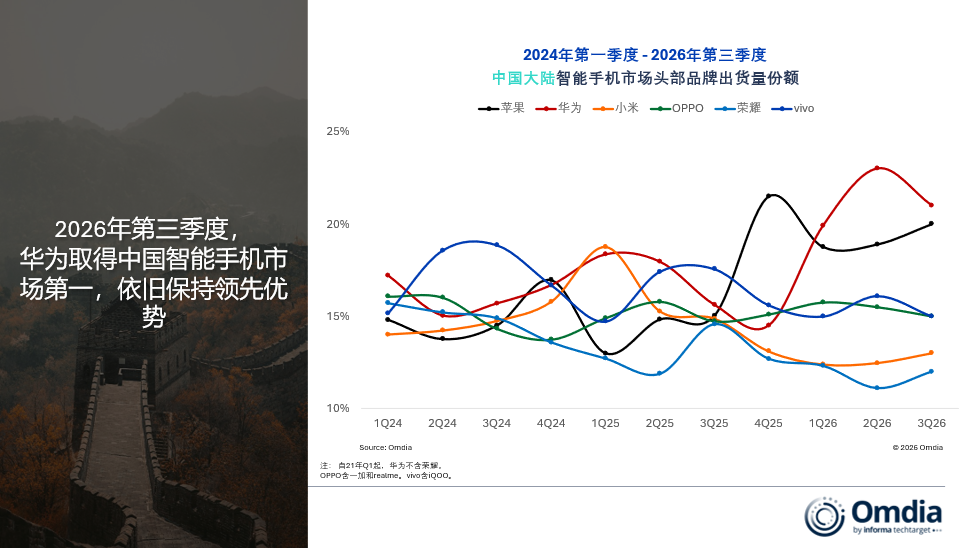
According to Omdia's latest research, in the third quarter of 2026, the mainland China smartphone market shipped about 59.3 million units, down 12% year on year, and the decline was significantly higher than 2% in the second quarter. This is also the lowest third-quarter shipment level in mainland China since 2013. In a context where memory costs remain high and consumers tend to be cautious about switching, performance among manufacturers is further divided. Huawei shipped 12.4 million units, up 18% year on year, ranking first with 21% share; Apple shipped 11.6 million units, up 15% year on year, ranking second with 20% share. The combined market share of the two manufacturers reached 41%, an increase of about 10 percentage points over the same period last year. Vivo shipped 9 million units, ranking third with a weak advantage; OPPO (including OnePlus and Realme) shipped 9 million units, ranking fourth, with a share of about 15%; Xiaomi (01810) shipped 8 million units, ranking fifth.
In the third quarter of 2026, high storage costs continued to put cost pressure on the entire industry, and the further increase in terminal pricing suppressed some consumer demand. Relying on a full-price product matrix, a mature pricing strategy, the iteration of the Hongmeng system ecosystem, and the popularity of new products in the “wide screen” format, Huawei continues to consolidate its leading position in the market. Apple maintains a strategy of not increasing the price of old products before new products are released, driving channels to prepare goods in advance, and at the same time accumulating market potential for the new model window in the fourth quarter. The remaining Android vendors faced the double pressure of cost and demand, and shipments declined. Vendors relied more on optimizing channel inventory, enhancing system and AI functions, and iterating mid-range product lines to maintain operational resilience. The overall market volume has declined, but there is still some vitality in the high-end market and new demand such as wide folding in the stock market.
Omdia chief analyst Hayden Hou (Hayden Hou) said, “Storage prices reached a phased high in the third quarter of 2026. Cost pressure was transmitted from top to bottom to terminal products, impacting each brand's shipping performance to varying degrees, and market differentiation further intensified. In order to cope with cost pressure, leading brands are actively strengthening the share of high-end products. For example, Xiaomi's flagship digital series canceled the digital standard edition this year, OPPO and Vivo added Pro Max models to the flagship series; at the same time, they optimized the mid-range and low-end product configuration structure, such as reducing product color schemes, and only introducing a small number of main memory configurations for models. With the launch of new Apple models and the centralized release of new flagships from domestic manufacturers, the third quarter was supposed to be a peak period for flagship switching, but due to cost pressure, market shipments fell short of expectations. How to maintain brand vitality while maintaining brand profits is still a core proposition for all manufacturers.”
Apple adjusted the pace of product releases this year, and the strategy of launching only Pro series products in September and moving products such as the digital standard edition to the next year was officially implemented. Changes in Apple's release cycle will not only change Apple's own annual shipping curve, but also bring changes in the competitive window for local manufacturers. Local brands need to match and adjust the pace of new product launches, resource investment, and product portfolio strategies to seize the alternating market gap between old and new Apple products.
Omdia senior analyst Lucas Zhong (Lucas Zhong) said, “The AI competition in the Chinese smartphone market has passed through the initial stage of competing for hardware computing power and large model parameters. The competitive focus is shifting to the underlying architecture of the operating system, task completion of Agent agents, and collaborative experience across application ecosystems. Although the current industry is full of solutions, the implementation of smart devices still faces practical obstacles such as open application rights, unified agreements, and end-side computing power restrictions. Most products are still in the transition from technical verification to large-scale commercial use. In an environment where storage costs are high, manufacturers need to balance R&D investment, hardware costs, and terminal pricing. Only by transforming AI capabilities into practical high-frequency scenarios can they truly leverage the switching needs of the stock market.”
Against the backdrop of pressure on large market shipments, the domestic consumer side is still showing strong resilience, but the consumer switching decision logic has changed. According to the “Omdia Chinese User Readiness Study”, although hardware configuration is still the basis for consumers' switching decisions, 28% of Chinese consumers will consider changing mobile phone brands because of stronger AI capabilities, indicating that hardware advantages alone are no longer enough to drive users to switch brands.
Omdia predicts that the annual smartphone shipments in mainland China in 2026 are expected to drop about 7% year over year.