


The Zhitong Finance App learned that the Netherlands-based EUV/DUV lithography machine Big Mac (ASML.US) announced its third quarter results and basic future prospects during the noon trading session on Wednesday, Beijing time, which can be described as a major strengthening agent for the semiconductor sector of the global stock market, which has recently experienced a significant correction, and even the AI computing power theme as a whole. Asmack's financial report and performance outlook are clearly positive for semiconductor equipment and the basic outlook for the global AI computing power industry chain. The core support comes from profit margins, fourth quarter guidance, and a huge wave of demand for semiconductor equipment in fabs driven by strong AI computing power demand that extends beyond 2028 and even into 2030.
The release of Asmack's performance report coincided with global semiconductor and stock trading related to extensive AI computing power infrastructure. As of October 13, the Philadelphia Semiconductor Index, which has the title of “Global Semiconductor Weather Vane”, had been falling for 5 consecutive days, and the cumulative retracement was close to 10%. In particular, the stock price of Micron, a leader in memory chips under the AI wave, fell 3.6% on the same day; the KOSPI benchmark index of the Korean stock market fell about 5.5% on the same day. The world's two largest memory chip dominators are also chip giants with 50% weight in the KOSPI index — Samsung Electronics and SK Hynix They fell sharply by about 7.4% and 10%, respectively, and recovery only began in early trading on the 14th. For the global AI computing power industry chain, which urgently needs verification of performance and basic prospects, Asmack can be described as providing substantial evidence that customers continue to seek production capacity.
Prior to the release of Asmack's strong performance and outlook, global chip manufacturing leaders TSMC and Samsung Electronics had previously given explosive initial performance guidelines. Chip manufacturing giant TSMC, which has the title of “King of Chip Foundry,” saw initial revenue growth of about 50% in the third quarter, and the initial operating profit of memory chip giant Samsung Electronics reached about 107.4 trillion won, an increase of 782.5% over the previous year, which is equivalent to 8.825 times that of the same period last year. However, the strong growth performance of these two major chip giants failed to last 10 years Eliminate the continuing valuation pressure faced by memory-chip-themed stocks at a time when 30-year US Treasury yields surged.
Compared with the initial performance of these two major chip giants, the core incremental information released by Asmack is unquestionably: the current supply plan is still difficult to meet demand from 2027 to 2028, so research is further expanding production capacity in 2028, and the purchasing intentions of some large customers have been extended to 2029-2030. These incremental details may be a strong catalyst for a major counterattack on the computing power theme.
OpenAI is negotiating a pre-investment valuation of about 1.4 trillion US dollars; the valuation judgment given by Anthropic's potential IPO investors reached 1.8 trillion to 2 trillion US dollars, and there are expectations that match or exceed the scale of SpaceX's issuance. These are still within the scope of the IPO listing expectations promoted by financing negotiations and Silicon Valley venture capital.
Compared to AI application valuation narratives, the AI computing power supply chain already has a more specific basis for strong demand: the media revealed Anthropic's infrastructure arrangement of about $518 billion over the next ten years, of which about 80% is irrevocable or agreed upon. Anthropic's revenue in 2025 increased about 12 times the previous year, close to 4.6 billion US dollars, operating losses exceeded 8 billion US dollars, computing power and infrastructure expenses reached 7.33 billion US dollars, about three times that of 2024, accounting for about US$12.65 billion in total operating expenses 58%; Nvidia's data center revenue in the latest quarter was US$89 billion, up 117% year on year; South Korea's semiconductor exports in September were US$60.3 billion, up 262.8% year on year. Officials also indicated an increase in the number of storage exports and contract prices.
From the perspective of heavyweight AI inference workloads, the continuous back-office execution of the AI agent Muse, which has recently become popular around the world, and the improvement in the capabilities of the cutting-edge AI model Astra in complex computer tasks have expanded the scope of work that AI can handle; multi-step tasks, tool calls, and parallel agents may also increase model calls and context processing corresponding to each user. Anthropic has observed in its research system that multi-agent tasks use about 15 times more tokens than normal chats. What can be deduced from this is that with the full penetration of cutting-edge AI agents such as Muse, AI computing power requirements will spread along GPU computing, HBM and DRAM capacity bandwidth, KV cache and SSD storage, high-performance CPU tool execution, and high-speed data transmission systems based on optical interconnect chips; overall resource requirements ultimately depend on the combined effects of increased task volume and improved unit task efficiency.
Looking at engineering logic, intelligent systems expand a question and answer to planning, search, tool call, code execution, and result verification. Multiple rounds of reasoning increase computational requirements. The management of the US semiconductor equipment giant Application Materials clearly stated earlier that smart applications urgently require AI accelerators such as large AI GPUs and more CPU-intensive computing architectures, and increase DRAM and NAND requirements to provide additional growth impetus for wafer manufacturing equipment.
Therefore, the semiconductor equipment side can be described as benefiting from the joint promotion of “demand for expansion of production” and “process upgrading”. Advanced logic chips have a fully surround gate structure, high-rise 3D NAND, and HBM stacking and advanced packaging, improving the technical requirements for EUV or even high-NA EUV lithography technology, precision deposition, selective etching, chemical mechanical polishing, and defect control. Demand continues to grow, which may not only drive new production lines, but also increase the need to upgrade existing production lines.
Semiconductor equipment is in short supply! Asmat shouted: Customers have even asked for lithography machine orders in 2030
Asmack warned that the sharp rise in AI spending means there may be a supply gap for its chip manufacturing equipment in the next two years; at the same time, the company raised its 2026 sales forecast.
According to the current supply plan, Asma said it would not be possible to fully meet demand in 2027 and 2028. When the company, headquartered in Veldhoven, the Netherlands, announced results on Wednesday, Asmack CEO Christophe Fouquet said at the performance conference: “We are studying how to increase production capacity by more than 30% in 2028 than previously announced.” “Customers are asking us for more equipment every day,” he highlights in another video.
Compared to the closing price in Amsterdam on Tuesday, Asmack's shares in Tradegate fell by more than 1%, but narrowed after management releases needed to be extended to 2030. European Stoxx 50 futures narrowed their gains slightly after the results were announced.
Asmack expects sales of 44 billion to 45 billion euros this year, and 44 billion euros is about 49 billion US dollars; in contrast, the lower limit of the forecast range previously given by the agency was 43 billion euros.
The industry is increasingly questioning whether the AI boom will continue. Asmack's advanced equipment takes more than a year from order placement to delivery, so its performance can reflect chipmakers' medium- to long-term capacity expansion and investment plans. This week, after Broadcom CEO Chen Fuyang compared industry investor sentiment to a casino, global semiconductor stocks were sold off.
However, some institutional investors are beginning to worry about whether Asmack can fulfill orders when market demand is strong. In July, the company said it plans to increase the production capacity of its second-most advanced low aperture extreme ultraviolet lithography machine by 30% next year, bringing the annual shipment target to about 85 units.
Fukai said that customers have improved equipment demand forecasting based on the “scale and duration” of AI-related investments. Some customers “expressed interest in placing orders with us for 2029 or even 2030,” Fukai said at the performance conference.
Asmack is the only company that produces this kind of cutting-edge lithography equipment. Its equipment is used to manufacture data center chips that support the AI boom. As AI infrastructure spending surges, the outlook can reflect the investment plans of manufacturers such as TSMC, Samsung Electronics, and Intel.
The company is speeding up delivery by shortening the production cycle — the time it takes to start manufacturing in a clean room to ship the complete equipment. Construction of its second industrial park in the Netherlands has begun, and the first phase is expected to be completed in 2029.
The boom in AI spending has propelled Asmack to become the company with the highest market capitalization in Europe. By the close of trading on Tuesday, its stock price had increased a cumulative total of 64% this year.
The company said that net sales rose sharply to 11.66 billion euros from July to September, slightly falling short of the agency's average analysts' expectations — that is, about 11.7 billion euros.
Seventeen EUV devices were sold during the quarter. As chip makers seek to increase productivity, revenue from servicing and upgrading existing equipment at customer sites increased 19% month-on-month.
Chief Financial Officer Roger Dawson said in a video released along with the results: “The overall increase in 2026 compared to 2025 is 36%, mainly driven by the highest-end EUV product line. As a result, the EUV business grew by more than 45% this year.”
South Korea was still Asmack's largest market for new system equipment in the third quarter, followed by the Chinese market. According to Asmat's management's latest forecast, China is expected to account for about 20% of this year's total revenue.
Last quarter, major chipmakers announced plans to order Asmack's most advanced devices, each costing $400 million. Samsung and TSMC said, respectively, that they will begin mass production of chips using high-numerical aperture EUV equipment (also known as high-NA EUV — high-numerical aperture extreme ultraviolet lithography) in 2028 and 2030. Intel said in September it had used the technology to process more than 1 million wafers.
Concerns about the potential dangers of AI are also growing. Companies such as OpenAI and Anthropic revealed a number of incidents where models acted unauthorised, causing outsiders to worry about AI security risks and discuss slowing or suspending cutting-edge AI development.
Microsoft CEO Satya Nadella recently called for restraint and said that companies deploying advanced AI should not rely only on guarantees from model developers.
Asmack's tenacious belief in AI: profit cashing out is speeding up, and production expansion still can't keep up with the bursting demand for AI computing power
According to more detailed performance disclosure data on Asmack's official website, Asma has moved further from revenue expansion to accelerated profit release: operating profit grew significantly faster than revenue, and demand for equipment upgrades combined with operating leverage to enhance profitability.
In the third quarter of 2026, Asmack's revenue reached 11.662 billion euros, an increase of 55.2 percent over 7.516 billion euros in the same period last year. The gross margin increased from 51.6% to 57.5%, an increase of 5.9 percentage points, indicating that revenue growth was accompanied by a stronger gross profit contribution. Revenue was within the management's previous guidance range of 11 billion to 12 billion euros, slightly lower than analysts' unanimous expectations of about 11.7 billion euros; gross margin broke through the previous guidance limit of 55% to 57%, and the highlights of the financial report can be described as focusing more on profit quality.
Operating profit increased 109.6% year over year from 2,468 billion euros to 5.173 billion euros, nearly double the revenue growth rate. Based on the amount in the chart, the operating profit margin increased from about 32.8% to 44.4%, an increase of about 11.5 percentage points: while gross margin improved, expenses such as R&D and sales management did not expand in the same proportion, so that additional revenue was more fully converted into operating profit. Net profit increased from €2.125 billion to €4.960 billion, up about 133.5% year on year; basic earnings per share rose from €5.49 to €12.95, an increase of 135.9%, and the caliber per share was also affected by changes in the weighted average number of shares.
Net profit is about 20% higher than FactSet's consolidated estimate of 4.13 billion euros, but Mistral AI investment revalued income of about 510 million euros before tax was recorded for the quarter, so the total net profit increase cannot be attributed to equipment operation. In contrast, the doubling of operating profit and the increase in operating profit margins directly reflect the significant improvement trend in Asma's main business.
In addition, Asmack's revenue from service and site upgrades reached 3.289 billion euros, up 67.6% from 1,962 billion euros, and 19.1% month-on-month, exceeding the previous forecast of about 2.9 billion euros; its revenue share increased from about 26.1% to 28.2%. To a large extent, this indicates that customers are not only purchasing new equipment, but also increasing throughput and seeking more wafer output by upgrading existing equipment. Sales of lithography systems increased from 72 units to 121 units, an increase of 68.1%, which is enough to reflect the marked expansion in the scale of semiconductor equipment delivery under the increasingly strong AI computing infrastructure frenzy.
In terms of outlook, fourth-quarter revenue is expected to be 14.2 billion to 15.2 billion euros, with a median value of 14.7 billion euros, which is about 3.6% higher than LSEG's forecast of 14.19 billion euros; gross margin is expected to be about 57%, higher than market expectations of 55.4%. The annual revenue guidance was raised from 43 billion to 45 billion euros to 44 billion to 45 billion euros, the lower limit of the range; gross margin increased from 54% to 56% for the whole year. The benefits of value pricing negotiations will be partially reflected in 2027 and more fully reflected from 2028, so current profit improvements and subsequent pricing contributions support continuous profit growth.
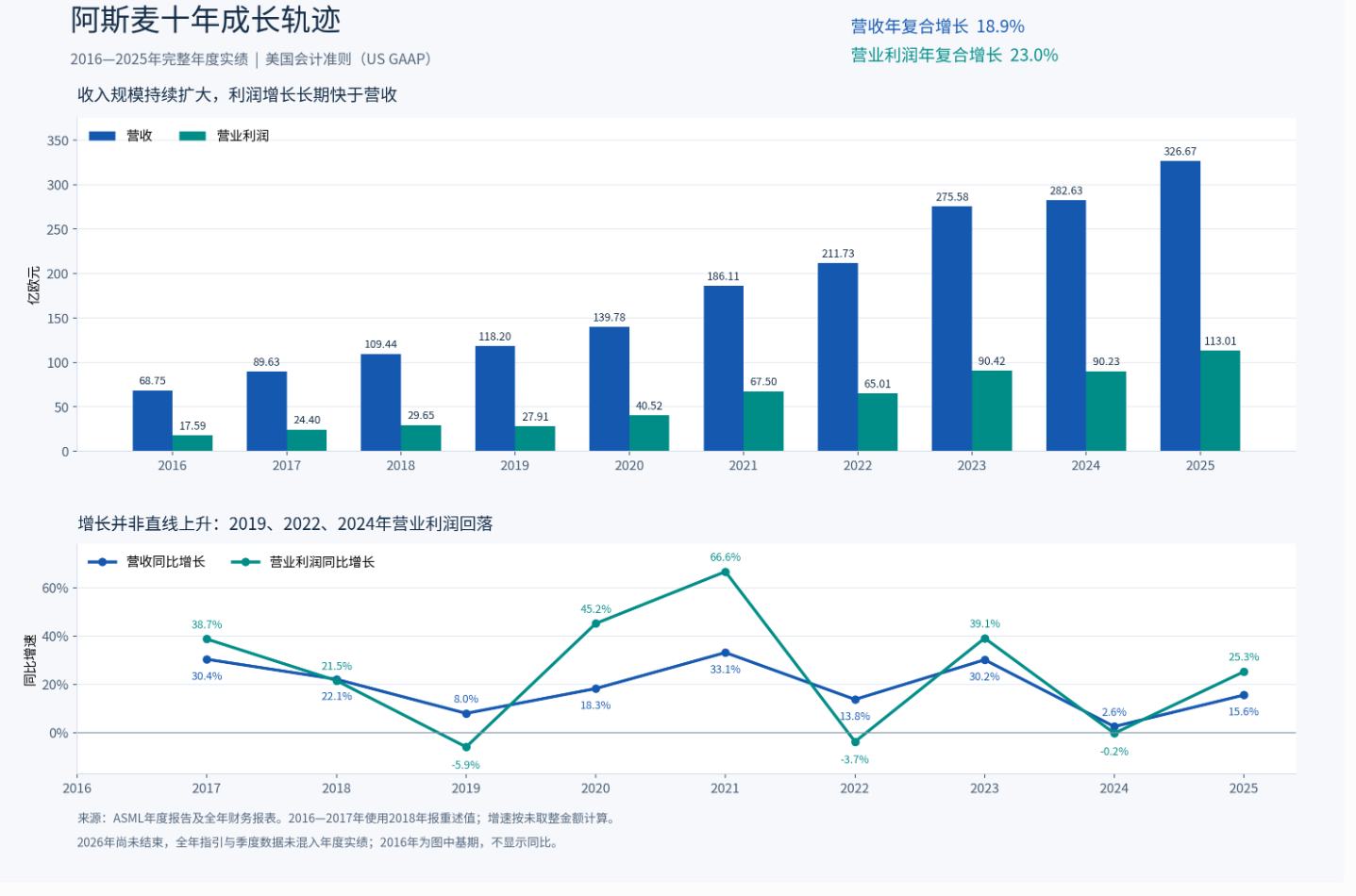
Judging from the ten-year growth trajectory, Asmack's revenue increased 4.75 times the original, with a compound annual increase of about 18.9%; operating profit increased 6.43 times, with a compound annual increase of about 23.0%, and the cumulative operating profit margin increased by about 9 percentage points. However, in 2019, 2022, and 2024, there were differences in revenue growth and decline in operating profit, indicating that technological advantages can boost the long-term profit center, and annual profit is still affected by product mix, delivery pace, and cost investment. Operating profit increased 25.3% again in 2025, indicating that profit expansion was once again faster than revenue growth.
From the use of smart devices to the trend of large-scale expansion of fab production capacity: the “wave of AI computing power” accelerates transmission to the device side
The intelligence represented by Muse, Astra, and Claude extends a user task to planning, retrieval, tool call, and multiple rounds of reasoning; long context, multiple modes, and concurrent execution, further increasing computation, KV caching, and data handling requirements. When the expansion of the call scale exceeds the capacity released by improving algorithm efficiency, demand is transmitted to wafer manufacturing along GPU, TPU, ASIC, HBM, and server supporting chips. Different computing routes compete for market share, yet they all rely on advanced logic processes, storage capacity, and packaging capabilities.
As a result, the device side also benefits from increased wafer production and complicated manufacturing processes. Advanced logic and some advanced DRAM increase critical lithography requirements; 3D transistors, storage stacking, and advanced packaging increase deposition, etching, measurement, and material input. The increase in the number of NAND layers directly drives etching and deposition, so it is not possible to purchase all AI equipment requirements at once to be classified as EUV. At the same time, increasing the throughput of existing lithography machines can release production capacity within existing plants, which explains the strong growth in Asmack's upgrade business.
Asmack's strong performance growth trajectory can be described as echoing Wall Street financial giant Deutsche Bank (Deutsche Bank)'s recent increase in the 2026-2028 WFE spending forecast to 154 billion, 217 billion, and 270 billion US dollars, corresponding to growth rates of 40%, 41%, and 24%. The basis is that 8-10 major tier-1 fabs will enter the installation phase in 2027, and the forecast is largely independent of large-scale price increases. Asmat plans to increase production capacity of low NA EUV and infiltrated DUV by about 30% in 2027. The further production expansion plan previously studied in 2028 is still insufficient to meet demand, and now it is evaluating an increase of more than 30%. Fab installation schedules and equipment supply bottlenecks are mutually confirming the intensity of this round of capital expenditure.
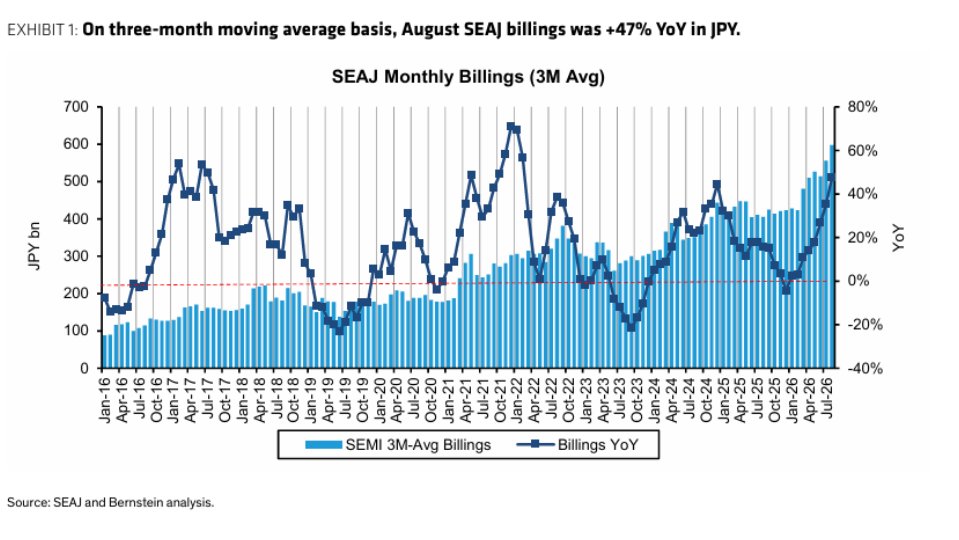
Another Wall Street giant, Bernstein recently said that a huge wave of investment in semiconductor stocks (that is, AI semiconductors) around the topic of AI computing power is spreading from the procurement of AI computing power resources by cutting-edge AI laboratories and major cloud computing companies to semiconductor manufacturing equipment stocks related to AI computing power infrastructure. Bernstein cites that semiconductor equipment supplier sales in the Japanese market reached 545 billion yen in August, up 50% year on year. Among them, front-end manufacturing, assembly, and test equipment increased by about 37%, 22%, and 98%, respectively; the three-month moving average sales continued to rise, and the expansion in demand for display equipment was supported by stronger medium-term demand.
According to a recent research report released by a team of analysts at Morgan Stanley, even if the world's most popular memory chip stocks such as SK Hynix, Samsung, and Micron traded “their profit growth trajectory peaked” ahead of schedule, semiconductor equipment stocks may continue to receive huge net capital inflows — that is, storage stocks begin trading and reach a peak in profit, which can occur at the same time as equipment purchases.
Morgan Stanley stressed that stock price trading is about the speed of future price increases and room for profit improvement. Historically, weakening storage stocks can lead the peak of profit for 4 to 8 months; even if profits reach record highs, they may be pressured by the market's expectations of subsequent increases in supply. At the same time, high profits spur the expansion of original production: the DRAM capital expenditure quoted in the report is expected to rise from US$98 billion in 2026 to US$150 billion to US$160 billion in 2027, while additional effective output will not be released until the second half of 2027. This creates a time difference — storage stocks first discount future supply, and equipment suppliers first receive the procurement revenue needed to build these supplies, providing a basis for the phased performance differentiation of the two types of stocks.
Asmack's growth sources also went beyond the single storage price cycle. GPU, TPU, and ASIC upgrades jointly drive investment in advanced logic processes. Advanced DRAM migration increases key lithography requirements, and existing equipment upgrades help customers increase output; these requirements correspond to additional wafer production capacity, manufacturing accuracy, and production efficiency, respectively. HBM expansion involves DRAM wafer manufacturing and subsequent stacking packaging. Asmack mainly benefits from the former; etching, deposition, and packaging equipment suppliers benefit differently. Asmack's service upgrade revenue increased by 67.6%, and the 2027-2028 supply plan is still difficult to fully meet demand, indicating that its growth driver has covered both the delivery of new equipment and the improvement of the efficiency of existing equipment, and has a broader demand base than simply betting on storage price increases.
The key that the semiconductor equipment sector may outperform the storage theme is that customer production expansion and technology migration continue to translate into improvements in equipment delivery, stand-alone value, and continued profit. Damo is shifting its allocation focus to computing chips, networks, and supporting equipment, reflecting that capital is looking for the next stage of growth, rather than just selecting stocks based on current low price-earnings ratios; Asmack's technical barriers, upgraded business, and subsequent pricing contributions are in line with this direction. The basis for establishing its comparative advantage is that customers maintain investment in production expansion and process upgrades: however, it is important to note that if storage prices fall back and eventually lead to capital expenditure cuts, the equipment will also be transmitted. Currently, one of the more accurate AI computing power layout strategies is that the market tends to advance the inflection point of the transaction cycle for memory chips, but it has not eliminated the bullish logic that the device side is still in the delivery expansion stage.