


- OGE Energy, through utility subsidiary OG&E, is supplying power to Google’s large data center campuses in Muskogee County and Stillwater as part of Oklahoma’s buildout of 64 operating or planned data centers across the state.
- The arrangements to power these AI and cloud facilities are structured to support regional economic development while aiming to shield existing OG&E customers from higher bills. This highlights how large-load demand can be pursued without shifting costs onto households and small businesses.
- We will now look at how OGE Energy's investment narrative evolves as it becomes a key power provider for Google's Oklahoma data centers.
Scan beyond OGE Energy and size up other grid and data-center plays through our hand-picked 43 power grid technology and infrastructure stocks, which is building the backbone for AI and cloud demand.
OGE Energy Investment Narrative Recap
To own OGE Energy, you need to be comfortable with a utility that is leaning into very large power customers while carrying a heavy capital plan. The short term swing factor is execution on that US$7.3b program and the Oklahoma large load tariff, so those Google data center campuses matter as proof that the framework is being used.
At the same time, the biggest near term risk has not gone away. Industrial and oilfield demand still looks soft and past regulatory pushback on cost recovery shows that approvals are not automatic. If similar rulings reappear on future plants or transmission work, that could strain earnings, cash flow and the dividend coverage story.
The most relevant development for this data center news is OGE Energy’s focus on long term contracts with minimum charges and customer funded interconnection for large users. That structure matters for you because it aims to keep returns tied to committed load instead of purely volumetric demand that could swing around.
When you compare that with the existing risk list, the picture is mixed. Large campuses such as Google’s help support the capital program and grid buildout, yet the utility still relies on external borrowing, faces interest coverage constraints and does not fully cover its 3.63% dividend with free cash flow. Execution and regulatory follow through remain the key watchpoints.
What The Current Forecasts Assume For OGE Energy
Analysts are effectively asking you to underwrite a bigger, more profitable OGE Energy that leans into large loads like Google while keeping the rest of the customer base onside. The core assumptions behind that view matter, because they shape both the growth story and the risks around execution and regulation you have already seen play out in Oklahoma.
On the top line, the consensus view points to revenue expanding at 6.2% a year over the next three years. That is a reasonably brisk clip for a regulated utility, so it embeds expectations that the current capital program, data center buildout and large-load tariff all translate into a larger billable base rather than just higher costs. For you as an investor, that growth rate sets the bar that future rate cases and volume trends will be judged against.
Profitability assumptions move in the same direction. Analysts are modeling profit margins rising from 14.4% today to 16.1% in three years. A higher margin profile like that usually needs effective cost recovery on new plants and transmission, no major missteps on construction, and a regulatory framework that still allows the utility to earn its authorized return while layering on big projects tied to AI and cloud demand.
Earnings expectations are spelled out more clearly. Forecasts have OGE Energy generating US$467.0m in earnings today and reaching US$625.3m by about 2029, with most analysts clustered around that estimate. That implies an earnings increase of roughly US$158m over the period, helped by both higher revenue and the margin expansion just outlined. The consensus is not banking on a one-off spike but a step up in the run rate that reflects the larger asset base and new large-load contracts coming into the system.
Those profit forecasts feed directly into how the stock is being valued. To match the current analyst price targets, the shares would need to trade on a P/E of 22.2x those 2029 earnings, up from 19.9x today and above the 19.7x multiple cited for the broader US electric utilities group. That setup assumes investors are willing to pay a premium relative to the sector for the combination of data center exposure, capital spending plans and balance sheet discipline, rather than treating OGE Energy as just another regional regulated utility.
On the balance sheet, the projections factor in share count growing by 2.54% a year for the next three years and use a 7.24% discount rate to translate future cash flows into today’s value. This implies some level of ongoing equity issuance or dilution alongside debt financing to support the US$7.3b program from 2026 to 2030. When you line that up against the company’s target FFO to debt ratio of about 17%, it flags that access to capital and rating agency comfort remain central to the equity story.
Put together, the scenario analysts are using is quite specific. OGE Energy leans on roughly mid single digit annual revenue growth, higher margins, larger earnings and a somewhat richer P/E multiple by 2029, all while taking on more projects for hyperscale customers. None of these numbers are extreme on their own, but taken as a package they form a clear test for the investment case, particularly on regulation and the timing of cost recovery.
OGE Energy's narrative projects US$3.9b revenue and US$625.3m earnings by 2029. This scenario assumes 6.2% yearly revenue growth and an earnings increase of about US$158m from US$467.0m today.
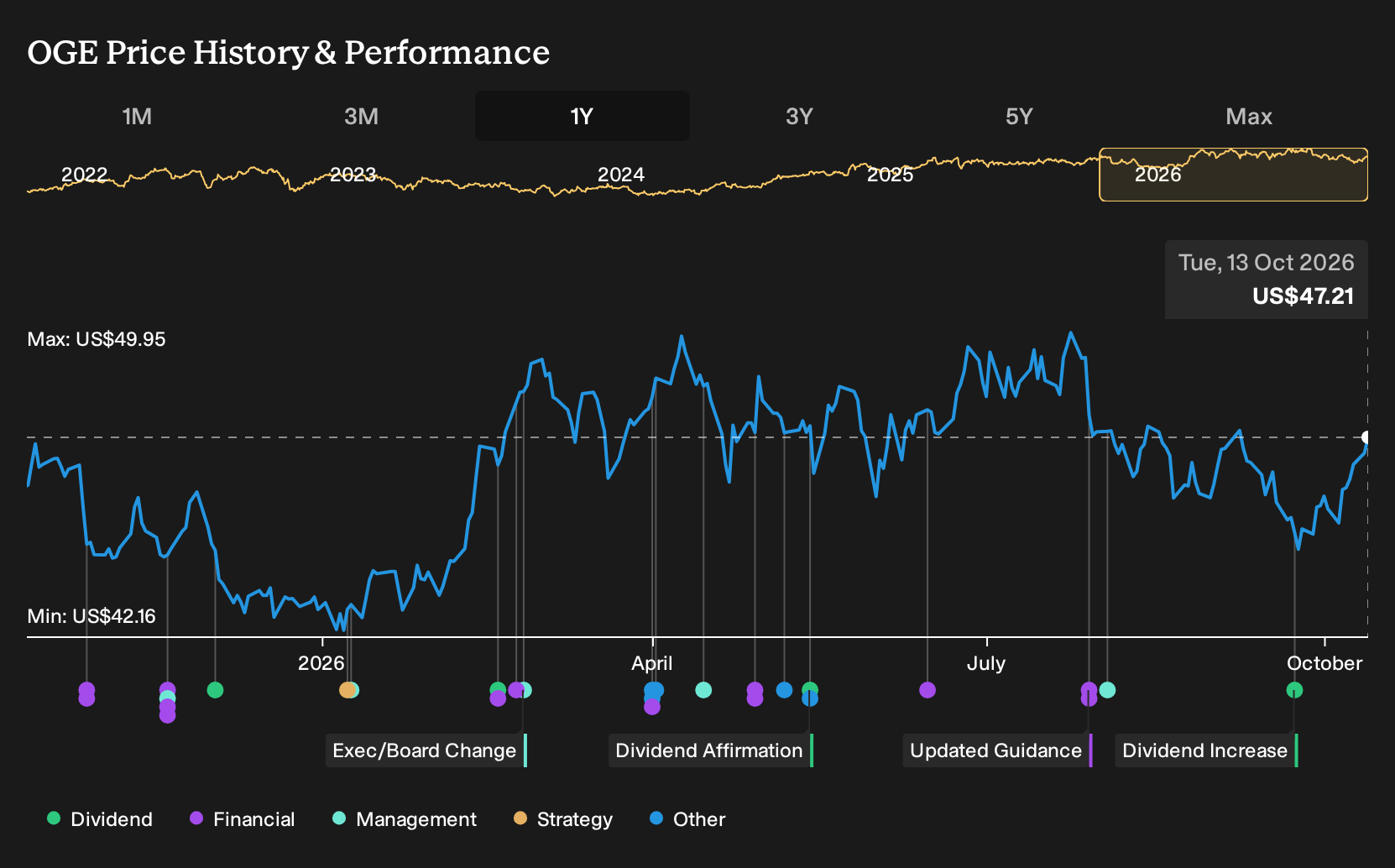
Uncover why OGE Energy's fair value indicates a 7% potential upside to its current price that could narrow quickly.
Exploring Other Perspectives
Three fair value estimates from the Simply Wall St Community span from US$36.33 to more than US$101,000, so opinion on OGE Energy is clearly all over the map. Those views do not yet reflect Oklahoma’s rising data center buildout or the related capital and regulatory pressures, which you should weigh before siding with any single camp.
Explore 2 other OGE Energy fair value estimates, including one that suggests as much as 214887% upside from the current price!
The Verdict Is Yours
Don't just follow the ticker. Dig into the data and build a conviction that's truly your own.
- A great starting point for your OGE Energy research is our analysis highlighting 1 key reward and 2 important warning signs that could impact your investment decision.
- See our latest analysis for OGE Energy. The report includes a comprehensive fundamental analysis summarized in a single visual, the Snowflake, making it easy to evaluate OGE Energy's overall financial health at a glance.
Looking For More Investment Ideas Beyond OGE Energy?
If the OGE Energy story has you thinking about how grid upgrades, data traffic and balance sheet strength all intersect, it can help to line it up against other listed utilities and infrastructure stocks. The Simply Wall St Screener lets you filter for the traits that matter most to you so you can build a watchlist that fits your own risk and income preferences.
- For investors who want income that aims to be more durable, start with companies screened as potential income anchors through our 8 dividend fortresses.
- If capital preservation ranks higher on your list than aggressive upside, look through the 32 resilient stocks with low risk scores to see businesses that score well on resilience and financial risk checks.
- When you want quality first and are hunting for underfollowed opportunities, scan through our 20 high quality undiscovered gems that combine stronger fundamentals with less crowded ownership.
This article by Simply Wall St is general in nature. We provide commentary based on historical data and analyst forecasts only using an unbiased methodology and our articles are not intended to be financial advice. It does not constitute a recommendation to buy or sell any stock, and does not take account of your objectives, or your financial situation. We aim to bring you long-term focused analysis driven by fundamental data. Note that our analysis may not factor in the latest price-sensitive company announcements or qualitative material. Simply Wall St has no position in any stocks mentioned.
Have feedback on this article? Concerned about the content? Get in touch with us directly. Alternatively, email editorial-team@simplywallst.com