


- Royal Bank of Canada has issued a C$500 million four-year callable fixed-to-floating rate Indigenous Bond under its Sustainable Bond Framework to fund lending and investment for Indigenous communities and businesses across Canada.
- This Indigenous Bond ties Royal Bank of Canada's funding directly to economic reconciliation goals, linking its balance sheet to targeted community financing rather than generic corporate purposes.
- We will now look at how Royal Bank of Canada's investment narrative is shaped by this C$500 million Indigenous Bond issuance.
Scan how Royal Bank of Canada's Indigenous Bond fits into a wider opportunity set by comparing it with curated list of solid balance sheet and fundamentals (8 results) that are also tapping debt markets to fund targeted growth and impact.
Royal Bank of Canada Investment Narrative Recap
To hold Royal Bank of Canada long term, you need to be comfortable with a large, diversified lender leaning on fee businesses, AI driven efficiency and cross border banking while carrying elevated credit costs in pockets like transportation, logistics, U.S. commercial real estate and a European utility exposure. The near term story still revolves around whether credit provisions ease and whether cost discipline offsets higher spending on AI and U.S. remediation.
The fresh run of callable fixed and floating rate issuance, including the C$500 million Indigenous Bond, does not materially change that core thesis. The key short term catalyst remains execution on AI and integration work that supports fee income and efficiency. The main risk remains a tougher credit cycle that keeps loan losses high and exposes softer underlying growth once one off benefits roll off.
The Thames Water situation is the most relevant parallel to the Indigenous Bond because it highlights Royal Bank of Canada’s broader exposure to large infrastructure and utility financing. Investors are already watching a significant European utility credit on the books. Any stresses in that type of lending can reinforce concerns about concentration risk and provisions for credit losses.
Set against that, the Indigenous Bond and the wider funding activity in October show Royal Bank of Canada continuing to access global markets across currencies and structures, from zero coupon notes to floating rate Eurobonds. Efficient wholesale funding helps support lending, transaction banking and wealth activities that analysts see as key earnings drivers, but it also increases the importance of disciplined risk management on both sides of the balance sheet.
Royal Bank of Canada's narrative projects CA$81.1b revenue and CA$26.7b earnings by 2029, based on analyst estimates that assume 6.5% yearly revenue growth and an earnings increase of about CA$4.5b from CA$22.2b today.
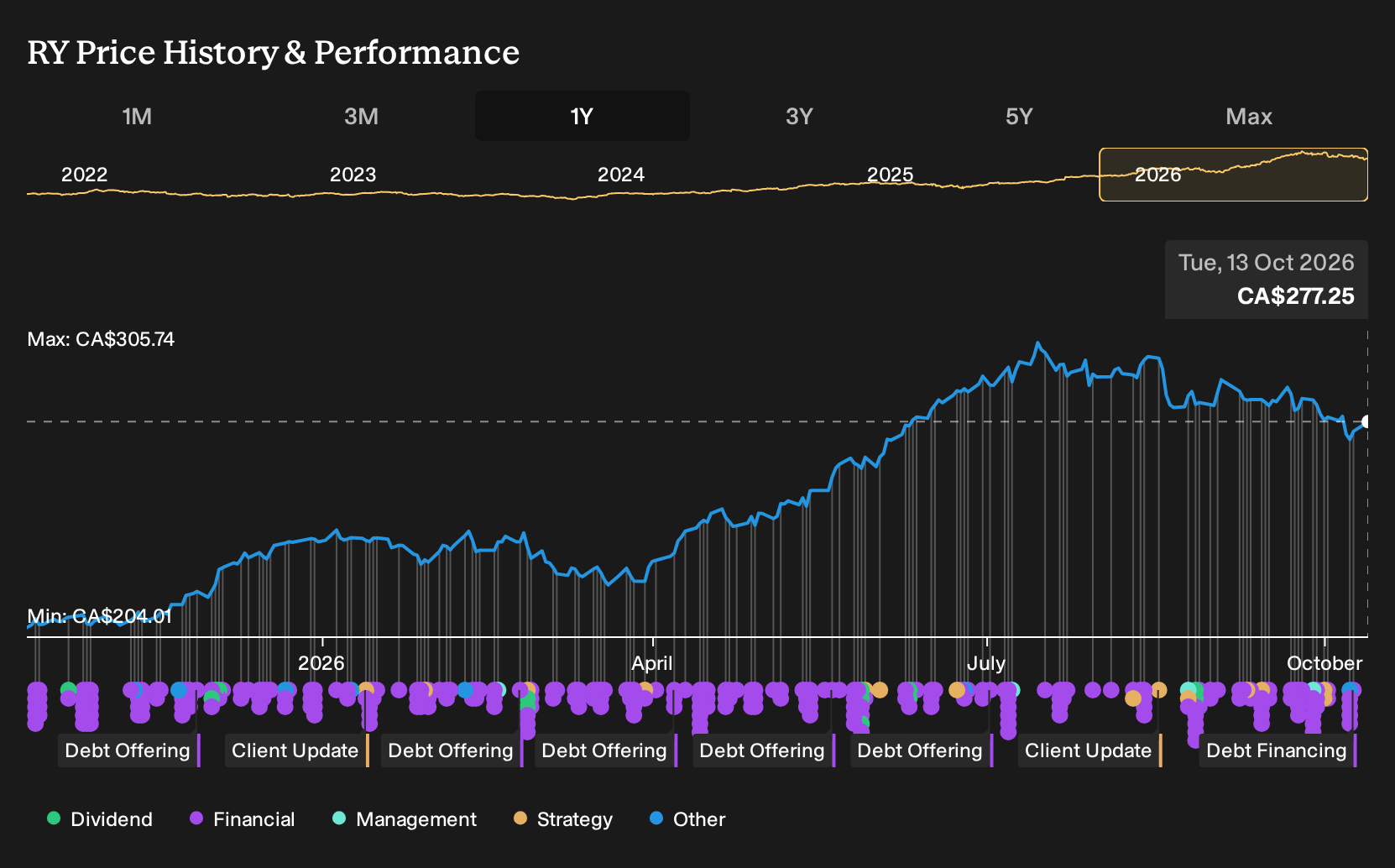
Uncover why Royal Bank of Canada's fair value indicates a 9% potential upside to its current price that may not last much longer.
Exploring Other Perspectives
Three fair value estimates from the Simply Wall St Community cluster between C$302 and C$354 per share, so you are seeing a fairly tight band rather than outlier calls. These views sit alongside fresh callable and floating rate issuance, as well as ongoing Thames Water exposure, which together keep funding costs and credit concentration firmly on your radar. Opinions clearly differ. Consider exploring several viewpoints before deciding how Royal Bank of Canada fits your own portfolio goals.
Explore 2 other Royal Bank of Canada fair value estimates, including one that suggests as much as 28% upside from the current price!
Decide For Yourself
Don't just follow the ticker; dig into the data and build a conviction that's truly your own.
- A great starting point for your Royal Bank of Canada research is our analysis highlighting 4 key rewards and 1 important warning sign that could impact your investment decision.
- See our latest analysis for Royal Bank of Canada. The report includes a comprehensive fundamental analysis summarized in a single visual, the Snowflake, making it easy to evaluate Royal Bank of Canada's overall financial health at a glance.
Looking for more Royal Bank of Canada investment ideas?
Once you have a handle on Royal Bank of Canada, it can help to line it up against other opportunities and see how it compares on quality, balance sheet strength and income potential using the Simply Wall St Screener.
- If you want companies with room to run that the market may be overlooking, scan through 10 high quality undiscovered gems that share strong fundamentals and cleaner financial profiles.
- For a focus on resilient balance sheets, pressure test Royal Bank of Canada against a curated list of solid balance sheet and fundamentals (8 results) that can help anchor a more defensive watchlist.
- If income is your priority, weigh Royal Bank of Canada alongside a hand picked set of 2 dividend fortresses that combine higher yields with disciplined fundamentals.
This article by Simply Wall St is general in nature. We provide commentary based on historical data and analyst forecasts only using an unbiased methodology and our articles are not intended to be financial advice. It does not constitute a recommendation to buy or sell any stock, and does not take account of your objectives, or your financial situation. We aim to bring you long-term focused analysis driven by fundamental data. Note that our analysis may not factor in the latest price-sensitive company announcements or qualitative material. Simply Wall St has no position in any stocks mentioned.
Have feedback on this article? Concerned about the content? Get in touch with us directly. Alternatively, email editorial-team@simplywallst.com