


On Oct. 5, Mizuho analyst Vijay Rakesh raised his Sandisk (SNDK) price target from $1,875 to $2,050, keeping an Outperform rating. He believes AI agents will create a fresh wave of storage demand. These agents keep working on tasks in the background, and everything they do creates data that has to be stored and accessed quickly. Rakesh expects AI workloads to make up 22% of NAND demand by 2030. He sees the strong reception to Meta Platforms' (META) Muse and OpenAI’s Dots as proof that agents are already part of everyday work. It isn't the first time the firm has pushed back on memory fears.
The Contracts Most Investors Are Overlooking
Some investors are still wary of memory stocks, and I understand why. Memory has always moved in boom-and-bust cycles, and much of Sandisk’s current run higher came from rising prices. As I covered earlier, China's push to expand its own memory production has only added to that worry. What I think many investors overlook is how differently Sandisk now sells its chips. Customers are signing multi-year deals with firm commitments and minimum prices. These deals add up to at least $93.9 billion in expected revenue, even at those minimum prices. Management even expects margins to stay attractive at those levels.
Bernstein, which reiterated its $3,000 target on Oct. 5, the highest on Wall Street, makes the same point. It estimated that even if prices crashed 72% from their peak, Sandisk could still earn $214 per share in fiscal 2030 thanks to its contracts. That's nearly triple what it earned in fiscal 2026. Without the contracts, the same crash would cut that figure to $81.
The data center segment now makes up 38% of the storage Sandisk ships, up from about 12% a year ago. Together with its contracts, I believe that gives Sandisk two ways to win. If prices soften, the contracts offer a cushion. If agentic AI lifts volumes as Mizuho expects, Sandisk can keep growing after its price increases slow down.
About Sandisk Stock
Sandisk develops, manufactures, and sells data storage devices and solutions using NAND flash technology. The company provides solid-state drives for desktop and notebook PCs, gaming consoles, and set-top boxes. It created the world’s first flash-based 20MB solid-state drive for IBM’s (IBM) ThinkPad laptop. Moreover, Sandisk is a well-known brand for small, portable USB drives used to transfer and store data. Founded in 1988, the company is headquartered in Milpitas, California.
Sandisk delivered exceptional gains over the past 12 months, with the stock climbing roughly 1,075%. By comparison, the iShares Semiconductor ETF (SOXX) generated gains of around 96% during the same period. The rally was driven by surging AI-related demand for memory and storage solutions, improving NAND pricing, and investor optimism following SNDK’s spin-off from Western Digital. The trend has continued this year as well, with SNDK shares up approximately 475%, outperforming the ETF’s gain of 78% over the same period.
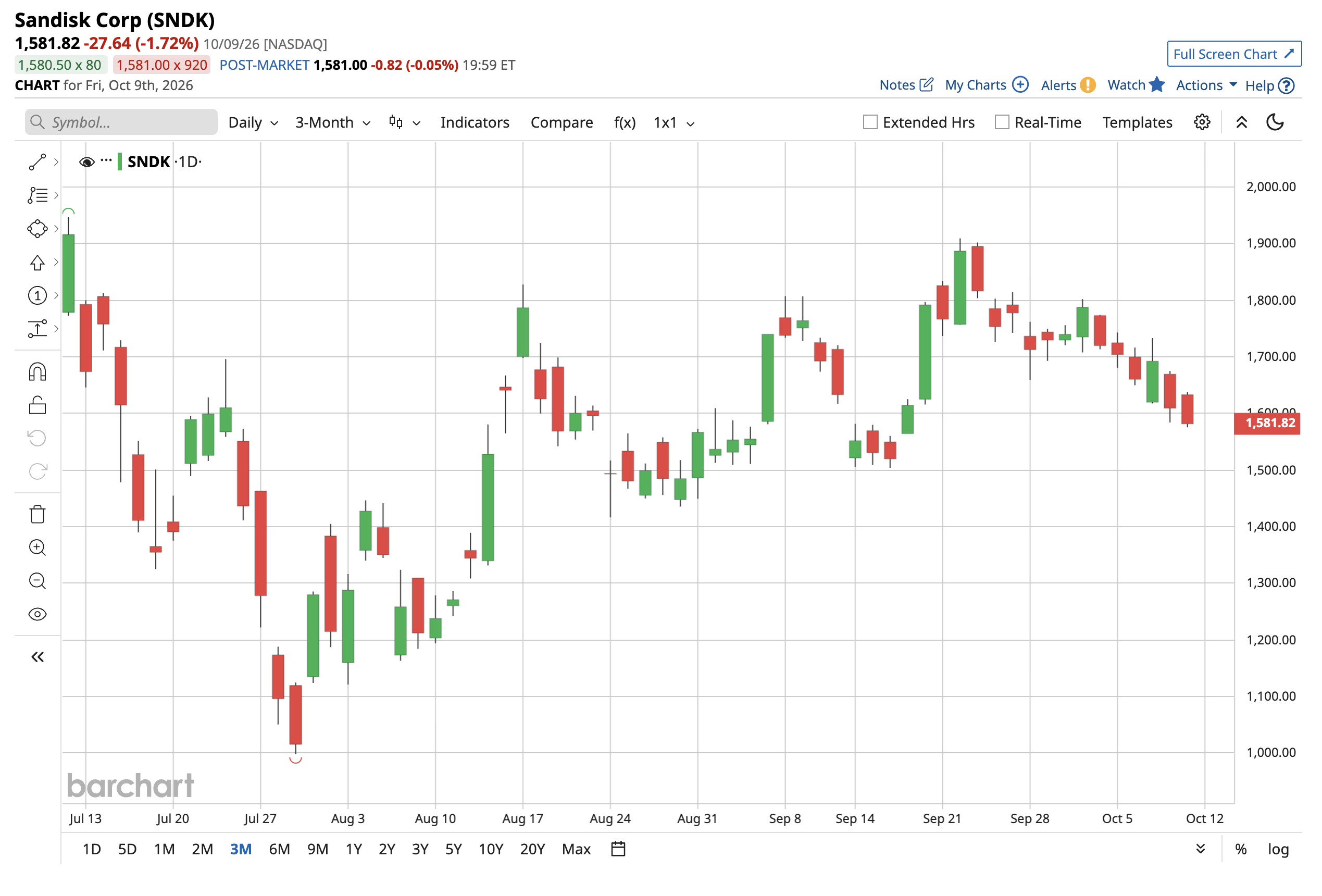
There’s no multi-year average to compare Sandisk’s valuation against, since it only became a standalone company in February 2025. On their own, though, the multiples look remarkably low for a stock that has run this far. The forward non-GAAP P/E is 7.75x, while the forward Price-to-sales ratio is 4.96x. That tells me the market still expects the memory boom to fade. Analysts expect EPS to jump 202% in fiscal 2027 and 24% in 2028, with a small dip in 2029 before recovering in 2030. The balance sheet is solid, though, as Sandisk is nearly debt-free, holding $4.76 billion in cash against just $201 million in debt.
Overall, if the contracts protect earnings as Bernstein expects, today’s single-digit multiples look fairly cheap.
Higher Memory Prices and Shipment Growth Drive SanDisk’s Outlook
Sandisk reported its fourth-quarter fiscal 2026 earnings on August 5. Revenue for the fourth quarter was $8.97 billion, up 372% year-over-year. The non-GAAP EPS came in at $39.25, comfortably beating the Wall Street consensus of $34.59. Non-GAAP gross margin reached 84.6%, far above the 26.4% margin reported a year earlier, while non-GAAP operating margin rose to 79.2%. The company’s growth was driven by its data center business, which generated $2.98 billion in quarterly revenue. Edge revenue also grew to $5.43 billion, up 48% sequentially.
Looking forward, for the first quarter of fiscal 2027, Sandisk guided for revenue of $10.3 billion to $10.8 billion, non-GAAP gross margin of 83% to 85%, and non-GAAP EPS is expected to be between $44 and $46. For the full year, the company expects capital spending to rise from fiscal 2026, mainly to support BiCS8 and BiCS10 ramps, while capital spending as a share of revenue should stay near 6%. CFO Luis Visoso said the company estimates the NAND market to exceed $300 billion in revenue in calendar year 2026 and approach $500 billion in revenue in calendar year 2027. He added that demand from customers is growing faster than the company’s supply.
What Do Analysts Expect for SNDK Stock?
Over the past two months, Wall Street has remained bullish on SNDK. Recently, Citi analyst Asiya Merchant reiterated a Buy rating and set a price target of $2,100. Similarly, Bernstein analyst Mark Newman also maintained a Buy rating on SNDK with a price target of $3,000.
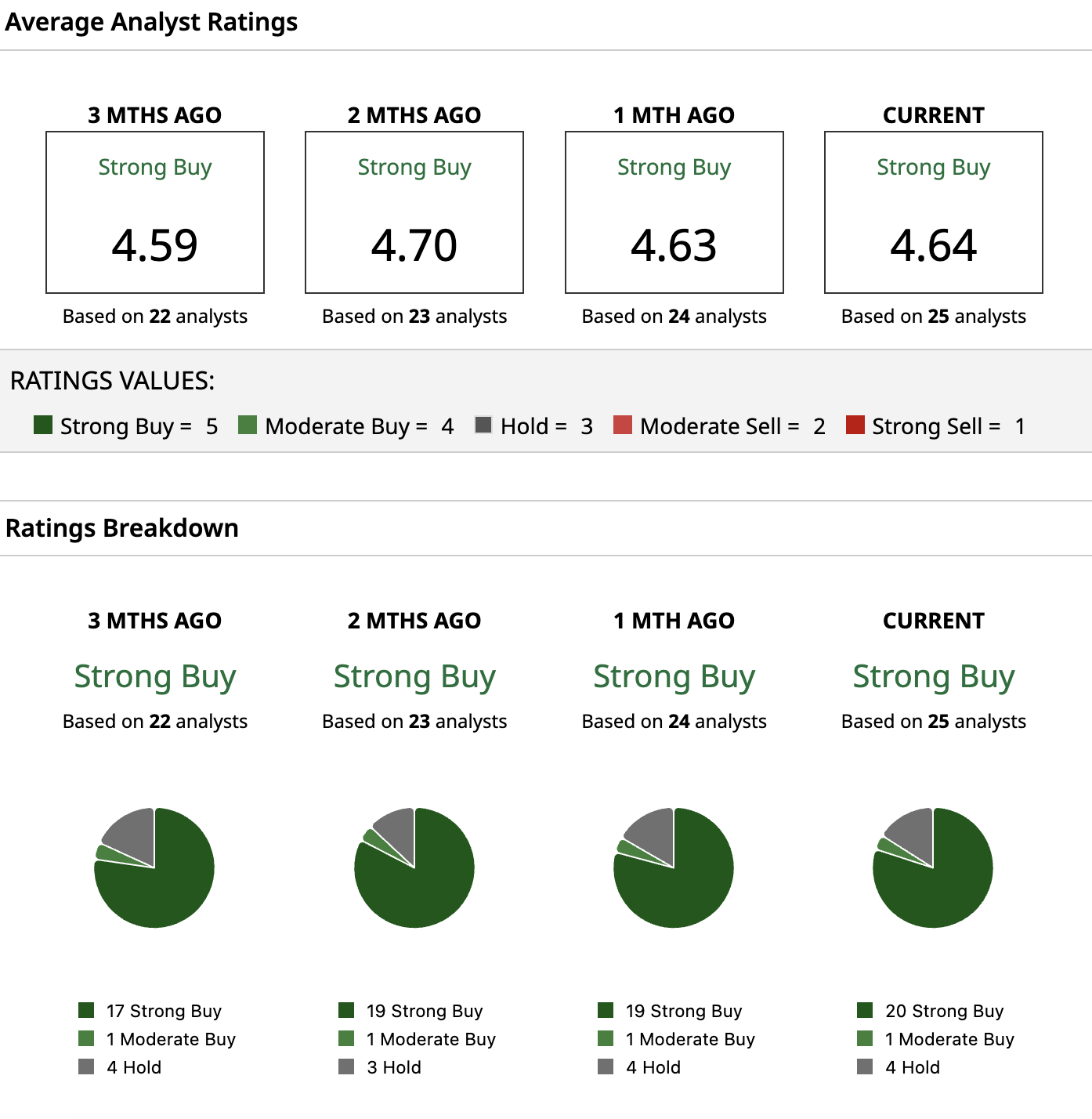
Based on 25 Wall Street analysts covering the stock, SNDK holds a consensus “Strong Buy” rating. The mean price target of $2,161 reflects 37% upside from current levels. The stock’s high price target of $3,000 is impressive, implying 90% upside from the current share price. This reflects analysts’ confidence in the long-term prospects of the company.
On the date of publication, Jabran Kundi did not have (either directly or indirectly) positions in any of the securities mentioned in this article. All information and data in this article is solely for informational purposes. For more information please view the Barchart Disclosure Policy here.