


The Zhitong Finance App learned that CINNO Research published an article stating that the scale of investment in China's intelligent computing power center industry continues to expand steadily. According to the latest statistics from CINNO • IC Research, the investment amount of China's intelligent computing power center industry in the third quarter of 2026 was about 728.8 billion yuan, up 34.4% year on year, an increase of 186.4 billion yuan over 542.4 billion yuan in the same period in 2025. The investment scale continues to expand, and computing power infrastructure has become a key investment direction in the digital economy.
Looking at the underlying logic of the industry: on the policy side, the construction of the national computing power interconnection node system is being accelerated, the “1+M+N” three-level system is being built at an accelerated pace, and the overall layout of national computing power resources continues to improve; on the demand side, the AI big model is accelerating towards industrialization, and computing power demand in real economy fields such as intelligent manufacturing, autonomous driving, and biomedicine is growing rapidly, providing long-term stable market support for the intelligent computing industry.
Currently, the industry is showing a healthy hierarchical development pattern where front-end reserves have doubled, mid-tier construction is progressing steadily, and back-end production continues to be released. According to the latest statistics from CINNO • IC Research, there were 62 intelligent computing center industrial projects in the third quarter of 2026, of which the project investment amount reached 521.7 billion yuan, accounting for 71.6% of the total investment; the delivery/commissioning phase was about 99.36 billion yuan, accounting for 13.6%; the starting/ongoing construction phase was about 91.74 billion yuan, accounting for 12.6%; and the caping/completion phase was about 16 billion yuan, accounting for 2.2%. The planning/preparation stage accounts for over 70%, indicating that the market's expectations for the medium- to long-term computing power supply and demand gap are clear, the industry project reserve pool continues to expand, and there is sufficient momentum for subsequent growth.
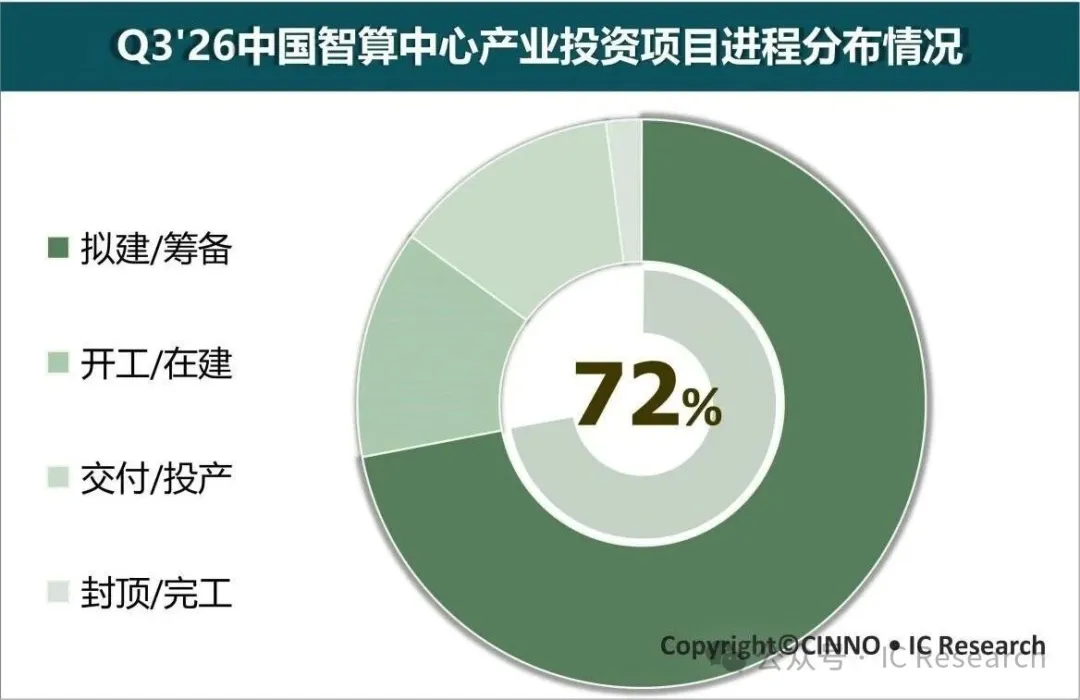
Figure: Q3'26 China Intelligent Computing Power Center Industrial Investment Project Process Distribution, Source: CINNO • IC Research
Compared with the same period in 2025, project/preparation projects jumped from about RMB 262 billion to RMB 521.7 billion, an increase of 99.1%, and the scale of project reserves almost doubled. The total investment in the start-up/construction phase increased slightly from 88.90 billion yuan to 91.74 billion yuan, a year-on-year increase of 3.2%, accounting for a slight decrease of 12.6% from 16.4%; the caping/completion phase fell from 1154 billion yuan to 16.0 billion yuan, a year-on-year decrease of 86.1%, and the delivery/commissioning phase increased from 76.11 billion yuan to 99.36 billion yuan, an increase of 30.5% year on year.
Overall, investment in projects under construction in the third quarter increased slightly, and the share declined slightly. The scale of capped and completed projects was adjusted in a short period of time, mainly due to the centralized capping of several large-scale projects in the same period of 2025, and the capping of projects in the third quarter of 2026, mainly on a small to medium scale; projects delivered and put into operation increased steadily year-on-year, and stock production capacity continued to be released. Judging from the pace of comprehensive project construction, the domestic intelligent computing industry is in a critical window period of “reserve accumulation and batch disbursement”. As reserve projects gradually move into the construction and commissioning stage, the industry is expected to usher in a new round of centralized capping and production peaks from the fourth quarter of 2026 to 2027.
Regional development trends: The agglomeration effect continues to strengthen, and the differentiated pattern of “green power in the north and localization in the south” is taking shape at an accelerated pace
As the construction of a national integrated computing power network continues to deepen, the agglomeration and differentiation characteristics of the layout of China's intelligent computing industry are becoming more and more obvious. Each region relies on resource endowments and industrial infrastructure to form a misaligned development path: the northern hub relies on clean energy advantages to develop green computing power, the southern hub relies on science and technology innovation and industrial advantages to promote large-scale implementation of domestic computing power, the national industrial division of labor pattern has basically taken shape, and leading regional cluster effects and demonstration effects continue to be prominent.
Northern Computing Power: Moving from “large-scale agglomeration” to a new stage of “computing and telecommunication collaboration”
Relying on the advantages of clean energy resources such as scenery, the northern computing power hub has become an important carrier for intelligent green power computing in the country. Industrial development is transforming from “large-scale agglomeration” to “high-quality electricity computing collaboration.” With Inner Mongolia as the representative, the pace of signing and filing of regional projects accelerated markedly in the third quarter. Relying on the 2026 Green Computing Power (Artificial Intelligence) Conference platform, Hohhot and Ulanqab dual-core signed a number of major projects, covering areas such as telecommunication collaboration and zero-carbon intelligent computing. In the same period, a number of zero-carbon computing power base and intelligent computing cluster projects were approved and filed, and the scope of implementation covered several League cities.
Judging from the characteristics of the landing project, 10,000 card intelligent computing clusters and GW computing power parks have become the focus of the regional layout. New construction projects generally use technical routes such as direct green electricity supply, liquid cooling and cooling, and high-density cabinets. Energy efficiency control indicators such as PUE continue to be tightened, and source network load storage integration has become an important direction for project construction. The centralized implementation of projects and the simultaneous upgrading of technical standards confirm that telecommunication collaboration, green and low carbon have become the core development logic of the national intelligent computing industry, and the deep integration of clean energy and computing power infrastructure is becoming the mainstream choice for new construction projects.
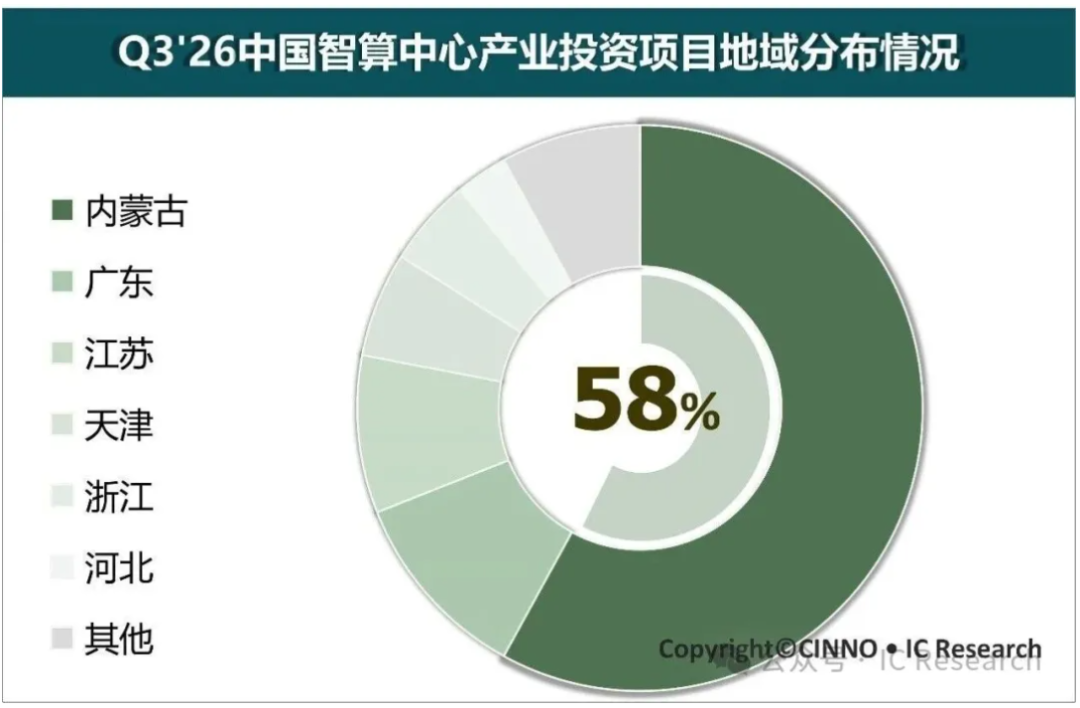
Illustration: Geographical distribution of Q3'26 China Intelligent Computing Power Center industrial investment projects, Source: CINNO • IC Research
Southern Computing Power: Focus on autonomous and controllable computing power, and accelerate large-scale commercial use of domestic computing power
Relying on scientific and technological innovation and supporting industrial advantages, the Southern Computing Power Hub focuses on autonomous and controllable computing power to accelerate the commercialization of domestic computing power. With Guangdong as the representative, the regional intelligent computing industry has formed a collaborative iterative trend of “localization+liquid cooling”. In the third quarter, the Guangdong-Hong Kong-Macao Greater Bay Area's first “Guoxin Training National Model” Shengteng Wan Card Intelligent Computing Cluster was launched in Shaoguan. It relied on domestic supernodes to build a large-scale computing power resource pool, marking a new stage of regional domestic computing power from pilot application to large-scale commercial use.
At the same time, the collaborative computing and electricity model is being replicated and promoted at the southern hub, and relevant plans in Guangdong have clearly proposed promoting collaborative construction of computing power centers, new energy sites, and power grids. Currently, the proportion of applications of high-density liquid cooling solutions and domestic computing power equipment at core computing power nodes such as Shaoguan and Guangzhou continues to increase. Industrial functions have been upgraded from basic computing power supply to integrated domestic computing power training and reasoning services, and the status of an important demonstration area for the localization and replacement of computing power across the country has been further consolidated.
Technology iteration trends: green and low carbon and domestic substitution go hand in hand, industry construction standards are fully upgraded
Combined with the characteristics of projects launched and reserve projects in various regions in the third quarter, the technological iteration of China's intelligent computing industry accelerated markedly. The industry competition logic is shifting from simple computational power scale competition to comprehensive capability competition of green energy efficiency, autonomy and control, and software and hardware collaboration. The two major technology trends will permeate the entire construction process of the China Intelligent Computing Power Center project.
First, green and low-carbon upgrading from construction requirements to industry entry thresholds and core competitiveness. Currently, newly built, under construction, and proposed intelligent computing projects generally use green power utilization, low PUE control, and energy storage support as core construction elements.
Second, localization replacement has entered a new stage of large-scale implementation. Driven by both market demand and supply chain security, domestic chips, supernodes, and intelligent computing cluster solutions are being implemented at an accelerated pace, and autonomous and controllable computing power at the bottom level will become the main line of long-term development of the industry.