


- QCR Holdings is scheduled to report quarterly results for the period ended September 2026, with analysts expecting earnings to be lower than the same quarter last year even as revenue is projected to be higher.
- The key twist is that the Most Accurate EPS Estimate sits above the consensus and QCR Holdings has outperformed EPS expectations in each of the last four quarters. This points to meaningful debate over how its underlying banking and fee engines are actually running.
- We will now look at how this potential earnings beat candidate status could reshape QCR Holdings' broader investment narrative.
Scan how other regional lenders are set up for potential surprises by weighing QCR Holdings against a hand picked group of 32 resilient stocks with low risk scores in your watchlist buildout.
QCR Holdings Investment Narrative Recap
To own QCR Holdings, you need to be comfortable with a regional bank that leans heavily on fee engines like LIHTC capital markets and growing wealth management, while still working through a big core system overhaul. The near term swing factor is how cleanly earnings hold up as costs for technology and regulatory readiness continue to run through the income statement.
The latest expectation of lower EPS on higher revenue keeps focus squarely on efficiency and the mix between spread income and fees. A possible earnings beat, if it materializes, would mostly validate current execution rather than change the thesis. The larger risk still sits in digital transformation delays, LIHTC deal volatility and expense creep.
The most relevant fresh data point is the setup for the September 2026 quarter, where QCR Holdings is projected to show lower earnings on higher revenue and carries a positive Earnings ESP with a recent record of topping EPS estimates. That combination indicates that the immediate story is about how well management is handling margin pressure against growing business volumes.
In that context, the longer term catalysts you may focus on remain the same. Progress on Jack Henry core conversions, keeping LIHTC securitizations profitable after a prior US$1.3 million loss, and holding noninterest expense growth under the 5% target are likely to do more to shape value than a single quarter. The coming print simply provides an updated read on execution against that playbook.
QCR Holdings Forecast Setup Through 2029
QCR Holdings sits on a fairly clear analyst roadmap. Consensus sketches out a business where revenue compounds at 6.7% a year and earnings are expected to step up from US$142.0 million today to US$154.3 million by 2029, even as margin assumptions pull back from a 37.4% level to 33.5%.
That change in profitability profile matters for how you read the story. Shrinking margins mean analysts are effectively betting that higher volumes and growing fee streams offset some compression in unit economics, rather than assuming pure operating leverage does all the work.
On the earnings line, the projected move from US$142.0 million to US$154.3 million implies an increase of US$12.3 million over the period. For a regional lender that is still spending on technology upgrades and regulatory readiness, that is a modest but meaningful lift that depends on execution, not just favorable conditions.
Revenue expectations are also quite specific. To line up with the consensus price targets, you would need to accept that QCR Holdings can reach US$460.3 million of sales by 2029 and that the stock could trade on a P/E of 13.3x those earnings, compared with 11.5x today and the same 11.5x yardstick cited for the wider US banks group.
QCR Holdings' narrative projects US$460.3 million revenue and US$154.3 million earnings by 2029. This framework assumes 6.7% yearly revenue growth and an earnings increase of US$12.3 million from the current US$142.0 million level.
Analysts are also layering in capital management. Forecasts build in a 2.75% annual decline in shares outstanding over the next three years. That points to buybacks or similar actions supporting per share figures, even if absolute profit growth is relatively contained.
Discount rates round out the picture. The Simply Wall St model cited uses 7.24% to pull future cash flows back to today, while the valuation summary references 7.2%. For you as an investor, the exact decimal is less important than the idea that these targets rest on a specific cost of capital assumption, not on open ended optimism.
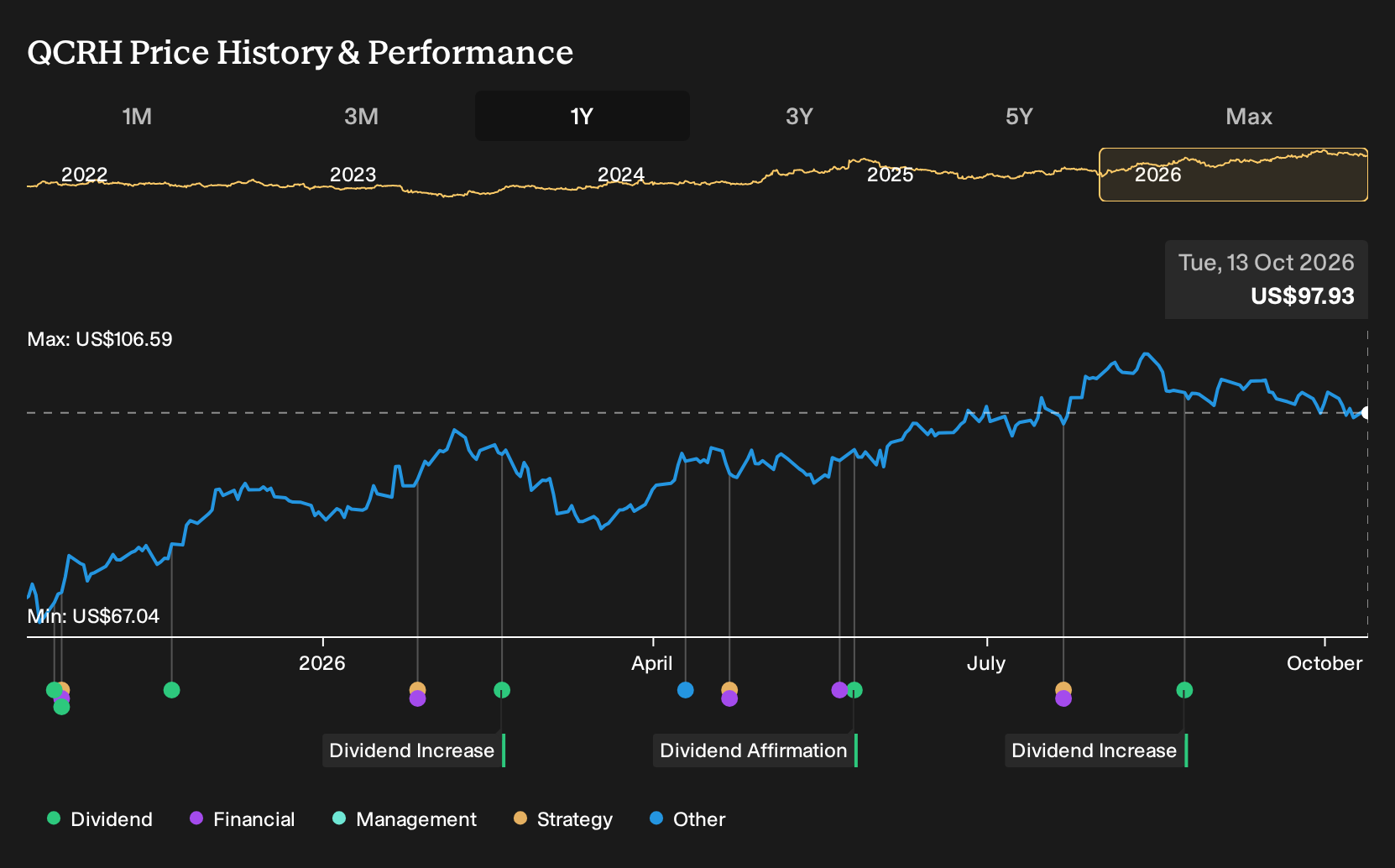
Uncover why QCR Holdings' fair value indicates a 13% potential upside to its current price that could narrow quickly.
Decide For Yourself
Disagree with existing narratives? Extraordinary investment returns rarely come from following the herd, so go with your instincts.
- A great starting point for your QCR Holdings research is our analysis highlighting 2 key rewards that could impact your investment decision.
- See our latest analysis for QCR Holdings. The report includes a comprehensive fundamental analysis summarized in a single visual, the Snowflake, making it easy to evaluate QCR Holdings' overall financial health at a glance.
Looking For More Investment Ideas Beyond QCR Holdings?
Once you have formed a view on QCR Holdings, it can help to compare that thesis with other businesses that share some of the same qualities you care about, whether that is balance sheet strength, income potential, or underappreciated fundamentals.
- If capital preservation sits high on your list, weigh QCR Holdings against a broader group of lower risk profiles by reviewing a 32 resilient stocks with low risk scores that may fit a similar defensive brief.
- For investors who want cash flow today as well as potential capital gains, line up QCR Holdings beside a curated set of income ideas through a focused screen of 8 dividend fortresses with robust payouts.
- If the appeal of QCR Holdings is its fundamental story at a reasonable valuation, test that thinking against a wider pool of 20 high quality undiscovered gems that pair solid financials with limited market attention.
This article by Simply Wall St is general in nature. We provide commentary based on historical data and analyst forecasts only using an unbiased methodology and our articles are not intended to be financial advice. It does not constitute a recommendation to buy or sell any stock, and does not take account of your objectives, or your financial situation. We aim to bring you long-term focused analysis driven by fundamental data. Note that our analysis may not factor in the latest price-sensitive company announcements or qualitative material. Simply Wall St has no position in any stocks mentioned.
Have feedback on this article? Concerned about the content? Get in touch with us directly. Alternatively, email editorial-team@simplywallst.com