


The Zhitong Finance App learned that fund managers who are concerned about economic growth and corporate profitability are increasingly doubting the sustainability of this round of rising US stocks. According to data compiled by Deutsche Bank, concerns about high US Treasury yields, the Middle East war, and inflationary stickiness have pushed subjective investors' stock exposure to the lower third of its historical range. At the same time, however, quantitative funds continued to buy stocks, benefiting from the continued rise in the benchmark index and declining volatility. The data shows that the gap between the two — the former is underrated and the latter is over US stocks — is currently the second largest since 2020.
Deutsche Bank strategist Parag Thatte said in a telephone interview: “From now on, this gap is unlikely to widen much, so one of them will soon have to make concessions.” If stock prices continue to rise, quantitative funds usually don't care how much the market has risen before, so they will have to keep buying, eventually forcing fund managers to give in. Conversely, if the market returns to sell-off, then subjective investors who have largely missed out on this round of upside in the near future will be attracted and have a chance to prove their judgment.
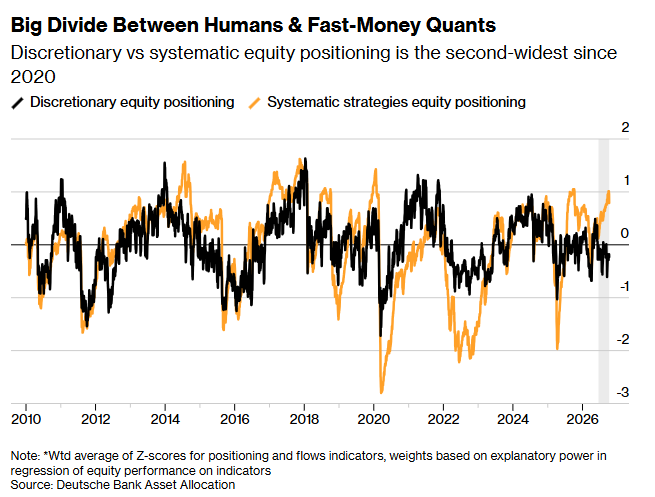
The difference between subjective and systematic stock positions is the second largest since 2020
Although systematized funds are not considered the largest players in the market based on the size of funds managed, they are certainly among the fastest-moving players. When their algorithms hit a specific threshold, such as a buy or sell indicator, they immediately close or increase positions. This could result in tens of billions of dollars flowing into or out of major stock indices.
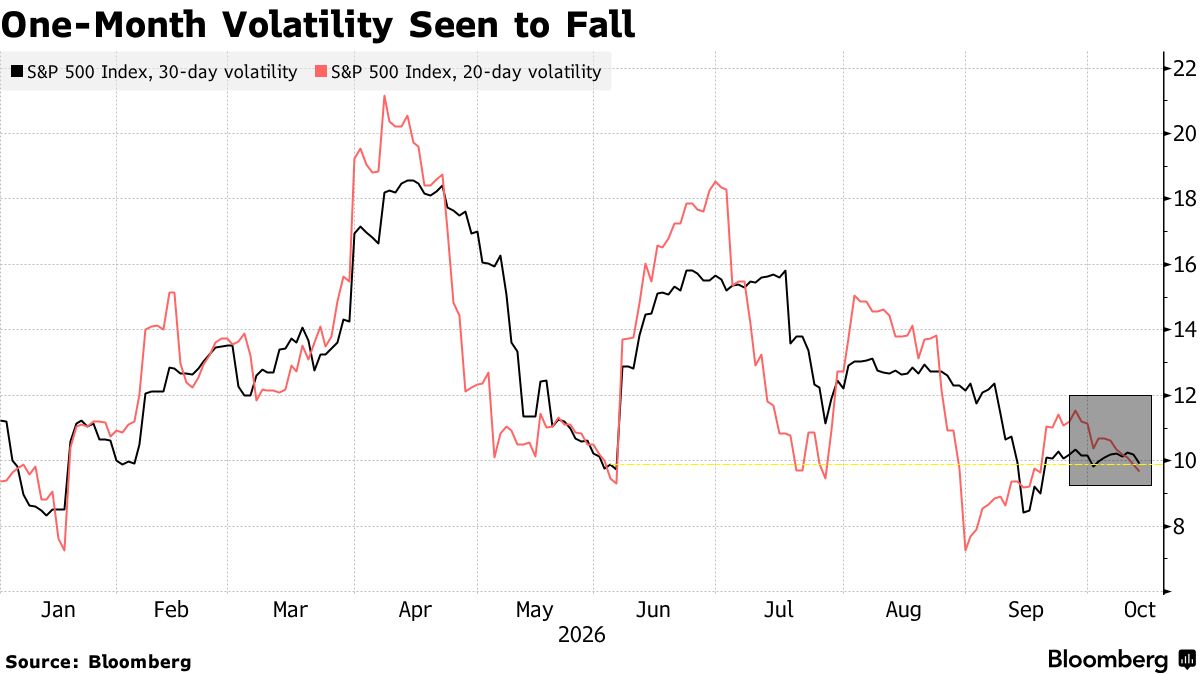
Maxwell Grinacoff, head of stock derivatives research at UBS Group, said that at present, the S&P 500 index has achieved a monthly volatility of about 9.9, the lowest level since June. In this case, volatility-control funds have been buying stocks. This type of fund usually increases stock positions when the market is calm and sells stocks when market volatility intensifies.
Maxwell Grinacoff added: “Only an exogenous shock, which caused the S&P 500 index to drop sharply for several consecutive trading days, could force a reversal of systematic positions and trigger a 'waterfall outflow' of capital from the stock market — but we haven't seen this yet.”
Despite market concerns about a bubble in artificial intelligence (AI) stocks and long-term borrowing costs rising to the highest level in decades, US stocks have been doing well recently. The S&P 500 index has risen 23% since its March low, and its market capitalization increased by $13 trillion during this period. The benchmark stock index has not experienced a decline of at least 2% for 89 consecutive trading days, while only 2 trading days have experienced such a decline since this year.
According to data compiled by Charlie McEligott, a cross-asset strategist at Nomura Holdings, the stock exposure of structured funds, including volatility control funds, commodity trading advisors (CTAs), and risk parity funds, has now rebounded to the 86th percentile, close to the highest level since this year.
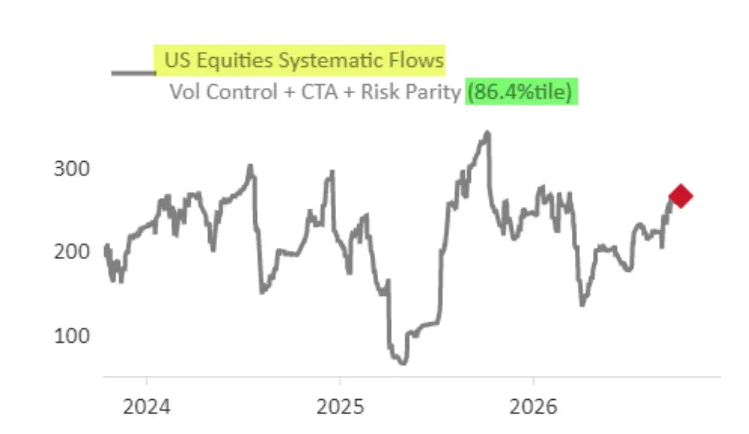
Parag Thatte said that given the way systematized funds work, the market sell-off may first begin with volatility-controlled funds releasing extreme positions. He added that this will increase the risk of a sharp reversal in the stock market, but for the volatility to soar and continue for some time, the market will need to experience a large-scale sell-off, that is, the S&P 500 index will drop at least 5% from its peak.
The trading activity of volatility-controlled funds is inversely related to the realized volatility: the greater the price fluctuation, the stronger the risk reduction signal sent to the volatility-controlled fund. This situation occurred in the spring of this year as market concerns about the Middle East war and economic conditions heated up, and volatility rose sharply. As their sensitivity to market sell-offs increased, these funds reduced their exposure to stocks.
Parag Thatte said that if subjective investors start selling stocks due to concerns about weakening economic growth or worsening corporate profit trends, this could theoretically drive up market volatility and force algorithm-driven strategies to also cancel positions.
But that doesn't mean that the rise in the market cannot continue. Subjective fund managers' current low stock positions mean that investors will still have more “ammo” to buy stocks in the next few months to avoid more serious sell-offs in the market.
Colton Loder, managing partner of alternative investment company Cohalo, said: “There are indeed some investors in the market that have under-placed the 'right' stocks, and they will buy them when the market recovers. There must be some kind of factor that will drive up volatility or create a negative stock trend. A systematic strategy can last a long time; it will continue until it doesn't last.”