


The trigger for Neogen (NEOG) is not a routine update. The FDA has issued a detailed warning letter over contamination issues tied to its HYCOAT veterinary product, following recalls and serious adverse outcomes in horses.
Neogen’s recent regulatory setback comes after a powerful run in the shares, with a year-to-date share price return of 67.57% and a 1-year total shareholder return of 98.48%. However, the 3-year and 5-year total shareholder returns remain deeply negative. Short-term momentum has cooled, with the latest 1-day share price return down 2.25% and the 7-day return down 1.92%. At the same time, investors are also absorbing October’s earnings miss, raised 2027 revenue guidance, and the new imaging collaboration with Hinalea.
Stress test Neogen’s news against its peers by scanning a hand-picked set of resilient operators in food, animal health, and testing using the 32 resilient stocks with low risk scores
.Neogen has already delivered a sharp rebound after years of weak longer term returns. The key question now is whether the recent optimism still allows for meaningful further gains, or if most of the easy upside has already been claimed.
Most Popular Narrative: 16% Undervalued
Neogen’s most followed valuation narrative puts fair value at $14, above the last close of $11.73. This frames today’s pullback against a still constructive long term story that leans on margin repair rather than rapid revenue expansion.
Operational improvements and automation at the new Petrifilm production facility, alongside targeted actions to reduce inefficiencies in sample collection and inventory management, are expected to drive gross margin and EBITDA margin improvements over the coming quarters as execution stabilizes and overhead absorption rates improve.
See why 5 investors see Neogen as 16% undervalued.
The narrative uses an 8.05% discount rate and assumes Neogen’s revenue holds roughly steady around $896.0 million by 2029, with profit margin lifting from a small loss to 12.6%. That earnings profile would equate to about $112.7 million of net income and requires the stock to trade on a future P/E of 34.5x to support the $14 fair value estimate.
Analysts behind this framework also model modest share count growth of 0.35% per year and treat the current analyst price target and fair value as effectively aligned, given the relatively small gap between the present share price and $14. This keeps the focus on whether margin repair, portfolio simplification and operational clean up can offset slow forecast revenue growth of 2.3% a year and the fact that Neogen is not expected to reach profitability over the next three years.
Result: Fair Value of $14 (UNDERVALUED)
Still, Neogen’s HYCOAT warning letter and ongoing integration issues with the 3M Food Safety assets could easily upend the tidy margin repair narrative.
Find out about the key risks to this Neogen narrative.
Another View On Neogen’s Valuation
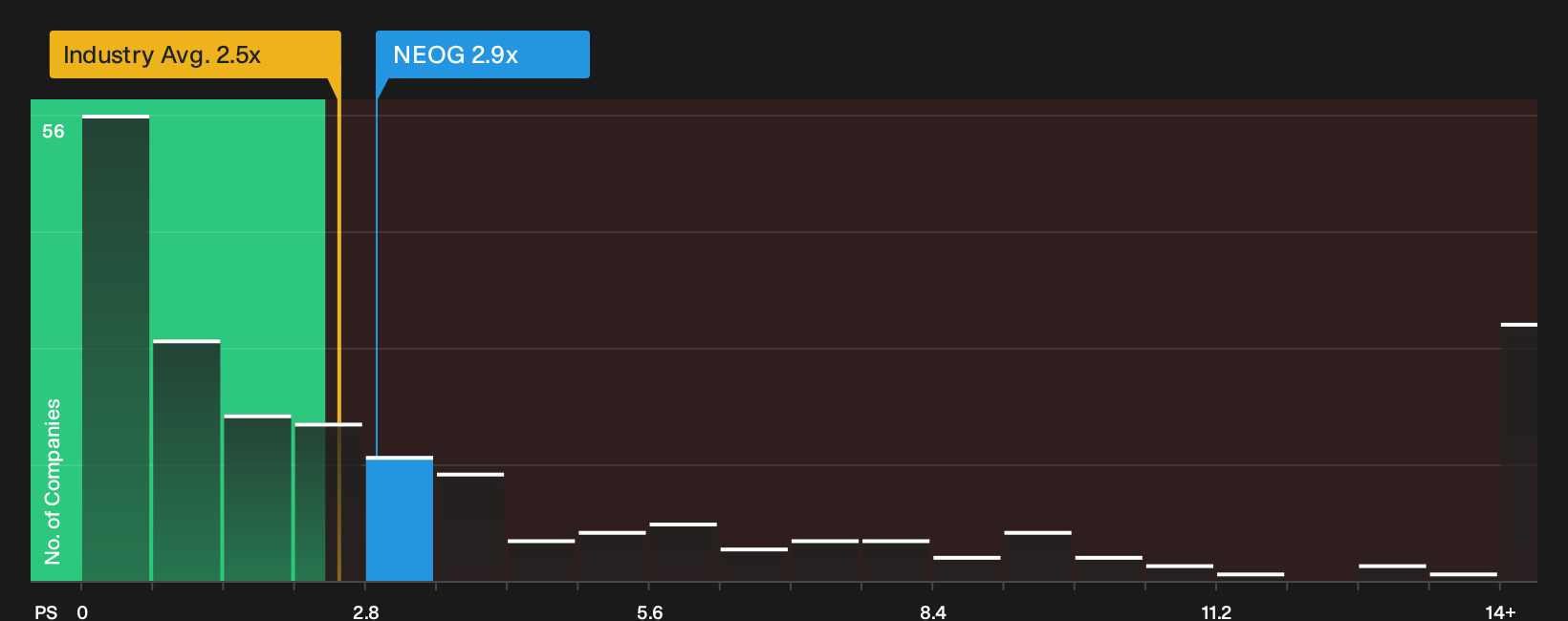
The earlier fair value story presents Neogen as about 16% undervalued at $14 using long term earnings assumptions. A simple P/S check sends a very different signal. The stock trades at 2.9x sales versus 2.5x for the US Medical Equipment industry and a fair ratio of 1.3x, which implies meaningful valuation risk if sentiment cools.
This gap suggests investors already pay a premium for Neogen despite weak profitability and slower forecast revenue growth. The question is whether future margin repair can justify paying more than both peers and the fair ratio, or if this premium eventually compresses.
See what the numbers say about this price — find out in our valuation breakdown.
Next Steps
The valuation signals around Neogen are mixed, and that is exactly why it helps to see the underlying risk data for yourself. If you want a quick starting point, take a closer look at the company’s 1 important warning sign.
Looking for more ideas beyond Neogen?
If Neogen has you rethinking risk and reward, use that momentum to widen your watchlist with other opportunities that fit your investing checklist.
- Target potential mispricing by scanning companies that screen as 32 high quality undervalued stocks before sentiment fully catches up.
- Strengthen portfolio resilience by concentrating on businesses with sturdy finances using the list of solid balance sheet and fundamentals (25 results).
- Get ahead of the crowd by reviewing a curated set of 20 high quality undiscovered gems.
This article by Simply Wall St is general in nature. We provide commentary based on historical data and analyst forecasts only using an unbiased methodology and our articles are not intended to be financial advice. It does not constitute a recommendation to buy or sell any stock, and does not take account of your objectives, or your financial situation. We aim to bring you long-term focused analysis driven by fundamental data. Note that our analysis may not factor in the latest price-sensitive company announcements or qualitative material. Simply Wall St has no position in any stocks mentioned.
Have feedback on this article? Concerned about the content? Get in touch with us directly. Alternatively, email editorial-team@simplywallst.com