


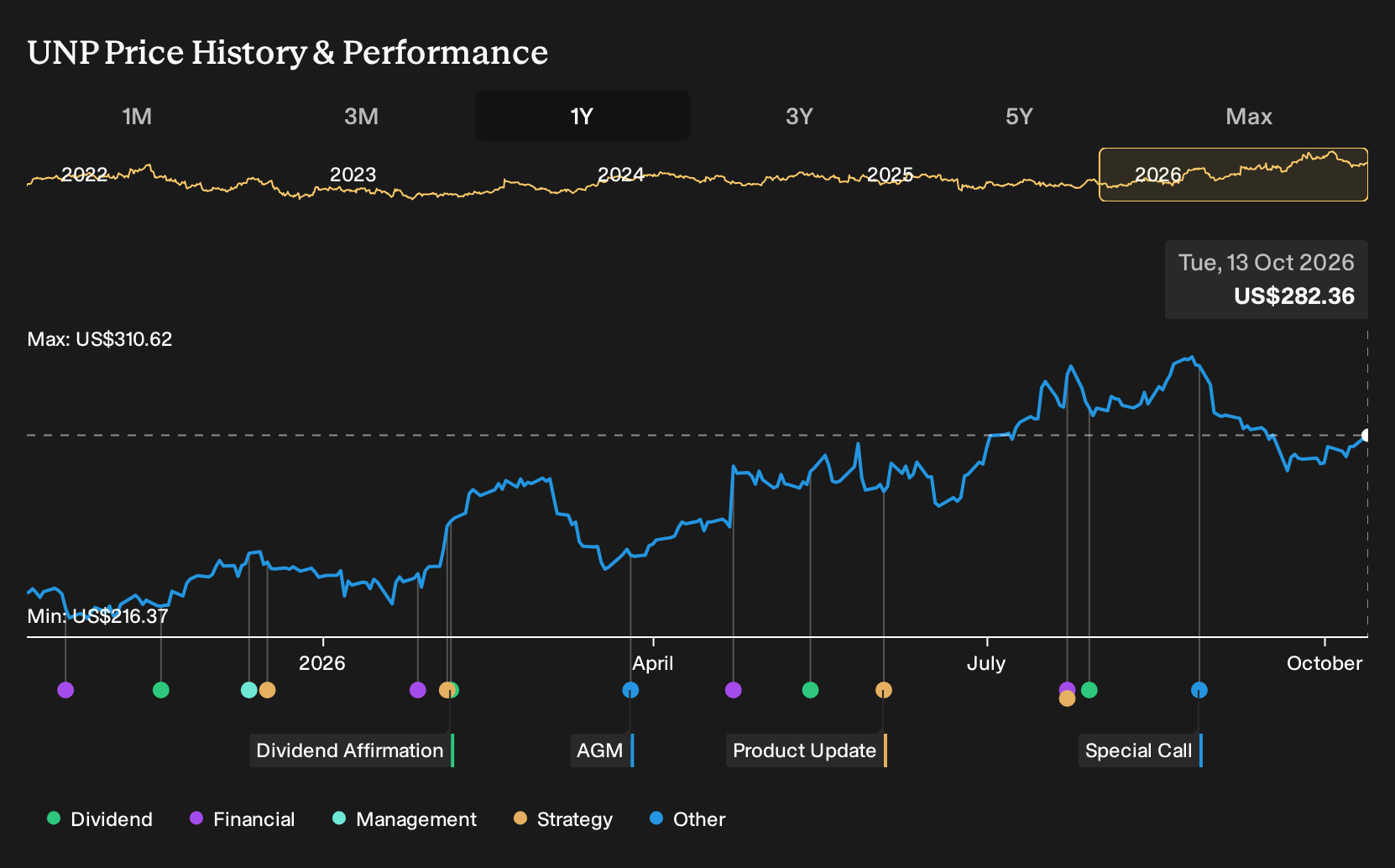
- Jefferies recently highlighted Union Pacific after the railroad reported 6% total volume growth through week 39 and 3% year to date, while higher September diesel costs compressed operating ratios and delayed the timing of expected margin benefits.
- The combination of growing freight volume and ongoing truck to rail conversion, alongside fuel driven cost pressure, gives a clearer view of how Union Pacific’s core operations are balancing demand strength against rising expenses.
- We will now look at how Union Pacific’s investment narrative could be influenced by higher diesel costs pressuring near term margins.
Union Pacific Investment Narrative Recap
To own Union Pacific, you need to be comfortable with a freight story that leans on volume resilience, truck to rail conversion and efficiency gains, while accepting that fuel and wage inflation can squeeze profitability at times. The latest update fits that picture. Stronger volume through week 39 supports the demand side. Higher diesel costs push against it.
The key near term catalyst is execution on operating efficiency programs and intermodal growth so that higher fuel and compensation do not erode the recent margin progress. The biggest current risk is that diesel and labour pressure stack on top of each other. This news mostly reinforces that trade off rather than changing it.
Among the ongoing initiatives, Union Pacific’s work on locomotive energy management and network optimization looks most relevant to the recent diesel hit. These tools are designed to lower fuel burn per ton mile and improve train performance, which becomes more valuable when pump prices move higher and stay there for a while.
If those projects scale effectively, they can help offset a portion of the 120 basis point operating ratio impact already linked to higher fuel. That feeds directly into the catalyst investors are watching most closely: can the railroad convert healthy freight demand, especially domestic intermodal and truck to rail wins, into higher earnings without letting fuel and wage inflation dominate the P&L?
Union Pacific's current analyst narrative points to about US$29.9b in revenue and US$9.4b in earnings by 2029, based on an assumed 5.5% yearly revenue growth rate. That earnings goal compares with about US$7.3b in earnings today, implying an increase of roughly US$2.1b by the 2029 forecast year.
Discover why Union Pacific's fair value indicates a 17% potential upside to its current price, which may be temporary.
Exploring Other Perspectives
Fair value estimates for Union Pacific from the Simply Wall St Community sit in a tight band between about US$291.86 and US$329.88 across 2 separate views, which still pre date the recent diesel driven margin squeeze. Those individual models do not all weigh fuel and wage risk equally, so use them to compare several sharply different opinion sets.
Explore another Union Pacific fair value estimate, including one that suggests it could be worth just $291.86.
Decide For Yourself
Disagree with existing narratives? Extraordinary investment returns rarely come from following the herd, so consider forming your own view.
- A great starting point for your Union Pacific research is our analysis highlighting 4 key rewards and 1 important warning sign that could impact your investment decision.
- See our latest analysis for Union Pacific. The report includes a comprehensive fundamental analysis summarized in a single visual, the Snowflake, making it easy to evaluate Union Pacific's overall financial health at a glance.
Looking For More Investment Ideas Beyond Union Pacific?
If the Union Pacific story has you thinking about where else freight, infrastructure and balance sheet strength might intersect, it can help to widen your watchlist using targeted stock filters on the Simply Wall St Screener.
- If you want businesses that combine strong finances with room to rerate, start with a focused set of 20 high quality undiscovered gems that already score well on quality metrics.
- For investors who care most about durability, narrow your research to a 32 resilient stocks with low risk scores that screens for companies with more resilient profiles.
- Income focused readers can zero in on payout potential by working through a curated group of 8 dividend fortresses that offer yields above 5% while still passing basic fundamental checks.
This article by Simply Wall St is general in nature. We provide commentary based on historical data and analyst forecasts only using an unbiased methodology and our articles are not intended to be financial advice. It does not constitute a recommendation to buy or sell any stock, and does not take account of your objectives, or your financial situation. We aim to bring you long-term focused analysis driven by fundamental data. Note that our analysis may not factor in the latest price-sensitive company announcements or qualitative material. Simply Wall St has no position in any stocks mentioned.
Have feedback on this article? Concerned about the content? Get in touch with us directly. Alternatively, email editorial-team@simplywallst.com