


Lumentum (LITE) is apparently having a problem that most companies would love to have: More demand for its products than it can accommodate.
According to a Seeking Alpha report, Lumentum CEO Michael Hurlston recently said the company's components are sold out through 2029. Wedbush Securities believes that could be bullish news for suppliers and semiconductor foundries.
One company that could benefit is Tower Semiconductor (TSEM), an Israeli chipmaker that's building a growing business around the technology that connects artificial intelligence data centers.
About Tower Semiconductor Stock
Tower operates semiconductor foundries—factories that manufacture specialized chips designed by other companies. Its products serve industries ranging from automotive and telecommunications to medical equipment and aerospace.
But one of its most interesting opportunities lies in silicon photonics, a technology that uses light rather than electrical signals to transmit information. That's increasingly important for AI data centers, where thousands of processors must communicate at tremendous speeds. Traditional electrical connections can consume substantial power and face limitations as data distance and volume increase.
Optical connections can move information quickly over longer distances while reducing some of those power demands. And Tower manufactures the specialized components that help make those connections possible.
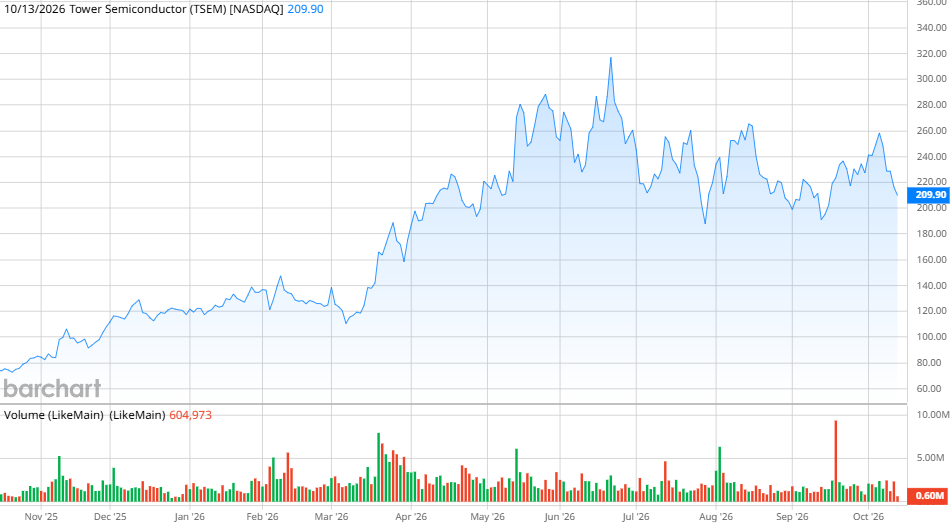
Shares of TSEM have been through the roof, jumping nearly 200% in the last year, pushing the company’s market cap to $23.7 billion.
Tower Is Already Seeing Increased Demand
Tower isn't simply waiting for the optical communications market to take off.
In May, the company announced $1.3 billion in silicon photonics contracts for 2027, along with $290 million in customer prepayments to reserve manufacturing capacity. It also reported larger contractual wafer commitments for 2028.
Then, in September, Tower and NewPhotonics announced high-volume shipments of optical chips supporting data transmission speeds of 800 gigabits to 1.6 terabits per second.
And on Tuesday, Tower announced an expanded multiyear agreement with Semtech (SMTC), which is reserving additional manufacturing capacity for components used in AI data center connections.
Those developments suggest that customers are committing to Tower's manufacturing technology. Its quarterly earnings just reinforce that narrative. Revenue in the second quarter was $460 million, up 24% from a year ago to set a quarterly company record. Net profit excluding nonrecurring items was also a record, coming in at $91 million, up 95% from the previous year.
“We began the year stating that Tower will have a very strong second half as the previously announced capacity investments become qualified and converted into shipments,” CEO Russell Ellwanger told analysts in the company’s earnings call. “Beginning the second half of 2026 with a $2 billion run rate turns the page into multiple new exciting chapters for the company. The strength of our customer demand, our growing partnerships, our proven execution capabilities, and the strategic investments that we have and still continue to announce provide a powerful catalyst to accelerate our short, mid- and long-term growth.”
Tower has scheduled its third-quarter report for Nov. 2. Management expects revenue of between $494 million and $526 million, which would be an increase of 31% at the midpoint.
What Do Analysts Expect From TSEM Stock?
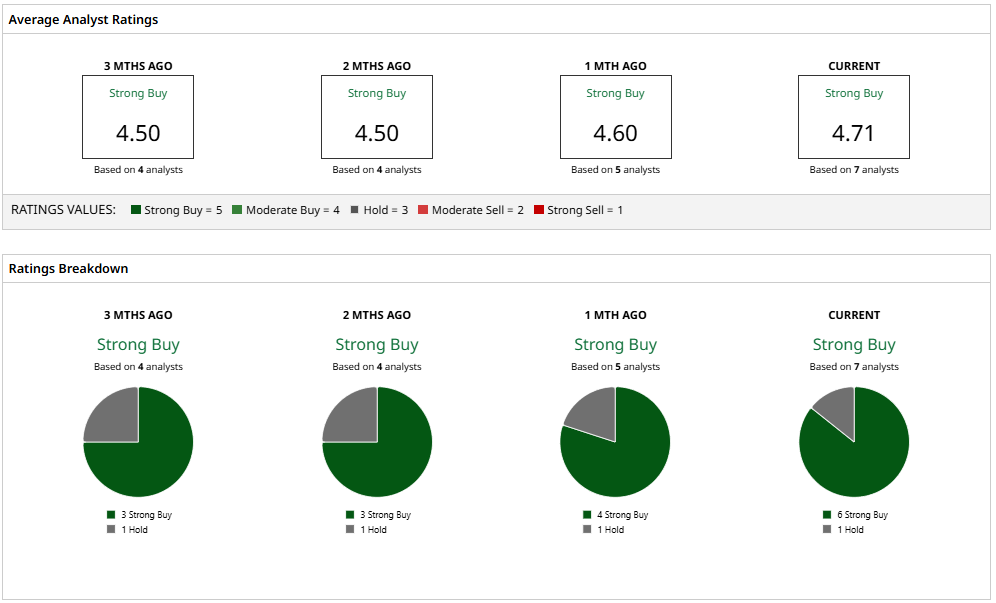
Tower is slowly getting attention from Wall Street analysts—only four analysts surveyed by Barchart covered TSEM stock just three months ago, but that number has nearly doubled. And the group has a consensus “Strong Buy” recommendation, with a mean price target of $309.89 that suggests a potential upside of 48%.
Lumentum's capacity commitments don't guarantee additional business for Tower. The company still needs to expand production, meet customer requirements, and turn manufacturing commitments into delivered products.
But there's an important distinction here. Tower isn't relying entirely on predictions about future AI demand. It already has substantial customer commitments and optical components moving into high-volume production.
As AI data centers grow, the connections between processors are becoming increasingly significant. Tower offers investors exposure to that opportunity without having to compete directly in the market for advanced AI processors.
That's a business worth paying attention to.
On the date of publication, Patrick Sanders did not have (either directly or indirectly) positions in any of the securities mentioned in this article. All information and data in this article is solely for informational purposes. For more information please view the Barchart Disclosure Policy here.