


Chinese tech giant Alibaba Group (BABA) is stepping up its artificial intelligence (AI) hardware ambitions. On Tuesday, the company unveiled its next-generation Qwen Glasses N1 series at an event in Hangzhou, expanding its consumer electronics portfolio as it looks to bring its Qwen AI ecosystem deeper into consumers’ everyday lives. Priced from 2,999 yuan or roughly $450 before discounts, the new smart glasses signal Alibaba’s willingness to compete on technology and product quality rather than price alone.
The Qwen Glasses N1 lineup features upgraded cameras and sensors, while the Pro edition introduces new eye-tracking capabilities. The devices also support practical applications such as shopping, payments, and health tracking. Alibaba said the glasses offer up to 25 hours of standby time or nine hours of music playback on a single charge. Wu Jianjun, general manager of Qwen AI hardware products, put the Pro edition’s price at 3,499 yuan.
Arriving roughly a year after the first generation launched in November, the new models integrate Alibaba’s Qwen AI assistant more closely while broadening its capabilities. Their starting price places them in a similar bracket to Meta Platforms’ (META) Ray-Ban smart glasses, though Meta expanded its lineup last month with a simpler, camera-free model priced at $349, designed primarily for interaction with its new Muse AI assistant.
Alibaba is also pushing beyond smart glasses, having begun sales of its Qwen Clip AI earbuds developed in collaboration with Bose. The move broadens consumer access to Qwen through wearable devices and reinforces the company’s wider effort to expand its AI presence beyond traditional software and services. With Alibaba investing in AI-powered consumer hardware to strengthen its ecosystem, investors will be watching how these new products contribute to its competitive positioning and broader growth strategy. Here’s a closer look at Alibaba stock.
About Alibaba Stock
Founded in 1999 by Jack Ma and 17 other co-founders, Alibaba is a Chinese multinational technology company headquartered in Hangzhou. What began as an online wholesale marketplace connecting Chinese exporters with global buyers has evolved into a broad digital ecosystem spanning e-commerce, cloud computing, logistics, digital entertainment, and consumer services. Its key platforms include Taobao and Tmall for domestic online shopping, Alibaba.com for global wholesale trade, and AliExpress and Lazada for international e-commerce.
Alongside its commerce operations, Alibaba Cloud provides computing infrastructure and technology services to businesses, making the group’s performance increasingly dependent on both consumer spending and enterprise technology demand. Artificial intelligence has become a central pillar of Alibaba’s growth strategy, with the company investing in everything from cloud infrastructure and AI computing to large language models (LLMs) and consumer-facing applications.
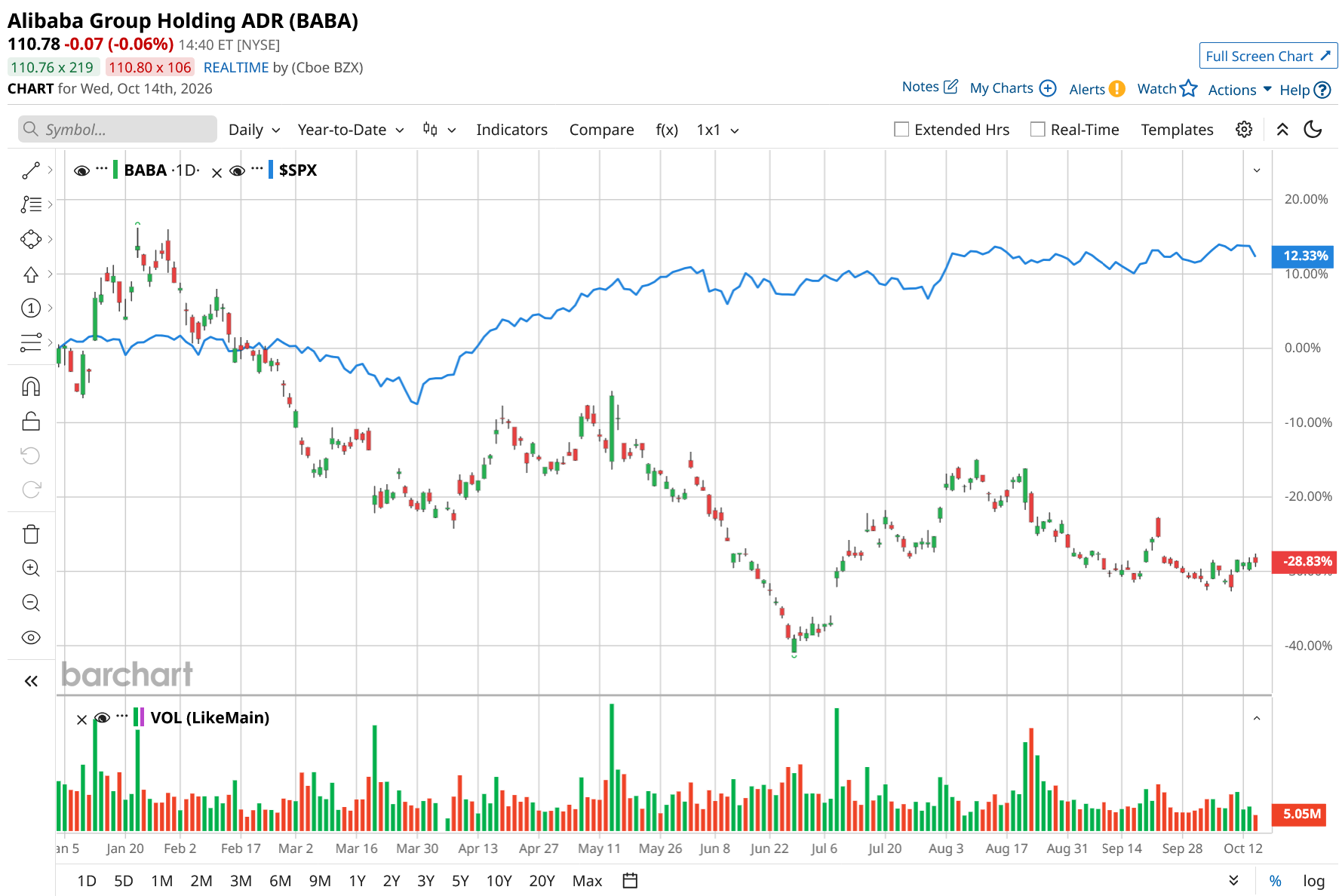
Alibaba’s AI ambitions are growing, but its stock is moving in the opposite direction. Valued at approximately $275.77 billion by market capitalization, the Chinese tech giant has seen its shares plunge 32% over the past 12 months and slide 24% year-to-date (YTD) in 2026. The selloff stands in sharp contrast to the broader market, with the S&P 500 Index ($SPX) gaining 15.9% over the past year and 12.5% so far in 2026.
Alibaba is also trading roughly 39% below its 52-week high of $182.50, reached in October last year, highlighting the mounting pressure on the stock despite its expanding AI ambitions. At the heart of the selloff are intensifying e-commerce competition and concerns over Alibaba’s hefty AI investments. Last year, the company committed at least 380 billion yuan over three years to AI and cloud infrastructure, raising concerns about mounting costs and the returns on this spending.
Dilution fears have added to the pressure following Alibaba’s issuance of shares to non-U.S. investors, with all net proceeds earmarked for advancing its full-stack AI capabilities, including expanding and upgrading its AI infrastructure. While the investment could strengthen Alibaba’s position in the AI race, investors remain wary of the financial burden and the potential impact on existing shareholders.
Inside Alibaba's Latest Financials
Alibaba Group delivered a mixed fiscal first-quarter performance for the quarter ended June 30, 2026, reporting solid revenue growth fueled by AI and cloud services but facing mounting pressure on profitability as infrastructure spending surged. Announced on Aug. 20, the results showed total revenue rising 9% year-over-year (YoY) to $39.64 billion.
The top-line growth reflected resilience across international commerce and steady commercial adoption of Alibaba’s enterprise infrastructure offerings, even as fierce competition continued to weigh on China’s domestic retail market. Alibaba’s E-commerce group remained a key revenue contributor, with revenue increasing 4% YoY to $30.34 billion.
Growth was supported by China Quick Commerce, which encompasses Taobao Instant Commerce, Freshippo, and other on-demand delivery businesses, and recorded a notable 45% annual jump. However, China E-commerce revenue declined 8% YoY, highlighting the uneven performance across the company’s domestic commerce operations.
Alibaba Cloud emerged as another major growth driver, with external revenue growth accelerating to 45%. AI-related product revenue also maintained its strong momentum, delivering triple-digit growth for the 12th consecutive quarter. Despite the healthy top-line performance, Alibaba’s bottom line took a significant hit as heavy AI infrastructure investments weighed on earnings.
Net income plunged 75% YoY to $1.54 billion, while non-GAAP earnings per ADS fell 42% to $1.26. The pressure was also evident in capital expenditure, which climbed 75% during the quarter to RMB 67.68 billion ($9.98 billion), compared with RMB 38.68 billion in the same quarter of 2025. Alibaba attributed the increase to its continued investment in AI infrastructure to meet strong and growing customer demand.
The sharp rise in capital expenditure reflected several factors, including fluctuations in procurement cycles, increased CPU computing capacity in anticipation of greater customer adoption of AI agents, and higher prices across a broad range of chip components. While these investments are intended to support expanding demand for AI and cloud services, they have significantly increased the near-term financial burden.
Cash flow also came under pressure. Free cash flow, a non-GAAP measure of liquidity, recorded an outflow of RMB 44.67 billion ($6.58 billion), compared with an outflow of RMB 18.82 billion in the same quarter of 2025. Alibaba attributed the deterioration primarily to higher cloud infrastructure expenditure. Nevertheless, the company maintained a substantial liquidity cushion, with cash and other liquid investments totaling $69.93 billion as of June 30, 2026.
How Do Analysts View BABA Stock?
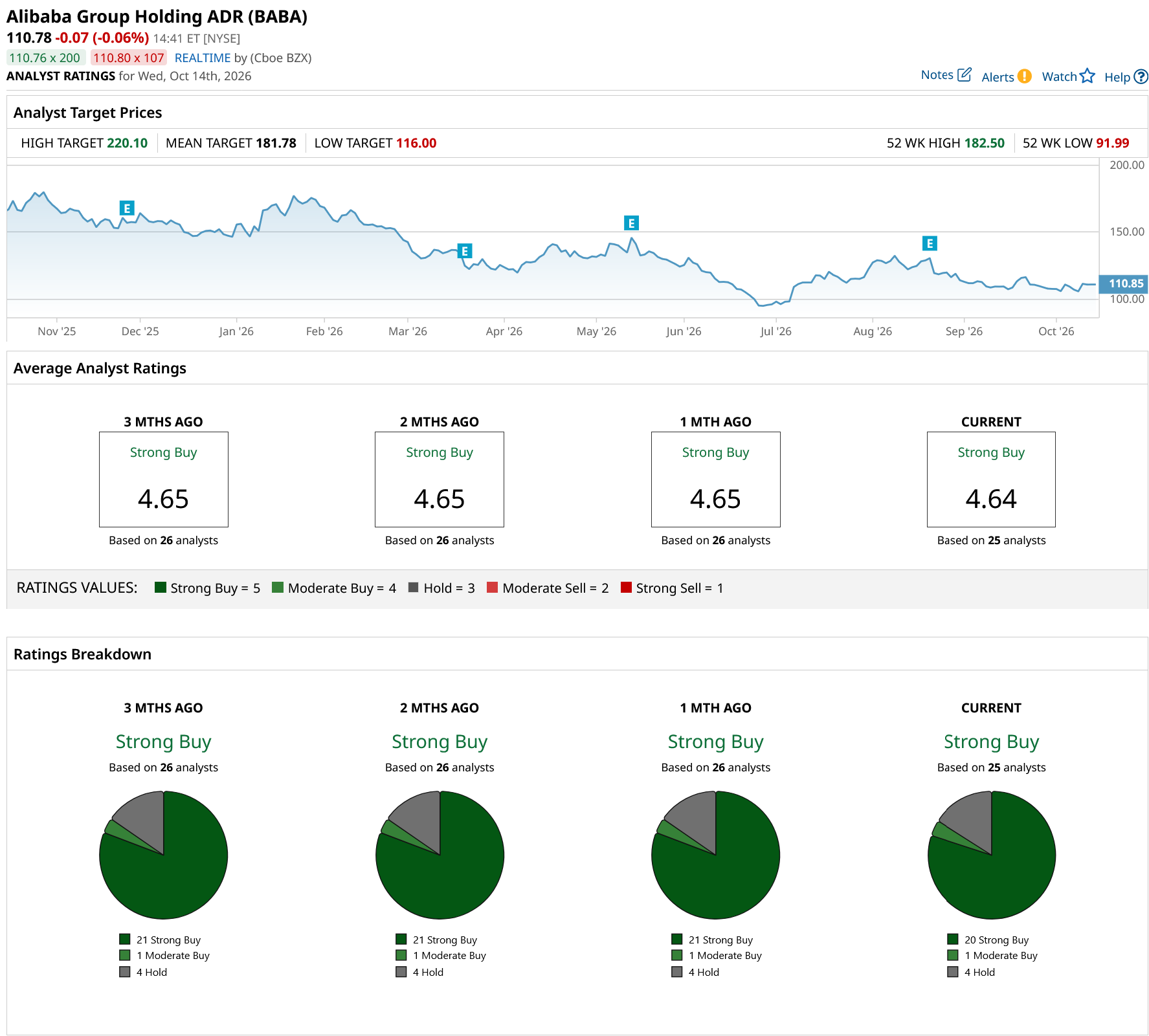
Despite its recent slump, Wall Street remains firmly bullish on BABA, awarding the stock a consensus “Strong Buy” rating. Of the 25 analysts covering the stock, 20 recommend a “Strong Buy,” one favors a “Moderate Buy,” and four maintain a “Hold” rating. The average price target of $181.78 points to an upside potential of roughly 64%, while the Street-high target of $220.10 suggests BABA stock could rally nearly 99% from current levels.
On the date of publication, Anushka Mukherji did not have (either directly or indirectly) positions in any of the securities mentioned in this article. All information and data in this article is solely for informational purposes. For more information please view the Barchart Disclosure Policy here.