


Oil prices have a funny way of reminding investors that markets do not operate in a vacuum. Wars, disrupted shipping routes, and diplomatic deadlocks can quickly turn crude into a geopolitical guessing game. Presently, escalating tensions in the Middle East, uncertainty over U.S.-Iran negotiations, and restrictions around the Strait of Hormuz are keeping supply concerns alive. Tanker attacks and shipping bottlenecks have added to the pressure, while hurricane-related production disruptions in the U.S. Gulf of Mexico have offered further support. However, the prospect of additional fuel supplies from Russia and a diplomatic breakthrough could limit gains.
But if legendary investor Paul Tudor Jones is right, investors may want to prepare for another leg higher rather than assume the worst is already behind them. He believes crude prices could jump, forecasting a potential $20 to $25 rally. His bullish stance reflects concerns that geopolitical tensions may not ease anytime soon, leaving oil prices exposed to further supply shocks. However, Jones thinks that while crude could benefit, another sharp rise in energy prices could spell trouble for equities.
So, how realistic is his prediction, and what could it mean for investors?
Crude Oil’s Price Trajectory: How Geopolitics and Shipping Costs Are Driving Prices
Brent Crude (QAY00) spot has given investors quite a ride in 2026. On a year-to-date (YTD) basis, it has gained significantly, up 73.5%. Despite edging up marginally over the past month, its recent five-day gain of 5% suggests the market remains capable of sharp reversals.
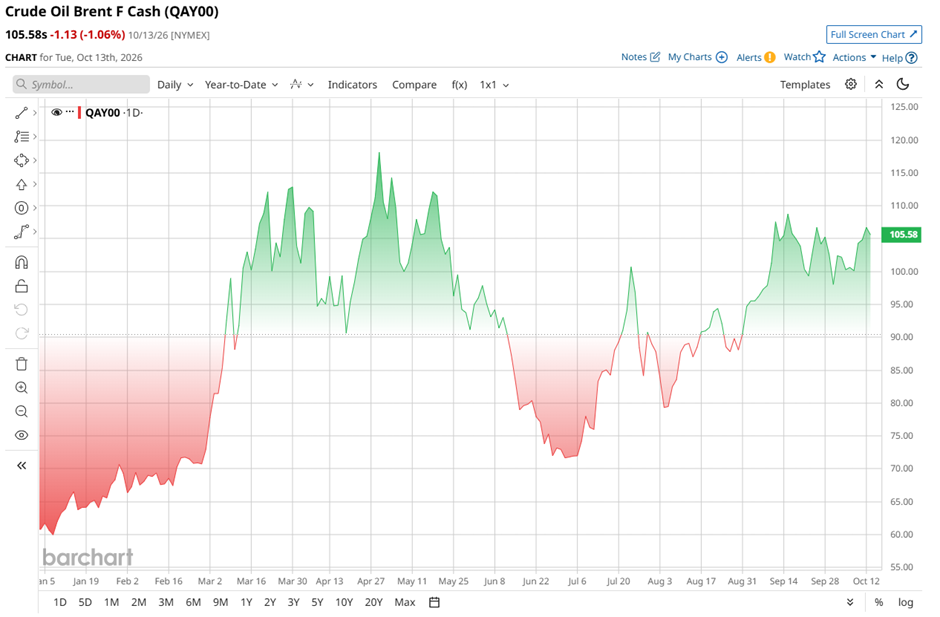
At the beginning of the year, the oil market was grappling with concerns that global production could outpace demand, potentially leaving the world awash in oil. Then came the escalating conflict in the Middle East, and suddenly, the bigger question was whether enough crude could reach the buyers who needed it. Nothing like a geopolitical crisis to turn an oversupply debate into a scramble for barrels.
The initial bearish outlook was not without reason. Expectations of rising production and relatively subdued consumption had weighed on the market, with the U.S. Energy Information Administration (EIA) projecting in February that Brent crude could average $58 per barrel in 2026. The underlying concern was straightforward: when producers pump more oil than the world consumes, inventories build, and prices generally come under pressure.
But that outlook took a dramatic turn as the U.S.-Israeli war with Iran disrupted energy production and shipments across the Middle East. The Strait of Hormuz, a critical passage for global oil trade, became a major source of concern. Attacks on tankers and energy infrastructure, coupled with restrictions on shipping, disrupted the movement of crude and refined fuels. With fewer barrels reaching the market reliably, buyers faced a tighter supply picture, while shipping and insurance costs climbed. Even if oil existed, getting it to the right place was becoming considerably more expensive.
J.P. Morgan analysts, including Global Commodities Strategy Head Natasha Kaneva, see October resembling April in one crucial respect—delivered crude prices have returned to spring highs, but the underlying problem has changed. April was about a shortage of oil; October is increasingly about the cost of transporting it.
Shipments through the Strait of Hormuz have somewhat recovered, but longer voyages, ship-to-ship transfers, and U.S. sanctions have tied up a significant share of the global tanker fleet. Freight costs have surged, pushing up the delivered price of crude even where supplies remain available. However, the squeeze has its limits. J.P. Morgan warned that weakening European refining margins could make expensive shipments uneconomical, potentially prompting refineries to cut operations and curbing how much more buyers are willing to pay for transportation.
The impact on prices has been substantial. According to the EIA’s October outlook, Brent crude averaged $114 per barrel in September, up $23 from August. Prices briefly reached $131 per barrel on Sept. 15 after attacks disrupted Saudi Arabia’s East-West pipeline, a vital alternative route for moving crude around the Strait of Hormuz. Although repairs helped restore some flows, ongoing security risks and constrained exports continued to support prices. The EIA subsequently raised its forecast for Brent to an average of $105 per barrel in the fourth quarter.
Of course, oil markets rarely move in one direction for long. While supply disruptions have provided a powerful tailwind, several factors have kept a lid on further gains. The prospect of additional supply, recovering exports, and weaker demand at elevated prices has offered some relief. Middle Eastern producers have gradually restored some output and redirected shipments through alternative routes, while the release of emergency reserves and the prospect of additional fuel supplies have helped offset some shortages. Of course, alternative routes have limited capacity, and the cost of moving oil around disrupted shipping lanes remains painfully high. More barrels on paper do not necessarily mean cheaper barrels at the refinery.
Demand, meanwhile, is another piece of the puzzle. Higher crude prices feed into gasoline, diesel, transportation, and manufacturing costs, eventually forcing consumers and businesses to reconsider how much fuel they can afford. The EIA previously warned that expensive fuel and reduced availability could curb global oil consumption in 2026, particularly in Asia. That creates a frustrating paradox for bullish oil investors—supply disruptions can push prices higher, but sufficiently high prices can also weaken the demand needed to sustain the rally.
There are also shorter-term forces at play. Hurricane-related shutdowns in the Gulf of Mexico have temporarily reduced domestic production, supporting WTI crude prices. Yet that boost could fade as offshore operations resume. U.S. inventory data provide another important signal—a drawdown can suggest stronger demand or tighter supply, while a build can indicate that more crude is available than refiners currently need. Neither figure tells the whole story on its own, but both help traders assess whether the market is tightening or loosening.
More recently, the latest geopolitical flare-ups have reinforced the market’s sensitivity to supply risks. As of today, Oct. 14, U.S. crude is trading near $95 per barrel, while Brent is around $106, as traders weighed renewed security concerns against the possibility of additional supplies and improved shipping flows. The numbers underline just how dramatically the market’s mood has shifted.
Why Paul Tudor Jones Anticipates Crude Oil Price Rally
Paul Tudor Jones is betting that crude oil has more room to climb, and he is not ruling out another $20 to $25 rally. Speaking to CNBC, the billionaire investor expressed confidence in oil's upside, arguing that investors should give prices the benefit of the doubt in the near term. His reasoning hinges on the lack of a convincing resolution to the Middle East crisis. Jones suggested that if meaningful diplomatic relief were possible, it might already have materialized before the U.S. midterm elections. Instead, he believes uncertainty will continue to hang over the market. While he assumes the president has a plan, Jones considers the current situation unsustainable. His warning for equities is equally blunt—another sharp rise in oil prices could spell serious trouble for stocks.
Conclusion
Oil and equities have an uneasy relationship—when crude climbs, corporate costs and inflation risks can follow, potentially complicating the Federal Reserve’s rate decisions and putting pressure on stock valuations. With rising energy costs threatening to squeeze consumers and businesses, America’s mounting debt adds another macroeconomic concern, even as optimism over strong earnings has recently supported stocks. Upcoming hurricane developments could also introduce fresh volatility into U.S. energy supplies.
Against this backdrop, Paul Tudor Jones’ forecast of an oil price rally deserves attention. If crude surges again, Wall Street may discover that strong earnings alone cannot keep geopolitical risks at bay.
On the date of publication, Sristi Suman Jayaswal did not have (either directly or indirectly) positions in any of the securities mentioned in this article. All information and data in this article is solely for informational purposes. For more information please view the Barchart Disclosure Policy here.