


During the zero-interest-rate policy (ZIRP) era, unhedged buy-and-hold equity strategies rewarded you for sitting on your holdings. “Don’t trade stocks, own them,” they said. That led to a surge in S&P 500 Index ($SPX) investing that probably even went beyond the dreams of index pioneer Jack Bogle, the late, great Vanguard founder.
But this is not the 1980s, and this is not a market that only the very wealthy are active in. Not with algorithms running the show. Those good old days of buying and holding are not coming back soon.
Diversification Is Failing Too
Through last Friday, this is the S&P 500, sorted according to how much each stock contributed to the total return of the index so far this year. The S&P 500 was up nearly 14% through that time. These stocks accounted for almost all of that.
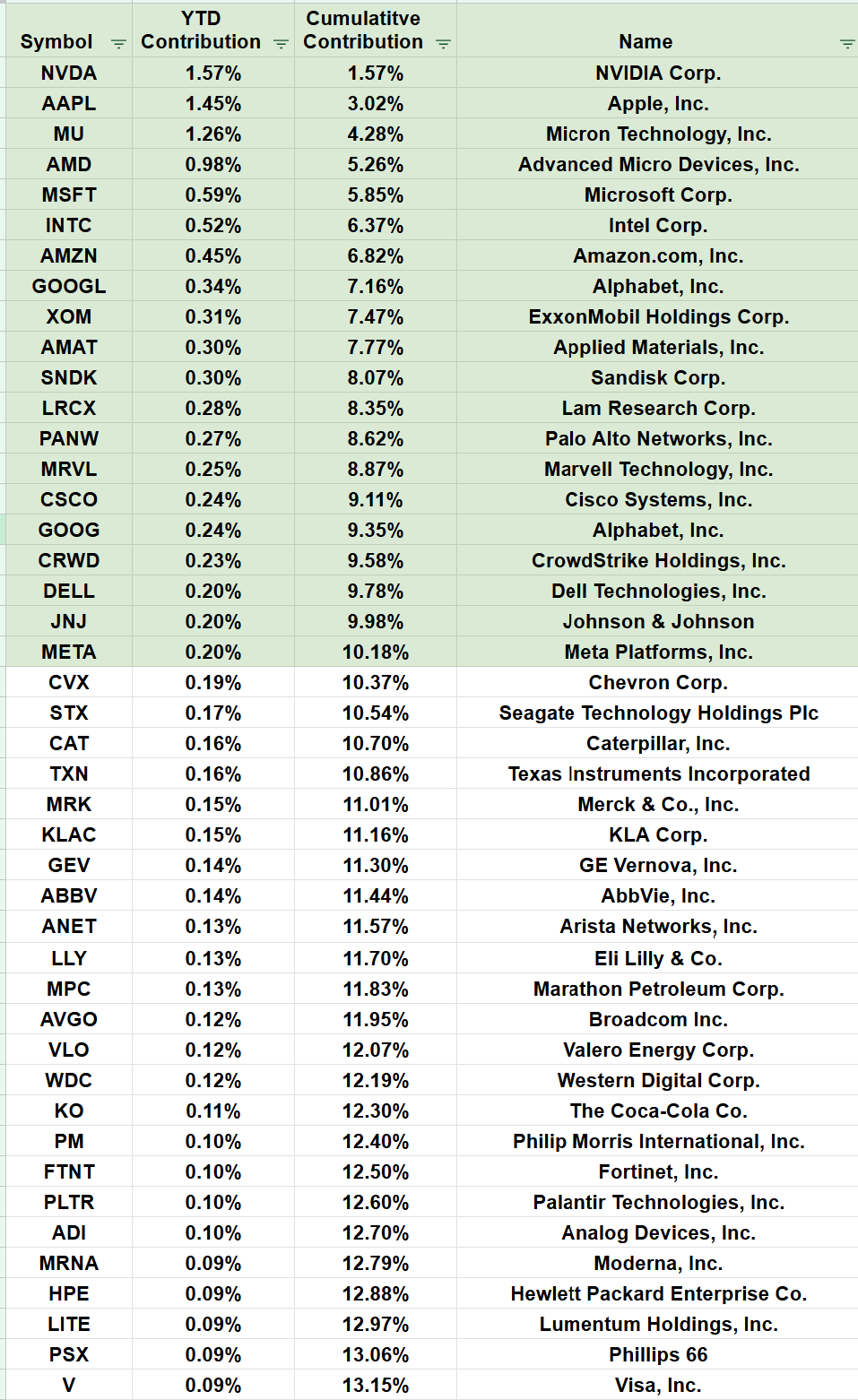
So what, you ask? There are only 44 stocks on that list. That means the more than 450 others combined to add just about zero.
This means diversification is failing. That makes stock picking more about keeping time horizons short because so few stocks have been able to outperform the index consistently.
This has occurred in past market cycles. But I’ve seen them all since 1986, and this one just seems more extreme to me. That could be due in part to the tremendous amount of overconfidence exhibited by the “buy the dip” crowd.
Frankly, that’s part of my point. Trading dips has been much more profitable than buy and hold. The headline stock market is getting by on an extraordinarily small group of leaders.
The entire index is riding almost exclusively on the AI infrastructure trade. That’s a wave of corporate capital borrowed and spent in anticipation of future monetization. That’s risky in a buy-and-hold approach. All the more reason I’m a stock trader, not a stock investor, until further notice.
Rent, Don't Own
Because the whole nature of the stock market has changed, active portfolio management has to evolve alongside it. Let’s break it down to these five rules. Feel free to call it “Rob’s survival kit” if you like. Just don’t ask me to find our way out of the woods in the real world.
- Treat stocks as rentals (i.e. don’t fall in love with them): Shift your holding period horizon from years to weeks or months. Long-term buy-and-hold equity investing works when valuations are reasonable and internal market breadth is strong. In a top-heavy market, individual stock positions should be viewed as temporary swing trades rather than permanent core holdings.
- Keep position sizes small: All stocks are a day away from a big overnight drop that a stop order won’t solve. Algorithmic trading makes individual stocks prone to sudden, violent drawdowns. Capping exploratory stock trades at tiny allocations reduces the risk of having those one or two stocks ruin it for the whole portfolio.
- Defined-maturity fixed income can empower: With 5-year Treasury yields offering 5%+ returns, fixed income provides a guaranteed return floor that equities cannot match. That allows me to do more with the rest of my portfolio. Even take some big shots.
- Never trade equities without a net: When holding broad index trackers like SPY, QQQ, or DIA, I typically pair long equity exposure with out-of-the-money put options or inverse hedges. I call it playing offense and defense at the same time.
- Pre-determine the worst-case scenario: Before entering any trade or allocation, know your exact maximum dollar risk upfront. If a trade setup does not allow for a hard, pre-calculated downside floor, I do not take the position.When you own a put option, the strike price of the put is your floor. When you invest $100 instead of $500 in a stock you like, that’s less at risk in dollar terms if it drops 20%.
We can’t control whether the AI trade continues to push ever higher. But at this stage of the market cycle, I do not see the urgency in taking big risks. I just do not see that the returns are commensurate. Until the stock market starts acting more like a market again, instead of a dog-and-pony show for a small number of stocks, I’ll stick with that plan.
More people are renting homes instead of buying. I think that’s a good idea for stock investing too.
Rob Isbitts is a semi-retired CIO, former fiduciary investment advisor, Barchart columnist, and straight-talker. Download his new free e-book on hedged bond investing for retirement at ETFYourself.com. His research and model portfolios are at ROAR.PiTrade.com.
On the date of publication, Rob Isbitts did not have (either directly or indirectly) positions in any of the securities mentioned in this article. All information and data in this article is solely for informational purposes. For more information please view the Barchart Disclosure Policy here.