


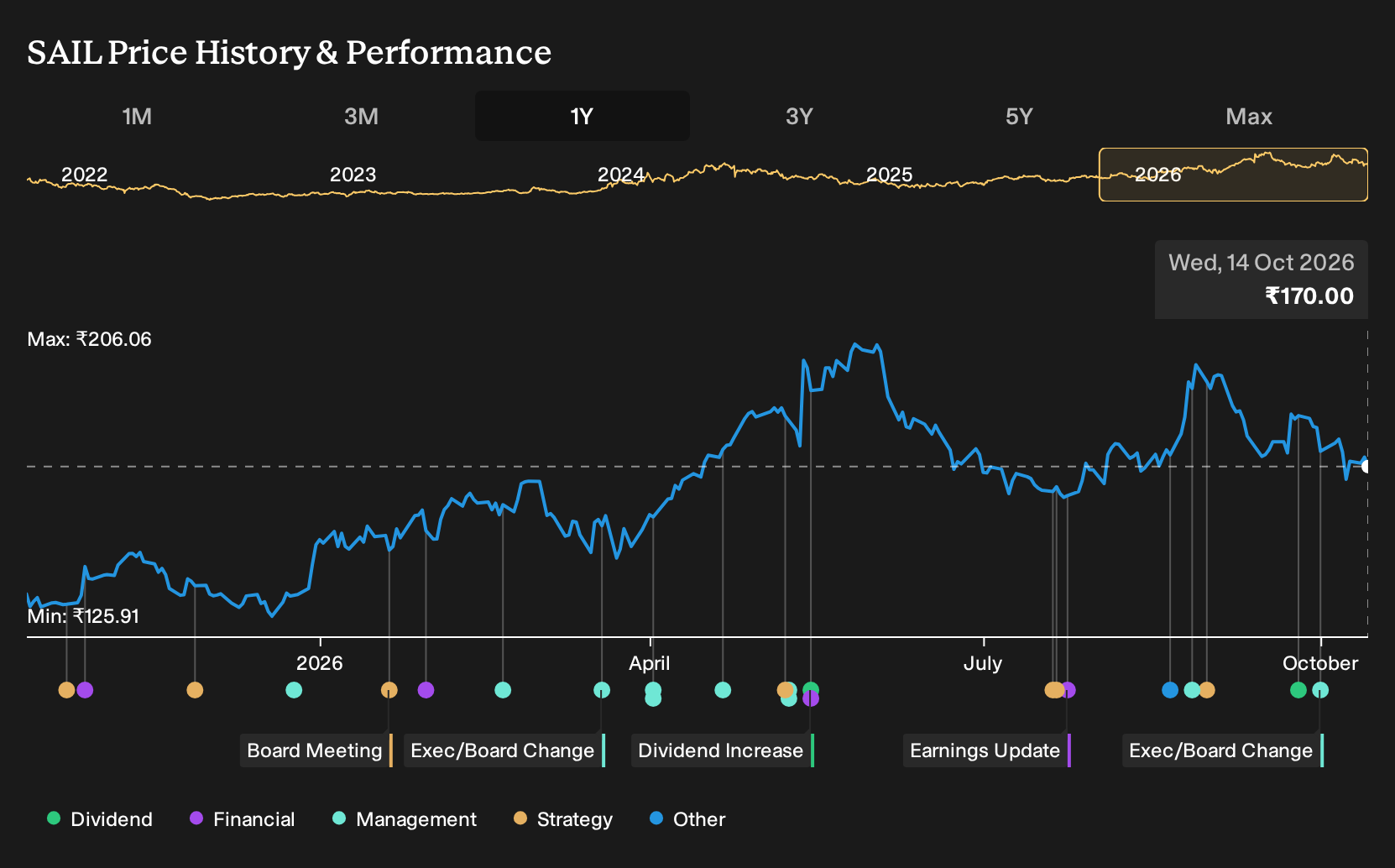
If Steel Authority of India was on your watchlist instead of in your portfolio, the outcome may feel like a missed chance. Holding Steel Authority of India over the past year would have returned 32.2%, including dividends. That kind of payoff naturally raises a question. What in the earlier debate over whether government led infrastructure and clean energy spending would really translate into higher capacity utilisation and richer product mix could have helped you spot this setup before it showed up in the numbers?
A Narrative on Simply Wall St is one investor's written case for a company, with its growth, margin and multiple assumptions spelled out. Those assumptions imply an estimated Fair Value.
Steel Authority of India has already moved. See which of 187 high quality undervalued stocks still trade below our estimates.
The Two Stories Investors Were Arguing About On Steel Authority of India
The shares cost ₹129 at the start of the period, so any view on Steel Authority of India came down to what you thought that price already reflected.
The bullish Narrative pinned Fair Value at ₹155, treating major government infrastructure and clean energy spending as a powerful driver of volumes and a richer mix of value-added steels.
The more cautious Narrative put Fair Value at ₹121, stressing that declining exports and high borrowing of ₹32,600 crores could keep pressure on cash generation and flexibility.
What The Results Changed For Steel Authority of India
The clearest fresh fact was the Q1 2027 result. Steel Authority of India reported revenue of ₹262,456.7 millions and net income of ₹16,440.5 millions, with net margin at 6.3% versus 2.9% in Q1 2026. That higher profitability supported the more positive focus on margins more than the cautious case on financial strain. It still did not settle the long term argument.
The useful takeaway is simple. When an investment story leans on operating leverage and product mix, you check net margin and absolute profit in each set of results rather than only watching the share price.
What Steel Authority of India’s Price Already Assumes
Steel Authority of India now trades at ₹170. The selected Narrative places its Fair Value below that level and frames the gap around whether heavier capex and tighter margins can be absorbed without weakening the balance sheet.
A buyer today is effectively assuming large expansion plans translate into durable profitability. The selected Narrative asks how that plays against risks tied to unit margins, coal and ore integration, and future funding needs.
"Key Takeaways: Bearish analysts expect Steel Authority of India to struggle to earn adequate returns on a sharply higher capex program as NSR pressure, elevated coal costs, and logistics constraints limit the payoff from new capacity. The main thing that has to go right is that SAIL converts its expansion and cost initiatives, including higher captive ore and coal integration and targeted cost reductions of about INR 2,000 to 3,000 per tonne, into sustainable margins while funding larger capex without destabilising the balance sheet."
That disagreement has a full argument behind it. → Uncover the lower Fair Value this Narrative argues for
Looking Beyond Steel Authority of India
Once you have a view on Steel Authority of India, attention can shift nearby. Big construction and power ambitions still depend on less visible building blocks.
One of those building blocks is critical materials for high performance motors and electronics. Without them, clean energy hardware and advanced vehicles can be difficult to produce.
Another business concentrates on mining, processing and shaping those rare inputs into magnets and related products. Its output can support everything from electric transport to certain defense applications.
Government backed contracts and long term deals with major technology and industrial buyers can influence demand. That blend of policy support and concentrated customers leaves a specific risk reward puzzle.
The case is on the record, with the assumptions it rests on. → See the Narrative that values this company 72% above its price
This article by Simply Wall St is general in nature. We provide commentary based on historical data and analyst forecasts only using an unbiased methodology and our articles are not intended to be financial advice. It does not constitute a recommendation to buy or sell any stock, and does not take account of your objectives, or your financial situation. We aim to bring you long-term focused analysis driven by fundamental data. Note that our analysis may not factor in the latest price-sensitive company announcements or qualitative material. Simply Wall St has no position in any stocks mentioned.
Have feedback on this article? Concerned about the content? Get in touch with us directly. Alternatively, email editorial-team@simplywallst.com