


Japanese yields have woken up, and that shift is starting to pull capital back home. As insurers, trust banks and asset managers reassess the trade off between foreign assets and JGBs, some listed stocks tied to this theme could see their income engines reshaped. This article walks through three companies exposed to that story, explaining how the recent news might affect their dividends and portfolio stability.
The three stocks that follow are only a first pass, and the wider screen surfaced 7 more Japanese income-oriented financials with equally compelling stories around dividend resilience and domestic yield exposure that are not covered here. To see the full list and identify which businesses best fit your own income brief, head straight into the Japanese Income-Oriented Financials Benefiting from Higher Domestic Yields screener.
Lifenet Insurance (TSE:7157)
Lifenet Insurance is a pure online life insurer in Japan, tightly linked to the screener theme because its earnings rely on investment spreads from yen assets and the appeal of simple, income-focused protection products as domestic yields shift.
Lifenet Insurance generates all its ¥34,693 million revenue from its Life Insurance Business in Japan and has a market value of about ¥122.3 billion.
"The individual life business is executing well with Individual Life AP growth accelerating to +6.5% YoY, new business momentum has carried into January 2026, and profitability was revised upward on favourable claims experience and sustained improvement in cost efficiency."
What happens when that operational momentum meets a sustained reset higher in yen income returns is the key swing factor for margins.
That margin reset question is exactly what the full narrative for Lifenet Insurance unpacks, highlighting where Lifenet Insurance could see spreads accelerate and where execution risk still lurks.

Nomura Holdings (TSE:8604)
Nomura Holdings is a large Tokyo based securities and asset management group that sits squarely in this theme because higher JGB yields can steer both institutions and households toward yen bond funds and fixed income products managed across its wealth and investment platforms.
Nomura runs a broad mix of businesses, from Wealth Management and Investment Management through to a large Wholesale arm tied to trading and investment banking. Wholesale generates about ¥1,270.3 billion, Wealth Management ¥527.5 billion and Investment Management ¥306.3 billion in revenue, and the group is valued at roughly ¥4,285.1 billion.
"Investors may be overly optimistic about Nomura's ability to benefit from Asia-Pacific wealth growth and demographic shifts, overlooking Japan's significantly aging and shrinking population, which could dampen domestic fee income, slow recurring asset inflows, and pressure long-term wealth management revenue."
What happens if a single pressure point quietly reshapes how much long term fee income Nomura can draw from a higher yield world?
If that pressure point matters to your income goals, read the full narrative for Nomura Holdings to see how Nomura could still turn aging demographics into fee growth.

Japan Post Holdings (TSE:6178)
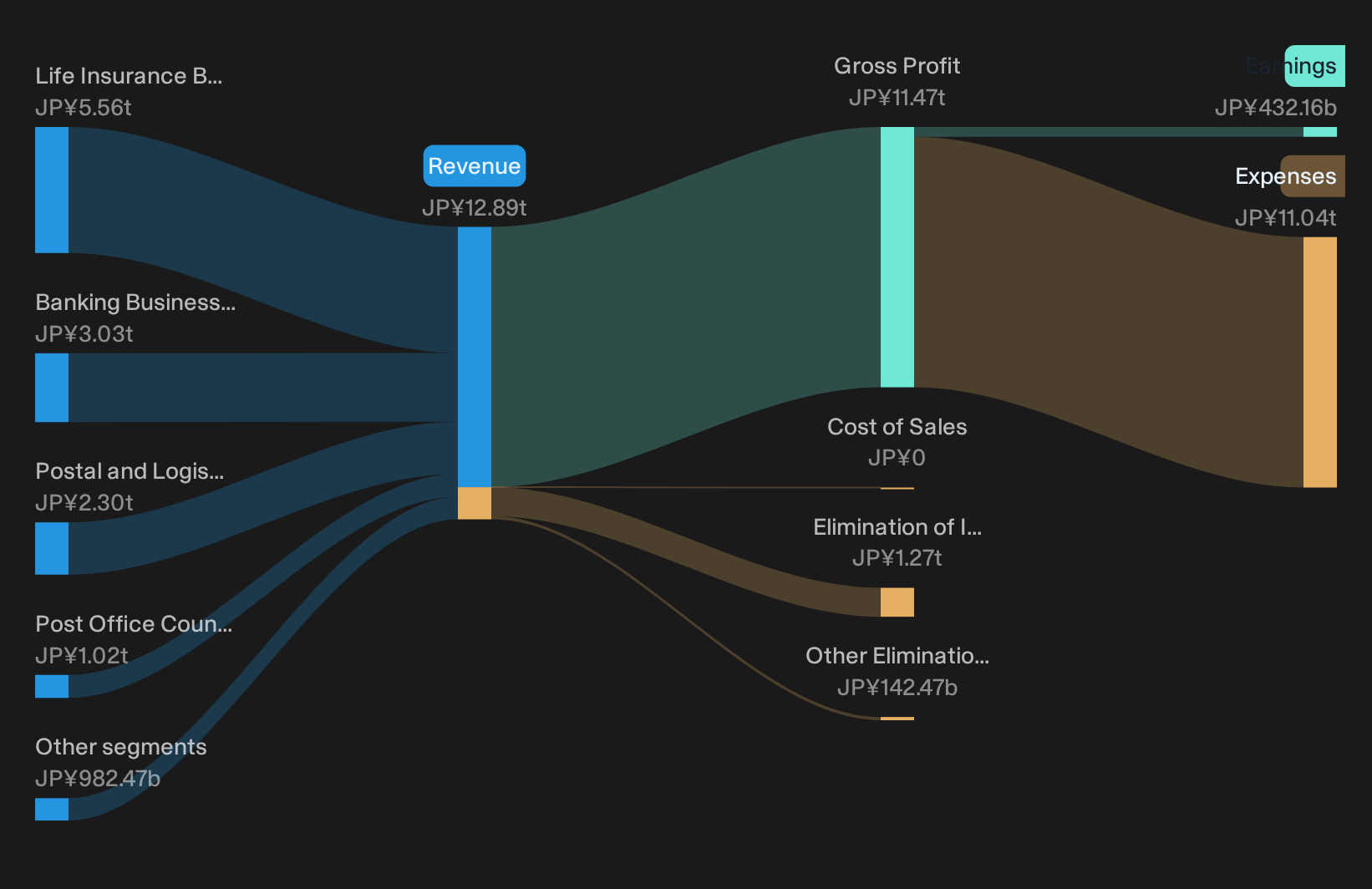
Japan Post Holdings is a giant postal bank and insurer tied closely to Japan’s income story, with ¥5,556.5b from Life Insurance and ¥3,033.1b from Banking alongside ¥2,303.1b from Postal and Logistics and ¥1,015.8b from Post Office Counter services. This gives a ¥6,386.2b market cap a deep domestic yield anchor.
Japan Post Holdings is effectively a national income machine, running large life insurance and postal savings books that are heavily invested in yen bonds and other fixed income. Rising JGB yields are closely linked to that model. However, the implications will be significant for income focused holders if dividend cash coverage does not keep pace with those investment gains.
If you care whether those investment gains really support future payouts, review the Japan Post Holdings financial health report for the full picture of Japan Post Holdings’ income engine.
Seeking Alternatives Before The Crowd?
Fresh ideas move first, and the stocks with real breakout potential often fly before most investors even notice. Spot under the radar strength while it matters and get in early.
- Target durable income by scanning a curated set of high yield payers classified as 28 dividend fortresses. This may help you avoid chasing dropping payouts after the crowd piles in.
- Explore structural momentum in automation by tracking companies within the 90 robotics and automation stocks. This can be a way to monitor potential early spending waves before valuations move higher.
- Review infrastructure players in the 43 power grid technology and infrastructure stocks to evaluate grid upgrade opportunities while they are still under the radar.
This article by Simply Wall St is general in nature. We provide commentary based on historical data and analyst forecasts only using an unbiased methodology and our articles are not intended to be financial advice. It does not constitute a recommendation to buy or sell any stock, and does not take account of your objectives, or your financial situation. We aim to bring you long-term focused analysis driven by fundamental data. Note that our analysis may not factor in the latest price-sensitive company announcements or qualitative material. Simply Wall St has no position in any stocks mentioned.
Have feedback on this article? Concerned about the content? Get in touch with us directly. Alternatively, email editorial-team@simplywallst.com