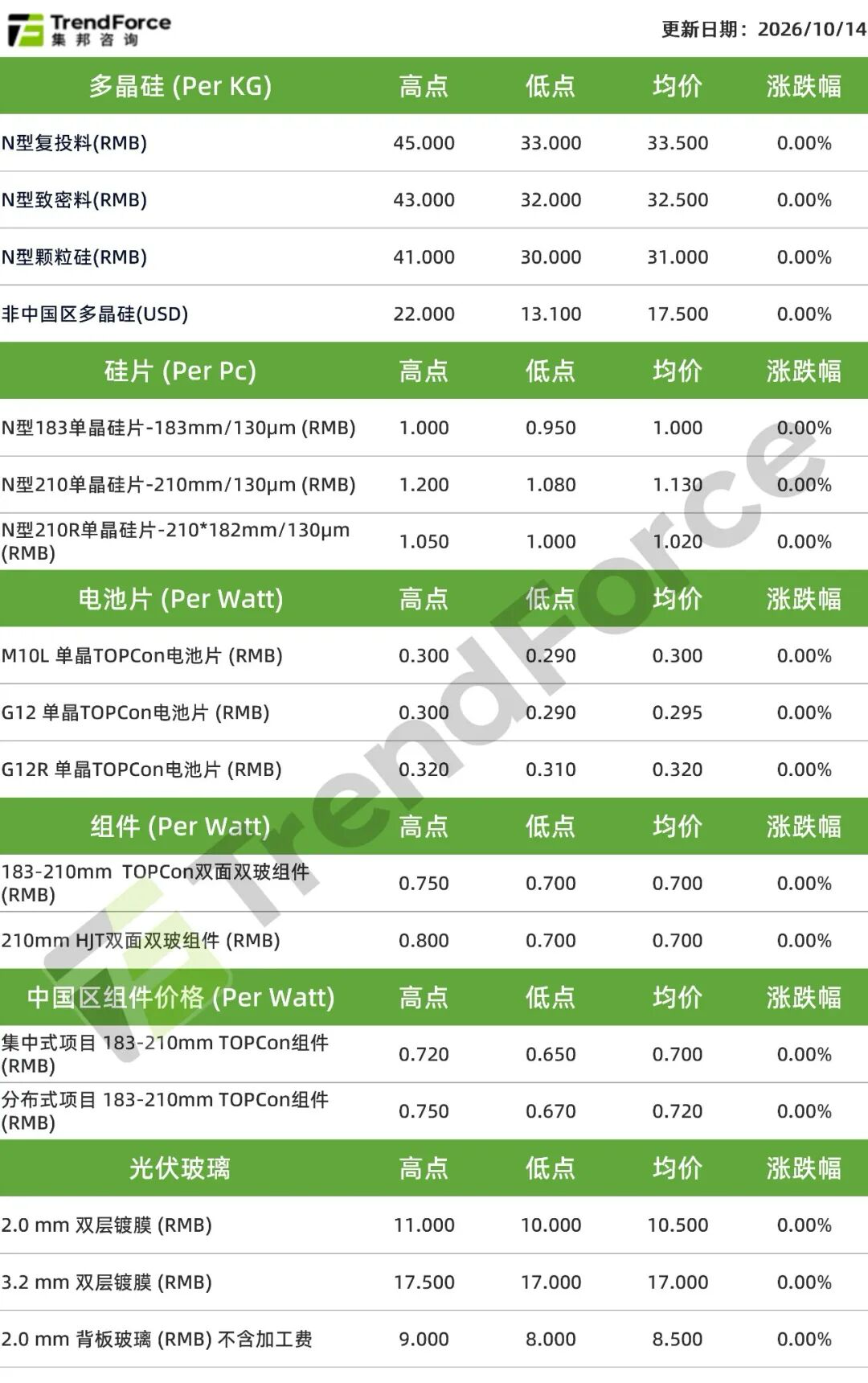
The Zhitong Finance App learned that TrendForce Jibang Consulting published an article stating that sales in the silicon material market are still light this week, but some companies have reached orders of a certain size at a price of 40 yuan/kg or more to support the market price. As downstream crystal factories expedite consumption of their own inventory, the probability that silicon prices will stabilize increases, a high-price price system is gradually formed, and market sentiment is increasing. Component prices continued the game trend, and the price was generally stable, but the actual transaction price loosened, and the transaction price of some orders moved about 1-3 cents/W lower than the price price. The current price is clearly out of touch with the actual transaction. The first-tier TopCon price is 0.70-0.72 yuan/W, and the second-tier price is lower than 0.68 yuan/W. Some actual transactions have slipped to 0.65-0.69 yuan/W, but the scale of spot transactions is limited, and terminal dealers are very wait-and-see.
Silicon material
The silicon side continues to accumulate stocks. Inventory remained above 560,000 tons this week, and the overpressure on supply and demand has not been significantly alleviated. This week, the Hangzhou Self-Regulatory Conference pushed polysilicon companies to unify sales reserve prices. The superposition industry is expected to cut production by about 20,000 tons in October, and market price appreciation expectations have increased.
However, the current silicon production schedule is still slightly higher than downstream demand. Although production cuts help ease the conflict between supply and demand, it is difficult to reverse the situation of high inventories in the short term.
Sales in the silicon market were still light this week, but some companies reached orders of a certain size at a price of 40 yuan/kg or more to support the market price. As downstream crystal factories expedite consumption of their own inventory, the probability that silicon prices will stabilize increases, a high-price price system is gradually formed, and market sentiment is increasing.
silicon wafer
The current silicon wafer inventory remains around 27GW, a slight increase from the previous period, and the overall price is weak and stable. In October, silicon wafer production schedule declined slightly from month to month. The price of superimposed silicon materials was high. Cost pressure on silicon wafer companies increased, and their willingness to raise prices increased. However, judging from supply and demand, the supply of silicon wafers is still relatively abundant, inventory levels are high, and prices lack momentum for a substantial rebound.
On the one hand, the reduction in silicon wafer production is less than that of downstream cells, the pace of supply and demand adjustments is inconsistent, and there is still a risk of accumulation of stocks under high inventories; on the other hand, terminal demand support is limited, and some companies concede shipments and traders sell at low prices, further suppressing market prices.
In addition, silicon wafers of different sizes are affected by the demand structure, and price trends are somewhat differentiated. Demand for the 183 and 210R sizes still faced downward pressure in late, and price support was relatively weak; the 210N benefited from the release of domestic centralized project demand, and the price performance was relatively strong. Whether a subsequent high-price silicon material system can be established will be the key to the price trend of silicon wafers.
Cell
The current battery inventory is about 7-8 days. Overall, there is a slight downward trend, and the shipping pressure has eased somewhat. In October, the battery production schedule declined markedly from month to month, the relationship between supply and demand improved marginally, and overall market prices stabilized.
However, the performance of products of different sizes varies. Among them, some professional battery companies have reduced production schedules for 183 size products, and market supply has shrunk, providing some support for prices, but demand for terminals is weak, and the momentum for price increases is still insufficient.
In terms of overseas markets, transit demand from the Middle East and India still has a strong driving effect on 210R high-efficiency batteries, but India's export demand may drop sharply in the latter half of the year, and 210R product prices face certain downside risks.
In contrast, domestic demand for centralized projects was gradually released in the fourth quarter, demand for 210-size batteries increased, and leading companies were willing to increase prices. Short-term price support was relatively strong, and the possibility of further growth was not ruled out.
photovoltaic module
Entering the fourth quarter, the commencement of domestic centralized projects has improved. Orders for 210 size components have increased, and demand for other sizes is still weak. Most of the terminals are mainly just needed and orders that won the bid in the early stages, and overall demand has not picked up significantly.
Component prices continued the game trend, and the price was generally stable, but the actual transaction price loosened, and the transaction price of some orders moved about 1-3 cents/W lower than the price price. The current price is clearly out of touch with the actual transaction. The first-tier TopCon price is 0.70-0.72 yuan/W, and the second-tier price is lower than 0.68 yuan/W. Some actual transactions have slipped to 0.65-0.69 yuan/W, but the scale of spot transactions is limited, and terminal dealers are very wait-and-see.
Overall, under the double pressure of weak demand and declining costs, component prices lack support, and there is a risk of further decline in the short term. However, as the industry's anti-domestic expectations increase, companies' willingness to control costs and stabilize prices has increased. The future focus will be on the implementation of relevant policies and the price situation of silicon materials.
Weekly price list