


The Zhitong Finance App learned that US AI-related stocks were sold off on Wednesday as the latest US inflation data exceeded market expectations and raised investors' concerns about rising interest rates and increased financing costs for the artificial intelligence (AI) industry. This wave of sell-offs continued until Thursday. The stock markets of China, Japan, and South Korea collectively declined. After closing down 1.88% on Wednesday, the futures of the NASDAQ index fell more than 1% before the Thursday market.

US chip stocks generally fell before the market on Thursday. As of press release, SK Hynix (SKHY.US) fell more than 6%, SanDisk (SNDK.US) and Western Digital (WDC.US) fell nearly 4%, Micron (MU.US) and Seagate (STX.US) fell more than 3%, Intel (INTC.US) and AMD (AMD.US) fell nearly 3%, and Qualcomm (QCOM.US), Nvidia (NVDA.US), and Broadcom (AVGO.US) all fell more than 1%.
Optical communications stocks also suffered: AXT Inc (AXT.US) fell more than 6%, while Mwell Technology (MRVL.US), Astera Labs (ALAB.US), Credo Technology (CRDO.US), Coherent (COHR.US), Corning (GLW.US), and Lumentum (LITE.US) all fell more than 3%.
Furthermore, stocks in the AI infrastructure sector, which were mainly sold off on Wednesday, continued their pre-market decline: AI cloud computing company Coreweave (CRWV.US) fell nearly 6%, AI infrastructure service provider Nebius (NBIS.US) fell more than 3%, Oracle (ORCL.US) fell nearly 2%, and Dell Technologies (DELL.US) fell nearly 4%. The stocks closed down 15.46%, 10.08%, 8.83%, and 11.27% respectively on Wednesday.
After the September CPI is announced, investors will focus on the US September PPI data to be released on Thursday to find the latest clues about factory-side inflation trends. If this data exceeds expectations like Wednesday's CPI data, it may further heighten market concerns about rising inflation and interest rates, and may bring another “heavy punch” to AI-related stocks that are already underperforming.
Inflation exceeds expectations, boosts expectations of interest rate hikes, heightens concerns about financing costs
Selling pressure was mainly due to the recovery in US inflation in September, which strengthened the market's expectations that the Federal Reserve would continue to raise interest rates. According to data released by the US Department of Labor on October 14, the consumer price index (CPI) rose 0.6% month-on-month in September, the biggest increase since April this year; the year-on-year increase rose to 3.7%, up from 3.4% in August, and also exceeded economists' expectations of 3.6%. Excluding volatile food and energy prices, core CPI rose 0.3% month-on-month, the same as in August, but higher than market expectations of 0.2%; the year-on-year increase rose to 2.6% from 2.4% in August, exceeding expectations of 2.5%.
Specifically, energy prices are the main force driving up overall inflation. The energy price index rose 5.2% month-on-month in September. Among them, the gasoline price index rose 9.1% month-on-month, contributing more than half of the CPI increase in that month. The war in the Middle East continued to drive up fuel costs. Energy prices rose 20.4% in September this year, and the rise in fuel costs further boosted air ticket prices. In September, ticket prices rose 1.2% month-on-month, with a cumulative increase of 22.4% during the year.
It is worth noting that the price increase has gone beyond the energy sector and is spreading more widely. Analysts pointed out that prices for entertainment, used cars and trucks, education, air tickets, health care, and clothing have all risen. Some of these increases are due to tariffs and energy factors, but others indicate that inflation is more sticky.
Oulu Sonora, head of US economic research at Fitch Ratings, said that the latest inflation data “gave a red light” to the Federal Reserve, and that the spread of price increases to the wider service sector may increase the risk that inflation will continue to rise.
The deeper problem is that AI infrastructure construction itself is becoming a driver of inflation. The boom in data center construction is driving up the prices of commodities such as semiconductors, and is being transmitted to a wider range of economic sectors through channels such as labor costs in the construction industry.
The higher-than-expected inflation data quickly reshaped the market's expectations of the Federal Reserve's interest rate path. According to the CME “Federal Reserve Watch” tool, after the CPI data was released, the probability of traders betting on the Federal Reserve's interest rate hike of 25 basis points rose rapidly, from about 18% before the data was released to about 70% as of press release; the probability of betting on the December rate hike was even closer to 90%. Although it has cooled down so far, it is still over 60%.
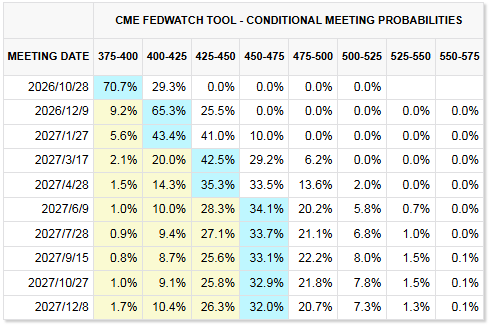
The latest round of decline in AI-related stocks reflects investors' concerns about huge capital investment and rising financing costs in the AI industry. The capital market is concerned about whether huge computing power investments can eventually generate sufficient revenue and cash flow to cover rising construction and financing costs as the AI industry continues to expand the scale of data center construction. Furthermore, as the AI data center construction boom continues, the stock prices of related companies have risen sharply before, so high valuations also make them more vulnerable to changes in market expectations.
Jefferies economist Mohit Kumar said, “If AI infrastructure construction slows down, it means that US economic growth is expected to cool down drastically.” However, he said, “We expect the earnings season to prove that corporate profits and demand are still strong.” But at the same time, he pointed out that Jefferies plans to make an appropriate profit before the US midterm elections and reduce some of its holdings.
Anthropic Q3 financial data 'not good enough'
The reason for the sell-off in AI stocks also included Anthropic's latest “good but not good enough” performance. According to reports, Anthropic revealed on Investors' Day before the closed-door IPO held in San Francisco that the company's third-quarter revenue reached US$16.8 billion, an increase of nearly 50% over US$11.5 billion in the second quarter, and achieved “adjusted profit” and positive cash flow.
However, the market's reaction was far from encouraging. Market research firm P Equity Research put it bluntly: “Anthropic's numbers are good, but they aren't good enough.” Investment analyst Geiger Capital is more straightforward: “Not good enough. It's over.”
According to reports, the hidden concern behind the numbers is a sharp slowdown in growth. According to ZeroEdge estimates, Anthropic's annualized revenue run rate (run rate) at the end of July this year reached 65 billion US dollars, and the monthly growth rate implied by the third-quarter data has plummeted to 3.4% to 6.6% from the previous compound monthly growth rate of about 33%. If this trend continues, the company's annualized revenue at the end of the year is about US$89 billion, and there is still a gap of about US$10 billion from the year-end target of “over US$100 billion” previously generally anticipated by the market.
The reality that Anthropic's revenue growth rate plummeted from a 33% monthly increase to single digits has undoubtedly dealt a blow to the high growth narrative that the AI industry relies on. Furthermore, although the third-quarter results announced by TSM.US sent a key signal that demand for computing power is still strong, and the company said demand is expected to continue to be strong in the fourth quarter, the company's statement about maintaining a cautious attitude when formulating the 2027 business plan due to macroeconomic uncertainty also dampened market sentiment.
Capital constraints on AI investments have surfaced
In addition to macro-level interest rate pressure, industry-level financing restraint warnings have become another important catalyst for this round of sell-offs. Earlier this week, Broadcom CEO Chen Fuyang compared some investors chasing the AI craze to “gamblers,” saying bluntly that many AI investors don't understand the technology they invest in at all, yet they have high expectations. He further warned that capital — not chip supply — will be the biggest constraint on the development of artificial intelligence.
Chen Fuyang also questioned the actual benefits of enterprises investing in AI, pointing out that AI model developers must find customers who can generate return on investment by introducing AI technology, rather than relying on users who are still in the trial stage and are constantly “wasting money” on tokens. He explained the problem with a vivid analogy: “It's like when you went to a video playground to play games when you were a kid, your parents gave you $10 worth of tokens, and you spent them all in 10 minutes, but you didn't learn anything. This is exactly what is happening in the corporate world today”.
This statement sparked widespread resonance and controversy in the market. Michael Berry, the prototype character of the movie “The Big Short” and a well-known investor, retweeted Chen Fuyang's conversation on social media platform X, highlighting in particular the problem that companies spend money to use AI tokens without necessarily creating actual value.
Broadcom's warning was confirmed by reality. AI cloud computing service provider Coreweave's unsecured bond maturing in 2032 fell to less than 80% of face value on Wednesday, with a yield of more than 15%; its credit default swap rose to a record high, and market pricing indicated that the company's probability of default over the next five years was over 50%. Analyst D.A. Davidson previously referred to CoreWeave as a “subprime loan file” for the AI sector and warned that if the AI financing boom subsides, the company may not be able to repay the high debt.
Daniel O'Regan, executive director of Mizuho Securities's stock exchange department, pointed out that investors “have become increasingly unwilling to fund AI-related expenses at any cost” over the past few weeks. AI capital expenditure has surpassed the company's ability to generate free cash flow, meaning that companies must seek external financing to purchase the hardware they need. As external financing becomes more difficult, spending on chips and other AI infrastructure may be substantially affected.
J.P. Morgan's team of analysts led by Nikolaos Panigirtzoglou wrote in an October 14 report that although the current stock price trend is similar to the pullback at the end of July, the current background environment for AI infrastructure stocks is even more unfavorable. Panigirtzoglou said that the reason is “although capital continues to flow into the overall stock fund, retail investors have so far lacked 'buying on diff' behavior, a cliff-style decline in repurchase capital outflows, insufficient bearish base, and higher asset management scale for leveraged stock ETFs.” “Despite the recent retracement, cyclical stocks do not appear to be oversold in terms of positions or capital flows.”