


- Eli Lilly recently reported fresh clinical and regulatory progress across obesity, diabetes and oncology, including new TOGETHER-PsO biomarker data, global Foundayo rollout plans and an additional FDA indication for Jaypirca in previously untreated CLL/SLL without 17p deletion.
- The combination of weight-loss franchises like Foundayo and Zepbound, together with oncology assets such as Jaypirca, reinforces Eli Lilly’s effort to spread future revenue across multiple high value therapeutic areas rather than relying on a single blockbuster category.
- Next is an examination of how Eli Lilly’s investment narrative could evolve as Foundayo’s global expansion influences the cardiometabolic opportunity.
Scan Eli Lilly’s latest obesity and oncology moves against a curated set of peers by running the same playbook across 32 high quality undervalued stocks.
Eli Lilly Investment Narrative Recap
To own Eli Lilly today, you effectively need to believe the incretin engine in obesity and diabetes, led by Mounjaro, Zepbound and Foundayo, keeps translating strong demand into access, capacity and cash flow, while newer areas like oncology and immunology add more durable revenue streams. The near term swing factor is still prescription volumes and pricing for GLP 1 drugs, with recent psoriasis and oncology data adding breadth but not resetting that core story.
Pricing pressure in the U.S., along with GLP 1 litigation and Lilly’s relatively high debt load, remains the biggest risk cluster because it goes straight to margins and financial flexibility. The latest dermatology and oncology readouts, including TOGETHER PsO biomarkers and the new Jaypirca indication, do not materially change that near term equation, but they do help show investors that the pipeline extends beyond obesity.
The most directly relevant announcement is the new exploratory TOGETHER PsO biomarker analysis that pairs Taltz with Zepbound in adults with moderate to severe plaque psoriasis and obesity. For an Eli Lilly shareholder, the key takeaway is not just better skin or weight outcomes; it is evidence that obesity and immune pathways can be addressed together using products the group already sells at scale.
This matters for catalysts because it supports the idea of a cardiometabolic and immunology franchise that can be prescribed in combinations, not just as single agents. That kind of cross portfolio use case may give Lilly more ways to defend GLP 1 pricing, deepen prescriber relationships and reduce reliance on any one indication, while still leaving the existing pricing and legal risks firmly in place.
Eli Lilly Forecasts Behind the Current Valuation
Analysts sketch a fairly specific financial arc for Eli Lilly that underpins the current debate on the stock. Their models assume revenue expands at roughly 14.3% a year over the next three years, with profit margins moving from 33.5% today to 42.1% by 2029 as incretin capacity, cardiometabolic uptake and newer oncology and neuroscience drugs feed through the income statement.
On earnings, the consensus view points to US$26.7b today shifting to US$50.1b by 2029 on a fully reported basis. That is roughly a 1.9x increase in profit over the forecast period, even before you adjust for the expected 0.45% annual reduction in share count that would lift earnings per share faster than total net income. The spread between the most optimistic analysts at US$56.3b and the most cautious at US$44.7b shows how sensitive that path is to GLP 1 pricing, legal outcomes and execution in non obesity franchises.
These profit and revenue assumptions are central to how the market is currently thinking about valuation. To line up with the consensus, you would be working off a 2029 top line of US$118.9b and earnings of US$50.1b, discounted back using a rate of about 7.2% to 7.24%. On those numbers, Eli Lilly would be trading at a P/E of 28.8x in 2029, down from about 38.1x today but still well above the 15.3x P/E currently quoted for the broader US pharmaceuticals group.
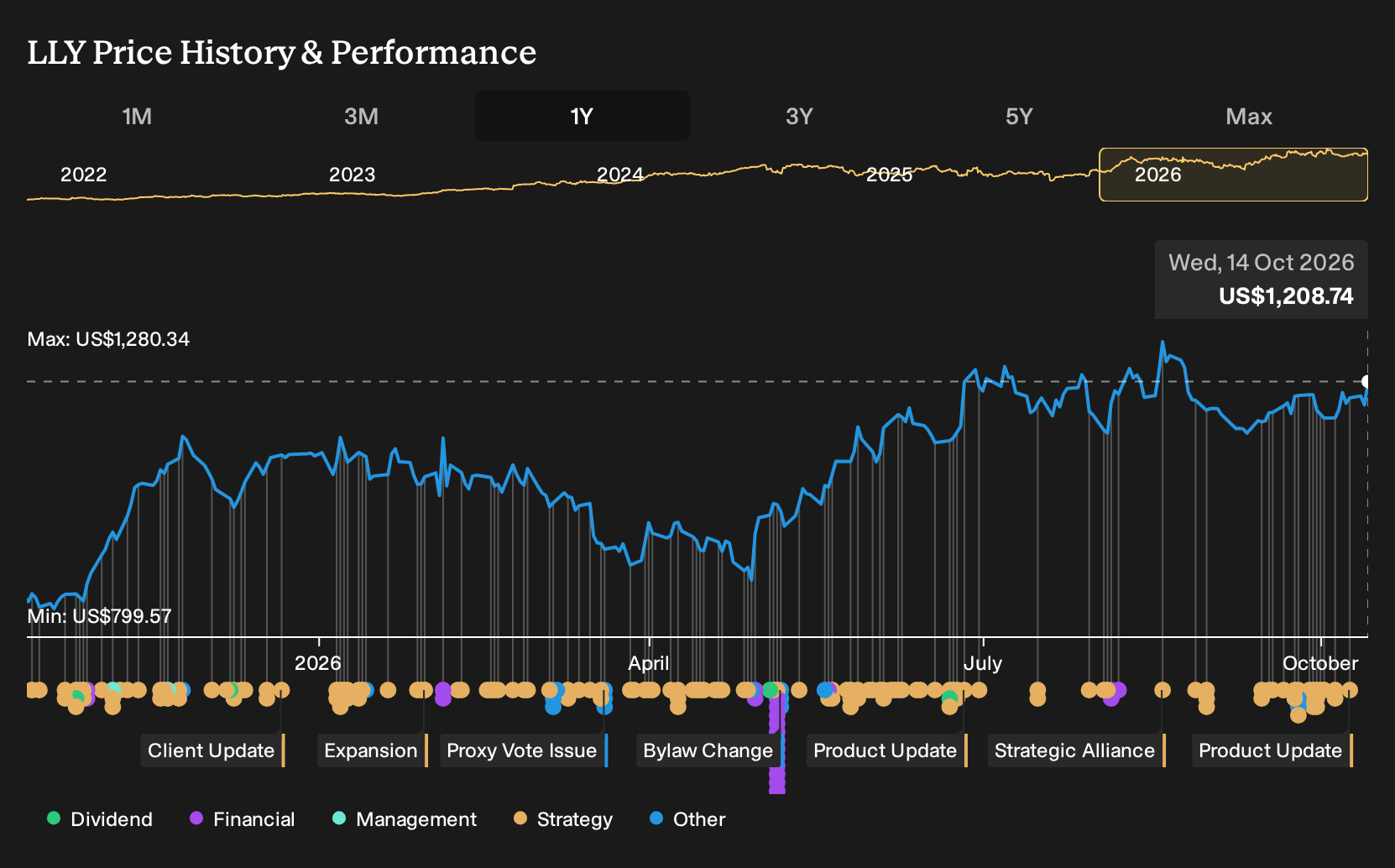
The gap between today’s share price of US$1,142.85 and the average analyst target of US$1,328.83 implies roughly 14% upside in those models. That target range is wide, from US$930 at the low end to US$1,600 at the top. This reflects both the potential scale of the GLP 1 and oncology opportunity and the open questions on pricing, competition and long term sustainability of current demand patterns.
Eli Lilly's narrative projects US$118.9b in revenue and US$50.1b in earnings by 2029. This assumes 14.3% yearly revenue growth and roughly a 1.9x earnings increase from US$26.7b today.
Uncover why Eli Lilly's fair value indicates a 10% potential upside to its current price, which could narrow quickly.
Exploring Other Perspectives
One bullish twist on Eli Lilly focuses on how these psoriasis and obesity biomarker links might support a richer cardiometabolic franchise than consensus assumes. The most optimistic analysts were already modeling about US$138.8b of 2029 revenue and US$56.3b of earnings before this news. If the TOGETHER PsO data reshape expectations, those narratives could shift again. Treat this as one of several viewpoints worth comparing.
Explore 11 other Eli Lilly fair value estimates, including one that suggests there may be as much as 38% upside from the current price.
Form Your Own Verdict
Disagree with existing narratives? Extraordinary investment returns rarely come from following the herd, so consider forming your own view.
- A great starting point for your Eli Lilly research is our analysis highlighting 3 key rewards and 1 important warning sign that could impact your investment decision.
- See our latest analysis for Eli Lilly. The report includes a comprehensive fundamental analysis summarized in a single visual, the Snowflake, making it easy to evaluate Eli Lilly's overall financial health at a glance.
Looking For More Investment Ideas Beyond Eli Lilly?
Once you have a view on Eli Lilly, it often helps to widen the lens and compare it with other opportunities that match your risk tolerance and income goals. The Simply Wall St Screener can surface very different types of companies, so you can see where Eli Lilly fits in your broader watchlist rather than judging it in isolation.
- If capital preservation is your priority, consider starting with resilient businesses by reviewing 32 resilient stocks with low risk scores that have historically paired steadier fundamentals with lower risk profiles.
- For investors hunting for mispriced quality, scan the market for companies that combine strong balance sheets with attractive valuations using the 32 high quality undervalued stocks.
- If income is front of mind, focus on cash generating enterprises and use the 7 dividend fortresses to zero in on higher yielding candidates that might complement a growth heavy position in Eli Lilly.
This article by Simply Wall St is general in nature. We provide commentary based on historical data and analyst forecasts only using an unbiased methodology and our articles are not intended to be financial advice. It does not constitute a recommendation to buy or sell any stock, and does not take account of your objectives, or your financial situation. We aim to bring you long-term focused analysis driven by fundamental data. Note that our analysis may not factor in the latest price-sensitive company announcements or qualitative material. Simply Wall St has no position in any stocks mentioned.
Have feedback on this article? Concerned about the content? Get in touch with us directly. Alternatively, email editorial-team@simplywallst.com