


Intuit has seen its share price fall hard over the past year, and that kind of reset naturally puts the focus squarely on what investors are paying for its earnings today. With the stock now well below where it traded in recent years, the question is whether the current price still lines up with the profit engine behind TurboTax, QuickBooks and the rest of the group.
- The share price has declined 51.8% over the past year, which raises the issue of whether the move has already adjusted the valuation to better match Intuit's earnings power.
- The business leans heavily on recurring software revenue and high-margin tax and accounting services, which can support more predictable earnings and may influence how much investors are prepared to pay per dollar of profit.
- There is a second opinion on Intuit worth weighing. See what analysts think Intuit's shares could be worth.
The issue now is whether Intuit's current share price is justified by the earnings it generates today and what analysts expect it to earn over time.
If you want to stress test this same earnings question beyond Intuit, compare it with 32 high quality undervalued stocks.
Is Intuit Still Cheap on Earnings?
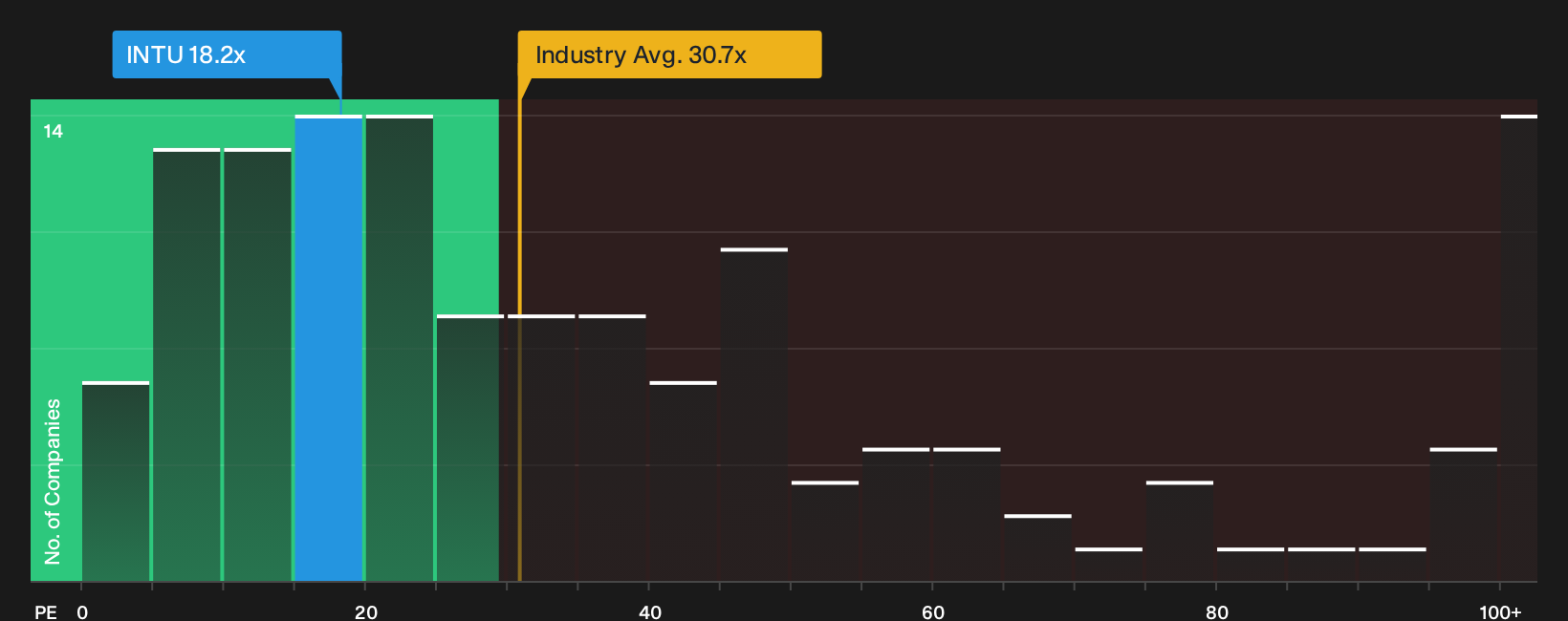
The P/E ratio suits Intuit because earnings are a key focus for mature software platforms with established customer bases. On this lens, the stock trades on a P/E of 18.2x, which is meaningfully lower than the Software sector average of 30.7x and also below a peer group that clusters around 48.4x. That gap suggests the market is attaching a lower earnings multiple to Intuit than to many comparable software businesses.
The fair multiple implied by this model, which looks at factors such as growth profile, profitability, size and risk, sits above where Intuit is priced today. That points to the shares screening as undervalued on earnings relative to what this framework would expect for a business with its characteristics. Readers weighing that signal still need to judge how durable Intuit's tax and accounting profit stream looks and how comfortable they are with the broader software sector before leaning too hard on the P/E discount as a guide. Explore the numbers behind Intuit's P/E valuation.
The Intuit Narrative: What Would Justify Today's Price?
Narratives pick up where the P/E puzzle leaves off by spelling out which future paths for Intuit's growth, margins and earnings would need to play out for the stock to look meaningfully cheaper or more expensive than today, based on frameworks shared on Simply Wall St's Community page. Each narrative turns that into a clear, testable idea about Intuit's business that you can track over time as new information arrives.
Community views on Intuit pull in different directions, with one camp seeing a quality franchise on sale and the other arguing expectations still look stretched.
Bull case: 45% undervalued
"Here is what makes Intuit unusual, once a small business puts its financial life into QuickBooks, switching to a competitor is genuinely painful…"
Discover why this Narrative puts Intuit at 45% undervalued.
Bear case: 7% overvalued
"Although Intuit is seeing early traction with its AI driven expert platform and virtual AI agents, heavy reliance on continued AI adoption raises risk…"
Explore why this Narrative puts Intuit at 7% overvalued.
One more Intuit check before you move on
Price ratios only tell you what the market is paying for Intuit today, while analyst models sketch where they think the earnings machine could be a few years from now. This gives you a powerful comparison point. Explore where analysts expect Intuit to be in a few years.
This article by Simply Wall St is general in nature. We provide commentary based on historical data and analyst forecasts only using an unbiased methodology and our articles are not intended to be financial advice. It does not constitute a recommendation to buy or sell any stock, and does not take account of your objectives, or your financial situation. We aim to bring you long-term focused analysis driven by fundamental data. Note that our analysis may not factor in the latest price-sensitive company announcements or qualitative material. Simply Wall St has no position in any stocks mentioned.
Have feedback on this article? Concerned about the content? Get in touch with us directly. Alternatively, email editorial-team@simplywallst.com