


- TriNet Group recently rolled out new and enhanced HR platform capabilities for small and medium sized businesses, including TriNet Leave powered by Cocoon, TriNet Recruit powered by JazzHR, TriNet Spend, and broader AI assistance for everyday workforce tasks.
- The updates pull leave management, recruiting, expense control, and AI driven insights into a more connected platform, which could influence how deeply clients rely on TriNet Group for day to day HR operations.
- This article examines how TriNet Group's investment narrative interacts with its expanded AI driven HR platform, including TriNet Leave.
Scan how TriNet Group's push into AI powered HR tools compares with other companies building similar automation by reviewing our curated list of 92 AI infrastructure stocks.
TriNet Group Investment Narrative Recap
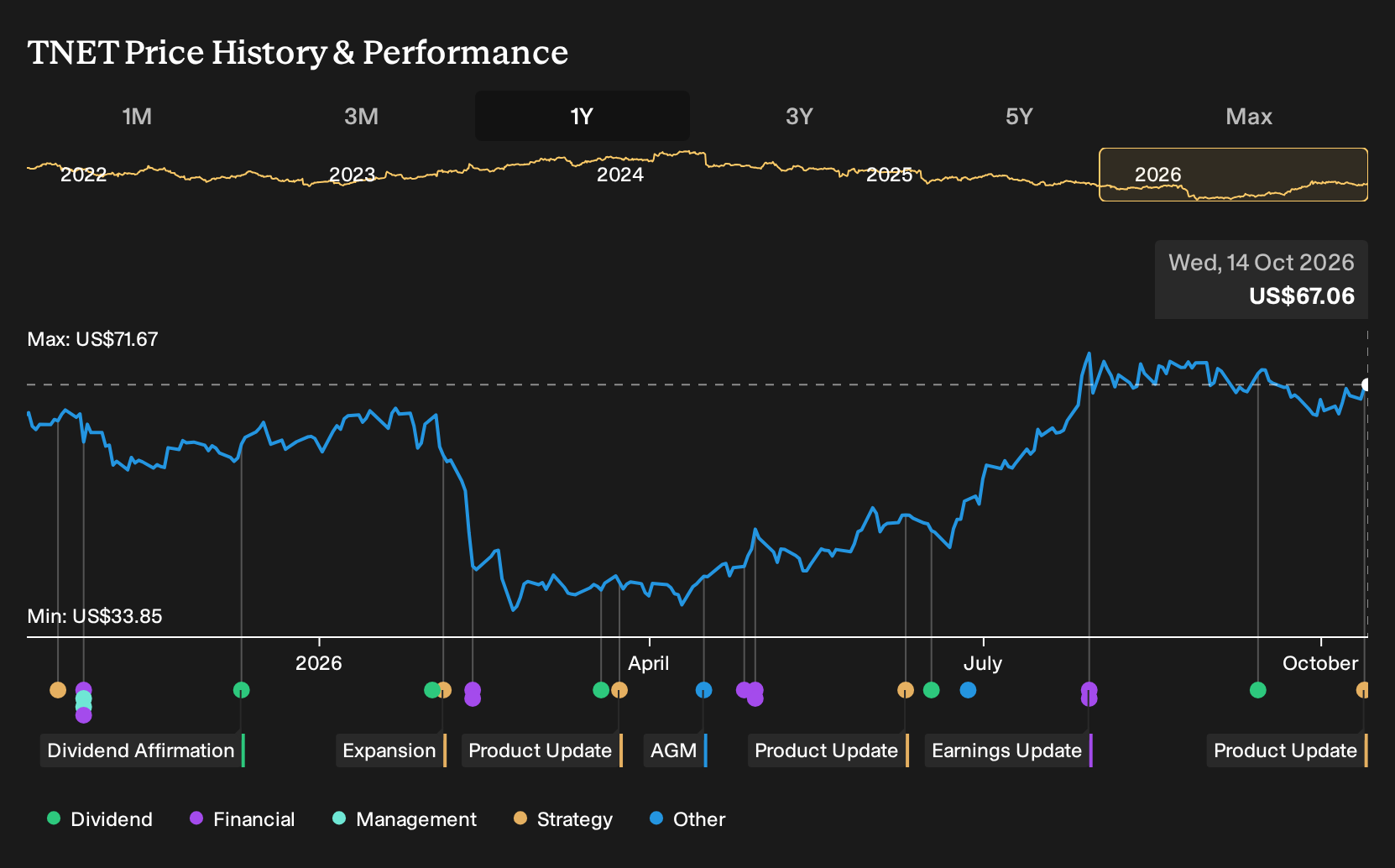
To own TriNet Group, you need to be comfortable with a business that trades near its analyst target while worksite employee counts and revenue have been soft recently. The core belief is that outsourced HR, compliance support and tech-driven workflows can keep clients engaged even if short-term volume pressure persists. The immediate swing factor remains whether client headcounts stabilize so revenue does not drift lower.
The biggest near-term risk stays clear. Weak client workforce growth and elevated health cost trends could squeeze margins if pricing and plan design do not fully offset medical inflation or if new investments do not lift volumes. The latest platform news does not fundamentally change those near-term pressure points yet.
TriNet Leave powered by Cocoon ties directly into that risk-reward balance. Centralized leave management and compliance tools give existing customers a reason to use more of the platform and can make the service harder to replace when contracts come up. That deeper integration can be important when worksite employee numbers are under pressure.
Execution is the key watchpoint. Rolling out TriNet Leave in phases while also launching TriNet Recruit, TriNet Spend and broader AI assistance adds product complexity and expense. If TriNet Group converts that expanded toolkit into steadier client retention and more professional services usage, the effort could support revenue stability and help offset pressure from health costs and muted WSE trends.
What The Current TriNet Group Forecasts Assume
TriNet Group's medium term story, as framed by analyst models, leans on modest revenue expansion and slightly thinner profit margins rather than a surge in profitability. Forecasts build in 2.2% yearly top line growth over the next three years while margins are expected to ease from 3.6% today to 3.2% by year three. Earnings today sit at about US$175.0 million, with consensus pointing to US$164.8 million by 2029 and a more optimistic camp looking for as much as US$204.7 million.
The implied earnings path matters because it shapes how much room the stock has if execution on AI driven HR tools, including TriNet Leave, goes to plan. Moving from US$175.0 million to a projected US$164.8 million suggests analysts are baking in some pressure on profitability even with revenue growth in the low single digits. A share count that is expected to decline 4.43% a year over the next three years partially offsets that softer earnings profile at the per share level. Discounting those cash flows at 7.93% and assuming a P/E that rises from 16.6x today to 20.2x in 2029 is what currently underpins the consensus view that the company is roughly fairly priced.
TriNet Group's narrative projects US$5.2b revenue and US$164.8 million earnings by 2029. This assumes 2.2% yearly revenue growth and an earnings decrease of US$10.2 million from current earnings of US$175.0 million.
Investors weighing the AI build out against these estimates need to focus on what would have to change for the earnings line to move toward the more bullish US$204.7 million scenario instead of the base case. That would likely require stronger than modeled client retention, a steadier worksite employee base than seen in the recent 12% year over year decline, or higher than expected usage of professional services and newer modules like TriNet Spend and TriNet Recruit. On the flip side, if health cost trends stay elevated and cannot be contained through pricing or plan design, the compression from 3.6% to 3.2% margins that analysts assume could prove optimistic.
Uncover why TriNet Group's fair value indicates the valuation aligns with its current price.
Exploring Other Perspectives
One catalyst the most optimistic analysts highlight is TriNet Group’s ability to turn its broader HR suite into higher earnings than the base case assumes. Before this news, that group was modeling about US$5.3b of revenue and US$204.6 million of earnings by 2029. You now get to decide whether these new AI driven tools justify that higher bar or if the more cautious US$5.2b and US$164.8 million path still feels closer to your view. Use the spread between those outlooks as a prompt to explore several different scenarios rather than anchoring to a single forecast.
Explore 3 other TriNet Group fair value estimates, including one that suggests as much as 184% upside from the current price!
Decide For Yourself
Disagree with existing narratives? Extraordinary investment returns rarely come from following the herd, so consider doing your own independent research.
- A great starting point for your TriNet Group research is our analysis highlighting 2 key rewards and 3 important warning signs that could impact your investment decision.
- See our latest analysis for TriNet Group. The report includes a comprehensive fundamental analysis summarized in a single visual, the Snowflake, making it easy to evaluate TriNet Group's overall financial health at a glance.
Looking For More Investment Ideas Beyond TriNet Group?
If TriNet Group's AI driven HR story has you thinking about portfolio balance, it can help to line it up against other businesses with very different profiles. Use the Simply Wall St screener to scan for companies that fit the traits you care about most, then compare those opportunities with the risks and rewards you see in TriNet Group.
- If capital preservation is your priority, consider starting with a group of companies that score well on financial resilience and risk controls such as 32 resilient stocks with low risk scores.
- For investors hunting for potential mispricing, you can quickly surface candidates that combine quality fundamentals with pricing that screens as cheap through the 32 high quality undervalued stocks.
- Income focused readers who want stability from cash returns might prefer to begin with a curated universe of higher yielding payers through the 7 dividend fortresses.
This article by Simply Wall St is general in nature. We provide commentary based on historical data and analyst forecasts only using an unbiased methodology and our articles are not intended to be financial advice. It does not constitute a recommendation to buy or sell any stock, and does not take account of your objectives, or your financial situation. We aim to bring you long-term focused analysis driven by fundamental data. Note that our analysis may not factor in the latest price-sensitive company announcements or qualitative material. Simply Wall St has no position in any stocks mentioned.
Have feedback on this article? Concerned about the content? Get in touch with us directly. Alternatively, email editorial-team@simplywallst.com