


- National Fuel Gas has approved a tax free plan to separate its Appalachian upstream subsidiary Seneca Resources and gathering arm NFG Midstream into a new public company, leaving the parent focused on fully rate regulated utility, pipeline and storage operations.
- The split also gives National Fuel Gas a future lever to raise cash by selling its remaining stake in the new upstream and gathering entity, which could support balance sheet strength and funding flexibility.
- We will now look at how National Fuel Gas's investment narrative shifts as it prepares to spin off its upstream operations.
Scan how National Fuel Gas’s planned split compares with other regulated and infrastructure focused utilities by running through our hand picked 43 power grid technology and infrastructure stocks today.
National Fuel Gas Investment Narrative Recap
To own National Fuel Gas through this split, you need to be comfortable with a simpler story. The parent will lean on fully rate regulated utility, pipeline and storage operations, plus the pending Ohio gas utility acquisition and contracted expansion projects such as Tioga Pathway. In the short term, the key catalyst remains execution on that Ohio integration and regulatory follow-through rather than the spin itself.
The biggest current risk does not go away with this transaction. Policy pressure on gas usage in New York and Pennsylvania, higher debt tied to the Ohio deal, and any slower than expected rate outcomes could still affect earnings, free cash flow, and dividend coverage even as upstream volatility moves to the new entity.
The most relevant recent announcement is the tax-free spin of Seneca Resources and NFG Midstream into a separate upstream and gathering company, targeted for the second half of 2027. For current holders, this means direct exposure to two different risk profiles, one regulated and one commodity linked, rather than a vertically integrated mix inside National Fuel Gas.
Execution around this separation now sits alongside the Ohio utility closing and pipeline expansion in-service dates as practical milestones to watch. Investors will likely pay close attention to how management allocates debt between the two companies, how reliably the regulated side earns its allowed returns, and whether upstream operating issues that previously pressured guidance remain ring-fenced in the new vehicle.
What The Analyst Scenario Implies For National Fuel Gas
Analysts sketch a clear set of assumptions around National Fuel Gas. Revenue is modeled to rise by 8.8% a year over the next three years, with margins drifting lower from 26.9% today to 23.9% over that same stretch. On those inputs, consensus points to earnings of $773.4 million by 2029, compared with $675.3 million today, which is roughly a $98 million increase off the current base.
National Fuel Gas' narrative projects $3.2 billion revenue and $773.4 million earnings by 2029. This requires 8.8% yearly revenue growth and roughly a $98 million earnings increase from $675.3 million today.
That earnings outlook links directly to the valuation sketch. At the current share price of $76.43, analysts anchor a consensus target of $93.0, which implies the stock trading on a P/E of 16.4x those 2029 earnings versus 10.8x today. The scenario also assumes the enterprise carries a higher share count, with outstanding stock rising about 5.15% a year over the next three years, and that investors use a discount rate in the low 7% range when weighing future cash flows.
For you as a shareholder, the useful takeaway is not the precise $93.0 figure. The important question is whether the building blocks behind it, from an 8.8% annual top line climb to a lower margin profile and a richer P/E multiple on a more regulated National Fuel Gas, line up with how you see policy risk, rate decisions, and the post spin structure playing out over the rest of the decade.
Uncover why National Fuel Gas' fair value indicates a 17% potential upside to its current price before the discount closes.
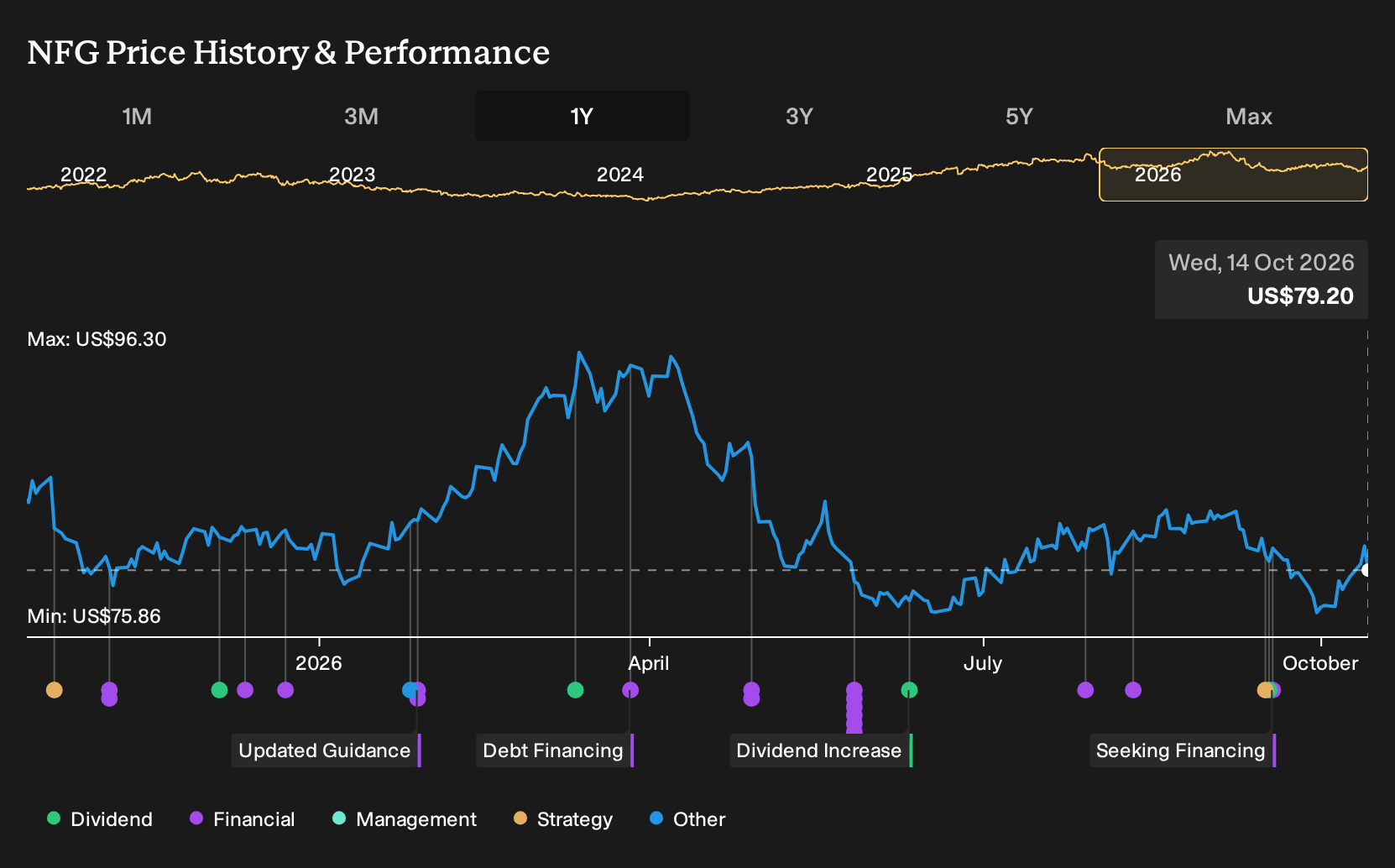
Exploring Other Perspectives
Across three fair value estimates from the Simply Wall St Community, National Fuel Gas lands in a tight US$93 to US$112.69 band, which still spans meaningful upside from the current price. Those private investors did not factor in the planned spin. Treat their range as one input, and explore several contrasting views before deciding how this split could reshape outcomes.
Explore 2 other National Fuel Gas fair value estimates, including one that suggests up to 42% upside from the current price!
Reach Your Own Conclusion
Disagree with existing narratives? Extraordinary investment returns rarely come from following the herd, so go with your instincts.
- A great starting point for your National Fuel Gas research is our analysis highlighting 4 key rewards and 2 important warning signs that could impact your investment decision.
- See our latest analysis for National Fuel Gas. The report includes a comprehensive fundamental analysis summarized in a single visual, the Snowflake, making it easy to evaluate National Fuel Gas' overall financial health at a glance.
Looking For More Investment Ideas Beyond National Fuel Gas?
If this National Fuel Gas thesis has sharpened your view on regulated energy and infrastructure, use that momentum to stress test other opportunities. A targeted screener can help you filter for the balance sheets, income profiles, or risk levels that best match your own comfort zone.
- If capital preservation comes first for you, start with a basket of companies that score well on stability and risk controls through the 32 resilient stocks with low risk scores.
- For investors who want income at the core of their portfolio, focus on cash generators that screen as potential 7 dividend fortresses.
- If you are hunting for quality that is not yet widely followed, broaden your watchlist with a curated set of 20 high quality undiscovered gems.
This article by Simply Wall St is general in nature. We provide commentary based on historical data and analyst forecasts only using an unbiased methodology and our articles are not intended to be financial advice. It does not constitute a recommendation to buy or sell any stock, and does not take account of your objectives, or your financial situation. We aim to bring you long-term focused analysis driven by fundamental data. Note that our analysis may not factor in the latest price-sensitive company announcements or qualitative material. Simply Wall St has no position in any stocks mentioned.
Have feedback on this article? Concerned about the content? Get in touch with us directly. Alternatively, email editorial-team@simplywallst.com